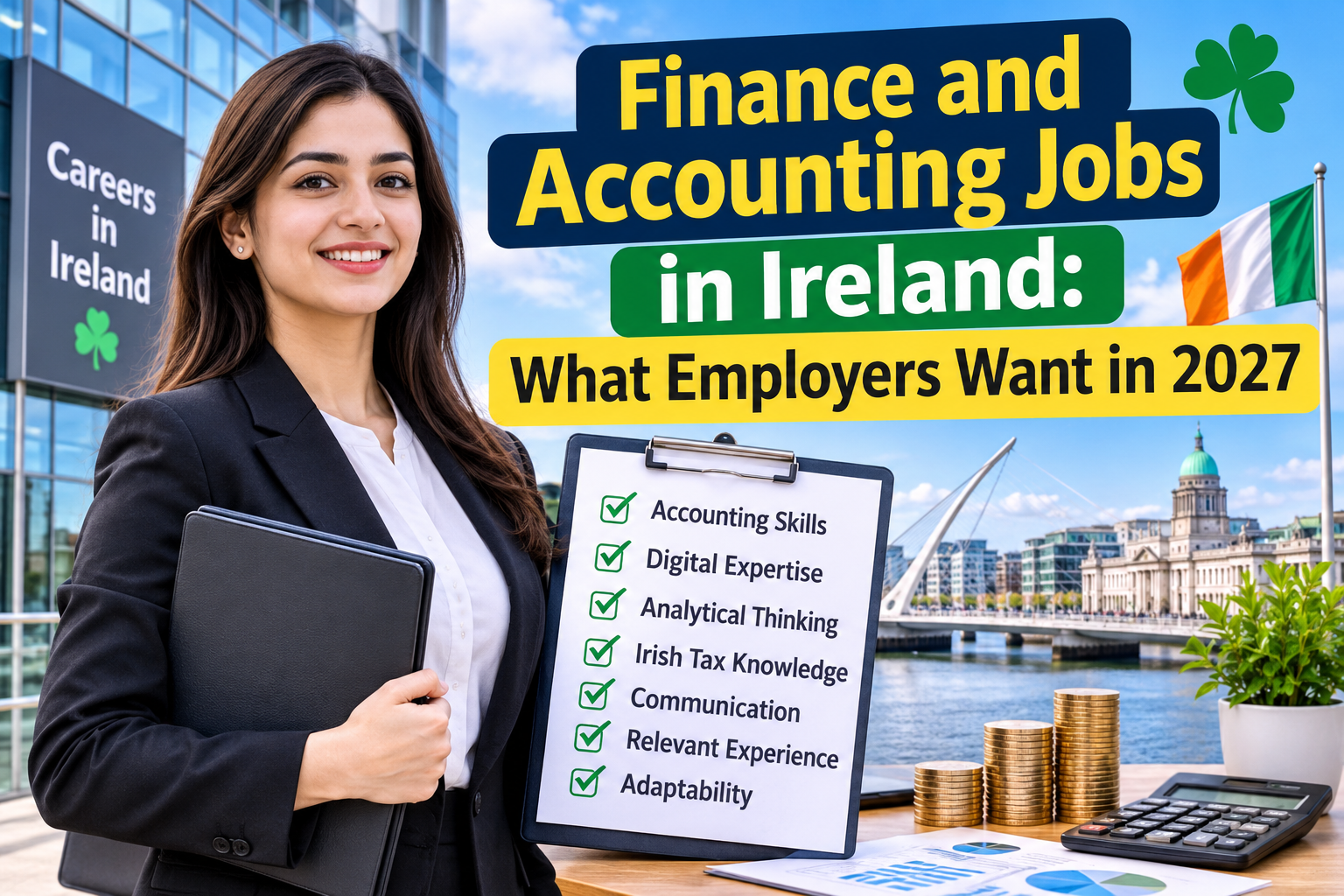
Introduction: Finance and Accounting Jobs in Ireland
Ireland is becoming a desirable location for Finance and Accounting professionals due to a growing economy and an increasing number of both multinational and local companies. Various organisations – whether multinationals, banks and small enterprises – require qualified personnel to administer, record and advise on financial matters. Alongside this, organisations are continually embracing new technology and updating financial legislation so an individual’s skillset will also continue to develop.
To work within Finance and Accounting in Ireland in 2027, individuals will need to go beyond general knowledge within this area. Employers will seek those who have good technical skills, alongside problem solving and communication skills. Individuals will also be expected to have accounting qualifications and know how to utilise current accounting technology.
Good technical knowledge is especially pertinent for those wishing to work in Finance and Accounting in Ireland. Candidates may need to provide evidence of their experience of financial analysis, account reconciliation, invoicing and/or budgeting. Having good technical knowledge will then allow staff to efficiently and correctly perform these duties.
What Finance and Accounting Jobs in Ireland?
1. Accounting Qualifications
Having relevant qualifications can further boost a person’s chances of finding work. Employers often acknowledge and value various professional qualifications including those provided by ACCA, Chartered Accountants Ireland, CIMA and CPA Ireland. Individuals possessing these qualifications are seen to understand key areas of accounting and financial practice.
Whilst many junior roles are open to those holding suitable degree qualifications, having professional qualifications can additionally prove favourable for those wishing to work within higher level or niche sectors. Furthermore, international candidates should research whether their current qualifications are recognised within Ireland and by professional institutes.
2. Computer/IT Literacy
Computing and IT literacy is becoming even more important within the finance sector. Staff are required to know how to utilise computer programmes relating to accounting, spreadsheets, financial reporting and enterprise resource planning. Being computer literate can enable individuals to effectively handle financial data.
Further to this, in 2027 computer/IT literacy will still be highly valued by employers wishing to appoint staff for Finance and Accounting Jobs in Ireland. Automation and artificial intelligence are being utilised by many companies to facilitate financial invoice processing, reporting and analysis. Therefore, individuals who are confident with computer programmes and can embrace technological innovation may find themselves in a favourable position in their careers.
3. Problem Solving and Analytical Skills
As financial staff frequently deal with substantial financial data, employers seek individuals who can analyse this and spot anomalies. Staff must then assess how well a company is performing and determine where financial risks could arise. Having good analytical skills will enable staff to advise an organisation effectively on areas such as investment, expenditure, cash flow and future development.
Alongside analytical skills, good problem solving skills are also highly sought after. For instance, accountants may need to investigate and then resolve account reconciliation problems. Candidates may also need to ascertain why a business is achieving different financial outcomes. Being able to present and then suggest solutions to financial problems can be extremely beneficial for employees.
4. Awareness of Irish Taxation and Finance Legislation
Applicants can boost their desirability by having knowledge of Irish Taxation and financial legislation. Employers may wish to employ individuals who are aware of taxation, VAT, payroll, and financial and compliance legislation.
Organisations are required to correctly record financial data and comply with both Irish and European legislation. Thus, it can be favourable for those wishing to work in Finance and Accounting Jobs in Ireland to understand the local compliance legislation. Further to this, depending on the specific job and employer, knowledge of relevant financial legislation such as International Financial Reporting Standards (IFRS) may also be useful.
5. Communication and Collaboration
Finance professionals often interact with numerous sections of an organisation, for example, human resources, operations, sales and senior management. Consequently, employers favour individuals who can effectively convey financial data in an easily understood manner. Staff must then be able to convey financial knowledge, such as budget information, financial performance, expenditure and financial risks to others, who may not specialise in accounting.
Good collaboration skills are also a key area. Prospective employees should evidence that they can effectively work with others, effectively organise work and adhere to deadlines. They should also be able to support an organisation in reaching its aims. In addition, good communication skills are advantageous for employees so that they can successfully engage with clients, auditors, suppliers and business partners.
6. Awareness of Artificial Intelligence and Automation
Automation and artificial intelligence are influencing the finance sector. Many companies now automate processes such as financial transaction handling, financial data recording, anomaly detection and report creation. Increasingly employers are seeking to appoint people who can competently utilise and apply artificial intelligence and automation but also ensure correct application and exercise appropriate professional judgement.
As stated in the 2027 Ireland Salary Guide, there is an increased emphasis being placed on niche skills such as generative AI by employers. Those wishing to work within Finance and Accounting Jobs in Ireland can further increase their desirability by researching how artificial intelligence is used within financial areas such as financial forecasting, analysis, reporting and risk evaluation. Nonetheless, it is also essential that employees appreciate why it is important to verify outputs generated by automation and ensure the security of sensitive financial information.
7. Business Acumen and Business Knowledge
Employers seek accountants who comprehend how financial activity influences a business. Business acumen enables staff to relate financial data to business aims, market trends, business expenditure and investment.
For example, a financial analyst may assess a company’s spending and then suggest ways to enhance its profitability. Moreover, a finance business partner might work with department heads to devise budgets and formulate financial strategy. Therefore, good business acumen is a highly favourable attribute for those wishing to work within Finance and Accounting Jobs in Ireland. This is particularly so for those hoping to work in financial planning, management accounting and financial analysis.
8. Experience and Industry Knowledge
Experience can greatly influence an individual’s suitability for a role. Usually employers favour those who have experience within an accounts, financial services, audit or corporate finance function. Experience of accounts payable, accounts receivable, payroll, tax, bookkeeping and financial reporting can all also be pertinent for certain roles.
New graduates can accumulate experience via internships, graduate schemes, and entry level accounts work. International candidates should emphasise transferable skills and show how their prior experience is applicable to the Irish work environment.
Within Ireland, employers seek to appoint personnel for a variety of financial and accounting roles including financial accountants, accounts assistants, financial analysts, tax managers, payroll officers and finance business partners.
Conclusion: Finance and Accounting Jobs in Ireland
In Ireland there are various areas which a Finance and Accountant can specialise in such as banks, financial industry, corporate, accountancy and business. Alongside technical accountancy skills, in 2027 employers are likely to seek employees that have digital, analytical, business and communication skills as well as being able to adapt.
Those wishing to work in Finance and Accounting Jobs in Ireland should endeavour to obtain appropriate qualifications, whilst also furthering their experience and becoming familiar with up-to-date accountancy technology. Understanding of Irish finance related legislation is also important. All of these can boost an individuals career prospects and enable them to advance within the highly-competitive Irish finance sector.
Are you planning to build your career in Ireland’s finance and accounting sector? Start preparing today by improving your accounting knowledge, updating your CV, and developing the skills employers expect in 2027. Explore opportunities through the Best Job Tool to discover relevant vacancies, compare career options, and take the next step towards your professional goals.




Leave a Reply