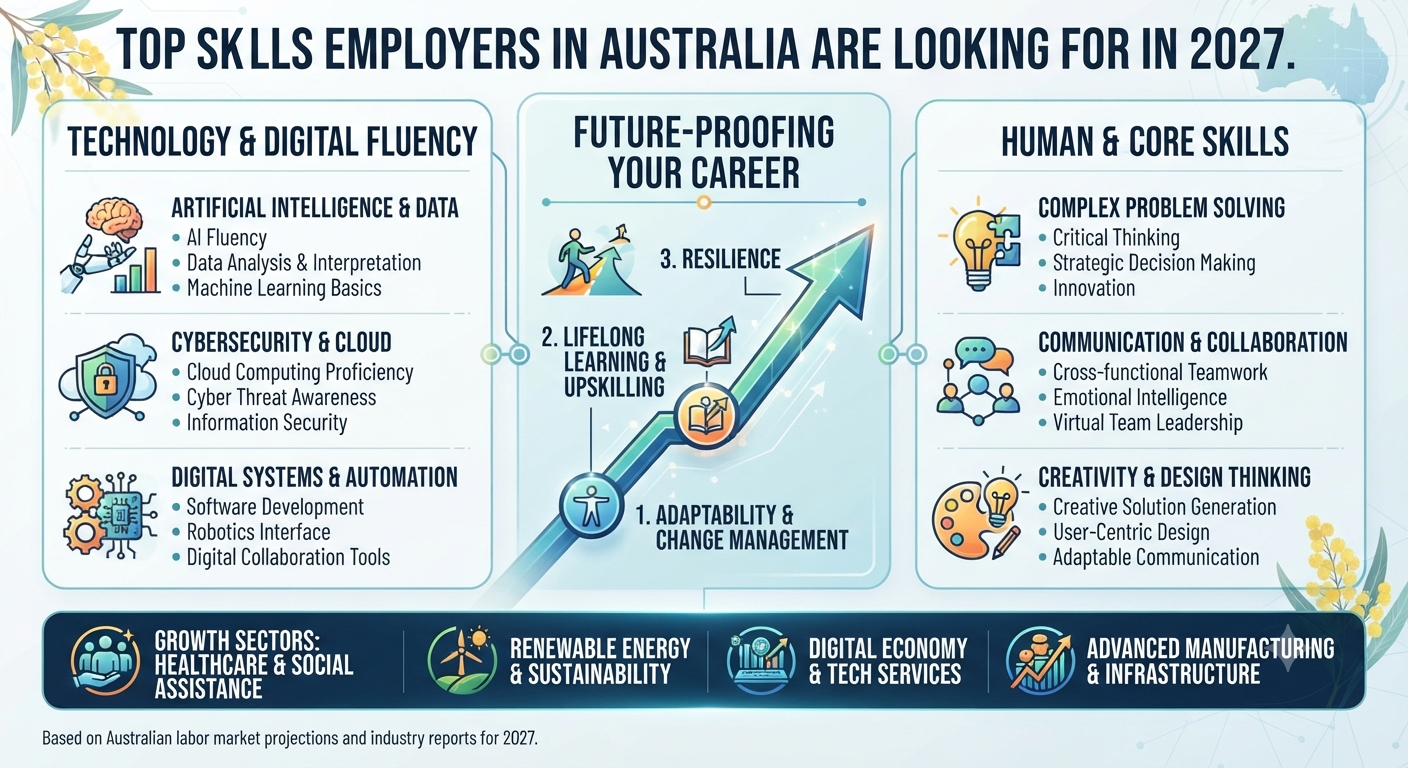
Introduction: Top Skills Employers in Australia
The Australian job market is continuously evolving as companies innovate, grow and meet client demands. Alongside educational backgrounds and professional experience, employers now seek team members that can embrace change, think critically and communicate. As competition within industries intensifies it is useful to recognise the top skills that employers are seeking in 2027.
If you are a recent graduate, a career changer or an international job-seeker wishing to work in Australia then furthering your skills can support your career. Within 2027, employers are anticipated to place importance on a person’s technical, digital and communication skills. Awareness of sought-after skills can thus inform career choices and increase an individual’s appeal to employers.
What Are the Top Skills Employers in Australia Looking for in 2027?
1. Digital Literacy and Digital Skills
Digital literacy is now vital in nearly all industries. People are expected to comprehend, and confidently utilise, digital technology and be able to manipulate and access information online. Generally, those that are digitally literate can work more efficiently and so enhance a company’s productivity.
Furthermore, a basic comprehension of areas including artificial intelligence, cloud-based services, cyber security and data can further support someone. Even non-digital professionals may require fundamental digital skills in order to fulfil their role. Consequently, enhancing digital skills is highly relevant when considering what are the top skills that Australian employers are seeking in 2027.
2. Communication
Excellent communication skills continue to be highly relevant for Australian professionals. People should be able to articulate thoughts and actively listen. Moreover, they should be able to engage in dialogue and convey messages in a professional manner to both clients and co-workers. Good written communication is also highly pertinent, for instance for report, email, presentation and documentation production.
Alongside communication, good ‘people skills’ are important. Being able to acknowledge and value others’ points of view, to work well in a team and to professionally address conflict can all foster a good work culture. Those that can show good communication and ‘people skills’ may gain an edge in interview settings, in comparison to those who emphasise just their technical skills.
3. Problem Solving and Critical Thinking
Companies often encounter issues and must modify approaches in response to evolving circumstances and client demands. Therefore, employers seek team members that can investigate concerns and devise solutions. Critical thinking enables staff to assess information and not automatically accept everything at face value.
A financial worker may for example need to detect anomalous costs. Marketing staff might analyse the effectiveness of a marketing initiative so it can be enhanced. Likewise, healthcare professionals must critically consider options in order to appropriately address client requirements. Thus, problem solving is an important skill that is relevant to many industries and is included in the list of top skills that Australian employers are seeking.
4. Flexibility
As technology progresses and companies formulate new approaches, the economic landscape is also continually shifting. Employers favour those that can flexibly adapt to new duties, learn novel systems and effectively navigate shifting work focuses whilst continuing to maintain productivity.
Flexibility is especially pertinent for those moving into a new industry or working in Australia. Individuals that are receptive to learning and open to receiving advice can continue to further their careers. Exhibiting flexibility also signals to employers that you can successfully address work-related issues and positively add to a company.
5. Leadership and Team Working
Whilst leadership roles are undertaken by both managers and higher-up personnel, employers also value members of staff that can own their work, encourage others and think creatively. Excellent leadership skills can enable individuals to lead projects, oversee work and further a company’s aims.
Equally, team working is key. Most companies require staff from various departments to work together. Team members should know how to distribute work, value others’ input and work towards shared goals. Both leadership and team working are therefore additional key skills that Australian employers are expected to seek in 2027.
6. Data Analysis
Data is now commonly analysed by companies to analyse consumer behaviour, assess business performance, highlight potential issues and inform decision making. As a consequence, data analysis skills are growingly pertinent within numerous industries such as finance, healthcare, marketing, retail and technology.
Professionals that can analyse data – for example by understanding spreadsheet programmes, data analysis and fundamental statistics – can further add value to employers. Experience of data analysis software including Microsoft Excel, Power BI and Tableau can also prove advantageous. Again, it is not essential to be a data scientist to effectively apply data analysis skills – basic data analysis can support decision making in many roles.
7. Emotional Intelligence
People need to recognise and control their own emotions and also be able to recognise the emotions of others. Employers place importance on individuals that can stay composed, accept advice and interact with others in a respectful manner.
Such skills are especially pertinent for those operating within customer service, healthcare, education and in management and human resources roles. Good emotional intelligence can facilitate effective communication, allow staff to professionally address conflict and support the creation of good working and client relationships. With greater emphasis currently being placed on company culture and staff wellbeing, emotional intelligence will continue to be an important skill that Australian employers seek.
8. Project Management and Organisation
Staff are required to efficiently manage their own time and to organise and deliver work to deadline. Furthermore, project management skills are pertinent as they can enable companies to effectively execute projects and utilise resources.
Individuals should be able to prioritise, track and share developments and recognise potential issues. Knowledge of project management software, for example Trello, Asana and Microsoft Project, can also be favourable. These skills are applicable to both junior and senior level professionals and can aid progression within a career.
9. Creativity
Whilst some professions are more obviously associated with creativity, such as the arts, all companies benefit from staff that can think innovatively. People should be able to generate ideas, devise novel methods for completing work and recommend enhancements. Creative ideas can thus enable companies to enhance their offerings and to effectively compete within markets, as well as to provide clients with good service.
Employers may especially value creativity in areas such as marketing, advertising, product design, technology and business strategy. Staff that are inquisitive and keen to try out fresh methods can make positive contributions to a team.
10. Customer Service and Client Relations
Client contentment is an important factor in business success. Professionals are required by companies operating in a range of industries, including retail, hospitality, banking, healthcare and telecommunications, to recognise client needs and to offer suitable solutions.
Good customer service is underpinned by good listening, patience and communication. It also involves professionally dealing with client concerns. Client relations skills can further assist in sustaining relationships with clients. Individuals that can successfully merge client needs with company aims can enhance a business’ image and performance.
Conclusion: Top Skills Employers in Australia
In 2027, Australian employers will value employees who not only have expert knowledge but also good communication and management skills. Digital capability, communication, problem solving, flexibility, management and analysis are just some of the skills which can be used to maintain an individual’s employability within various sectors.
The Top Skills Employers in Australia list is continually updated to match current workplace requirements. Individuals should therefore emphasise their commitment to both self directed learning and gaining experience. Alongside academic qualifications, it is important to further enhance your skill mix to effectively showcase your added value to an employer.
Analyse which skills are most applicable to your sector and dedicate time to developing these. Through suitable preparation and an enterprising attitude, you can further shape your career and advance towards your career aspirations within Australia.
Looking for employment opportunities in Australia? Use the Best Job Tool to explore relevant vacancies, discover potential employers, and find opportunities that match your qualifications and skills. Start your job search today and take the next step towards building a successful career in Australia.





Leave a Reply