Preparing for a job interview is an important step toward securing employment in Singapore. As a major business and financial hub, Singapore attracts professionals across industries, including finance, technology, healthcare, logistics, marketing, and engineering. Employers often look for candidates who demonstrate relevant skills, professional communication, adaptability, and an understanding of the role.
However, even qualified applicants can struggle during interviews if they provide unclear answers, fail to explain their achievements, or arrive without researching the company. Understanding common interview questions can help candidates communicate their strengths confidently and demonstrate why they are suitable for a position.
Although interview styles vary between employers and industries, many recruiters ask similar questions to evaluate a candidate’s experience, motivation, problem-solving abilities, and cultural fit. Here are some common interview questions in Singapore, along with practical ways to answer them effectively.
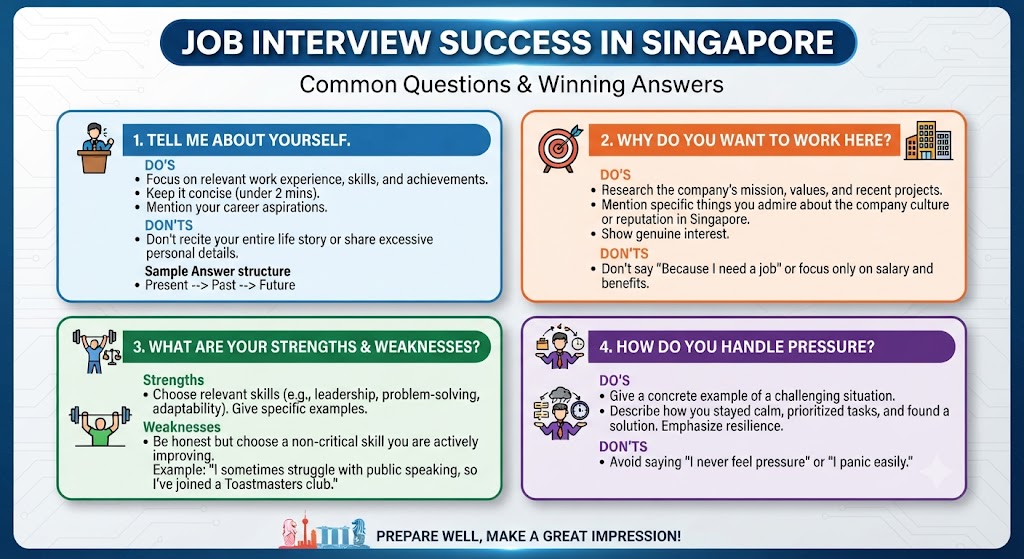
1. Tell Me About Yourself
This is one of the most common opening questions in Singapore job interviews. Employers use it to understand your professional background, relevant experience, and reasons for applying.
A frequent mistake is giving a lengthy personal history or repeating every detail already listed on the resume. Instead, focus on your current professional situation, relevant achievements, and career goals.
A useful structure includes:
- Your current role or professional background.
- Two or three skills relevant to the position.
- One significant achievement or example of your work.
- Why the opportunity interests you.
Sample answer:
“I am a marketing professional with three years of experience in digital campaigns, content development, and performance analysis. In my previous role, I worked on campaigns designed to increase website engagement and generate qualified leads. I particularly enjoy using data to improve marketing performance. I am interested in this position because it would allow me to contribute my existing skills while developing further experience in a dynamic business environment.”
Adapt this example to your actual background and achievements. Keep your answer concise, ideally around 60–90 seconds, and avoid memorising it word for word.
2. Why Do You Want to Work for Our Company?
Employers want to know whether you have researched their organisation and understand what makes the role attractive. A generic answer such as “Your company is successful” rarely demonstrates genuine interest.
Before the interview, review the company’s website, products or services, recent developments, and job description. Identify specific reasons the organisation interests you and connect them to your professional goals.
Sample answer:
“I am interested in joining your company because of its focus on customer experience and continuous improvement. The responsibilities described in the job advertisement align with my experience in process improvement and client communication. I would welcome the opportunity to contribute to the team while developing my expertise in this industry.”
A strong answer should demonstrate three things: knowledge of the company, alignment with the role, and a clear contribution you can make.
Avoid focusing exclusively on salary, annual leave, or the company’s reputation. These factors may matter when evaluating an offer, but your initial response should explain why the role and organisation are professionally relevant to you.
3. What Are Your Strengths?
This question helps employers assess whether your abilities match the position. However, simply listing qualities such as hardworking, organised, or motivated may not make your answer memorable.
Choose two or three strengths that are directly relevant to the job and support them with examples.
For instance, candidates applying for customer-facing roles may highlight communication and relationship management. Applicants for technical positions may emphasise analytical thinking, troubleshooting, or technical expertise.
Sample answer:
“One of my main strengths is problem-solving. In my previous role, I noticed that recurring customer enquiries were increasing response times. I helped organise common questions into a structured reference guide, which made it easier for the team to respond consistently. This experience taught me how small process improvements can support better customer service.”
The example should reflect something you genuinely did. If possible, include a measurable outcome, such as reduced processing time, improved customer satisfaction, or fewer errors.
Additionally, avoid claiming that you excel at everything. Specific strengths supported by credible examples are more convincing than broad statements.
4. What Is Your Greatest Weakness?
Employers ask this question to understand your self-awareness, honesty, and willingness to improve. Choosing a weakness that sounds like a disguised strength can make the response feel rehearsed.
Instead, identify a genuine professional development area that does not undermine an essential requirement of the role. Then explain what you are doing to improve.
Sample answer:
“I used to find it difficult to delegate tasks because I wanted to ensure everything met my standards. Over time, I realised that effective teamwork requires clear expectations and trust. I have started assigning responsibilities earlier, agreeing on milestones, and scheduling regular progress reviews. This approach has helped me collaborate more effectively.”
Your answer should demonstrate progress rather than simply identify a problem.
Avoid weaknesses that directly contradict a core job requirement. For example, saying you dislike communicating with people may be unhelpful when applying for a customer service position. At the same time, do not invent a weakness solely because you think it will impress the interviewer.
5. Why Should We Hire You?
This question gives you an opportunity to summarise the value you can bring to the organisation. Employers want to understand how your skills, experience, and working approach align with their needs.
To prepare, identify the three most important requirements in the job description. Then connect those requirements to your relevant qualifications and accomplishments.
Sample answer:
“I believe I would be a strong candidate because my experience aligns with the key responsibilities of this role. I have practical experience managing projects, coordinating with different stakeholders, and meeting deadlines. I also approach problems analytically and communicate progress clearly. I would bring these strengths to the team while remaining open to feedback and continuous learning.”
The best answer combines relevant skills with evidence and enthusiasm. Avoid comparing yourself negatively with other applicants or making unsupported claims about being the best candidate.
If you are a recent graduate, focus on internships, academic projects, practical training, volunteering, or transferable skills. Employers may value potential and a willingness to learn, especially for entry-level positions.
6. How Do You Handle Pressure and Tight Deadlines?
Singapore workplaces can involve demanding deadlines, cross-functional collaboration, and changing priorities, depending on the industry and position. Employers may ask this question to assess how you organise work, communicate challenges, and maintain quality under pressure.
Rather than saying you work well under stress, provide a real example that demonstrates your approach.
Sample answer:
“When several deadlines overlap, I first assess each task according to urgency, business impact, and dependencies. In my previous role, I managed two projects with overlapping deadlines by creating a prioritised schedule and communicating progress to the relevant stakeholders. When a delay became likely, I raised it early and discussed alternative timelines. This helped the team coordinate its work and avoid last-minute confusion.”
A useful way to structure your response is the STAR method:
- Situation: Explain the challenge or circumstances.
- Task: Describe what you needed to accomplish.
- Action: Explain the steps you personally took.
- Result: Share the outcome and what you learned.
This approach keeps your answer organised and gives the interviewer concrete evidence of your working style.
7. What Are Your Salary Expectations?
Salary discussions are common in Singapore recruitment. Employers may ask about your expectations to determine whether they align with the position’s budget and your level of experience.
Research typical compensation for similar roles, taking into account industry, responsibilities, seniority, qualifications, and relevant skills. Consider the complete package rather than salary alone, including variable compensation and benefits where applicable.
Sample answer:
“Based on my experience, the responsibilities of this position, and my research into comparable roles, I am looking for a competitive package within the market range. However, I am open to discussing the overall compensation structure and understanding the expectations and benefits associated with the position.”
If you have researched a realistic salary range, you can state it directly and explain that your expectations depend on the responsibilities and overall package.
Before giving a figure, clarify whether the employer is discussing monthly base salary, annual compensation, bonuses, or another arrangement. These distinctions can make a meaningful difference when comparing offers.
Avoid choosing a number without research. Equally, do not undervalue your experience simply to secure an interview. A well-supported expectation demonstrates preparation and helps both parties assess whether the opportunity is suitable.
8. Why Are You Leaving Your Current Job?
Interviewers may ask why you want to leave your current employer to understand your motivation, career direction, and expectations of the new position.
Even if you have experienced workplace disagreements, limited growth, or dissatisfaction with management, keep your response professional. Criticising former colleagues can distract from your qualifications and raise unnecessary concerns.
Sample answer:
“I have gained valuable experience in my current role, particularly in project coordination and client communication. I am now looking for an opportunity that offers greater exposure to strategic responsibilities and allows me to build on those skills. This position interests me because its responsibilities align with the direction I want to take in my career.”
If you were made redundant or your previous position ended, explain the circumstances honestly and briefly. If you are changing industries, focus on your reasons for making the transition and the transferable skills you bring.
Your objective is to explain what you are moving towards rather than dwelling on what you dislike about your current situation.
9. Are You Legally Eligible to Work in Singapore?
This question may be particularly relevant to international applicants. Singapore has specific work-pass requirements, and eligibility depends on factors such as the type of employment, the applicable pass, and current government rules.
Answer accurately about your present work authorisation and whether you require employer sponsorship or support with a work pass.
Sample answer for a candidate who requires a work pass:
“I am currently based outside Singapore and would require the appropriate work authorisation to take up employment there. I understand that eligibility depends on the applicable requirements, and I am prepared to provide the necessary information for the employer to assess the process.”
If you already have valid work authorisation, explain your status accurately without disclosing unnecessary personal information.
Do not assume that a job offer automatically guarantees work-pass approval. Employers and candidates should check the relevant requirements through Singapore’s Ministry of Manpower before making employment arrangements.
10. Do You Have Any Questions for Us?
Many interviews conclude with an opportunity for candidates to ask questions. Saying “No, I have no questions” may miss a valuable chance to demonstrate interest and evaluate whether the position suits your goals.
Prepare two or three thoughtful questions before the interview. Choose questions that have not already been answered during the discussion.
Examples include:
- What would success look like in the first three to six months?
- What are the team’s most important priorities at the moment?
- How does the company support professional development?
- What are the next steps in the recruitment process?
- How does this role collaborate with other departments?
These questions help you understand the role beyond the job description. They also demonstrate that you are considering how you can contribute to the organisation.
Avoid asking questions that can easily be answered by reviewing the company’s website. You should also leave detailed discussions about compensation, leave, and other employment terms for an appropriate stage of the recruitment process.
Conclusion
Preparing for common interview questions in Singapore can help you communicate your qualifications more clearly and approach recruitment with greater confidence. From introducing yourself and explaining your strengths to discussing salary expectations and work authorisation, each response should be relevant, honest, and supported by examples.
Start by researching the employer and reviewing the job description. Practise your answers using the STAR method, prepare thoughtful questions, and make sure you can explain the achievements listed on your resume. Additionally, remember that interviews are an opportunity for you to evaluate the employer, the working environment, and the potential for career growth.
There is no single answer that guarantees success. However, preparation, clear communication, and a practical understanding of the position can help you make a stronger impression.
As you prepare for your next opportunity, use a best job tool to explore relevant vacancies, compare job requirements, and identify positions that match your experience and career goals. Combining targeted applications with consistent interview practice can help you move closer to your next career opportunity in Singapore.





Leave a Reply