Introduction: Project Management
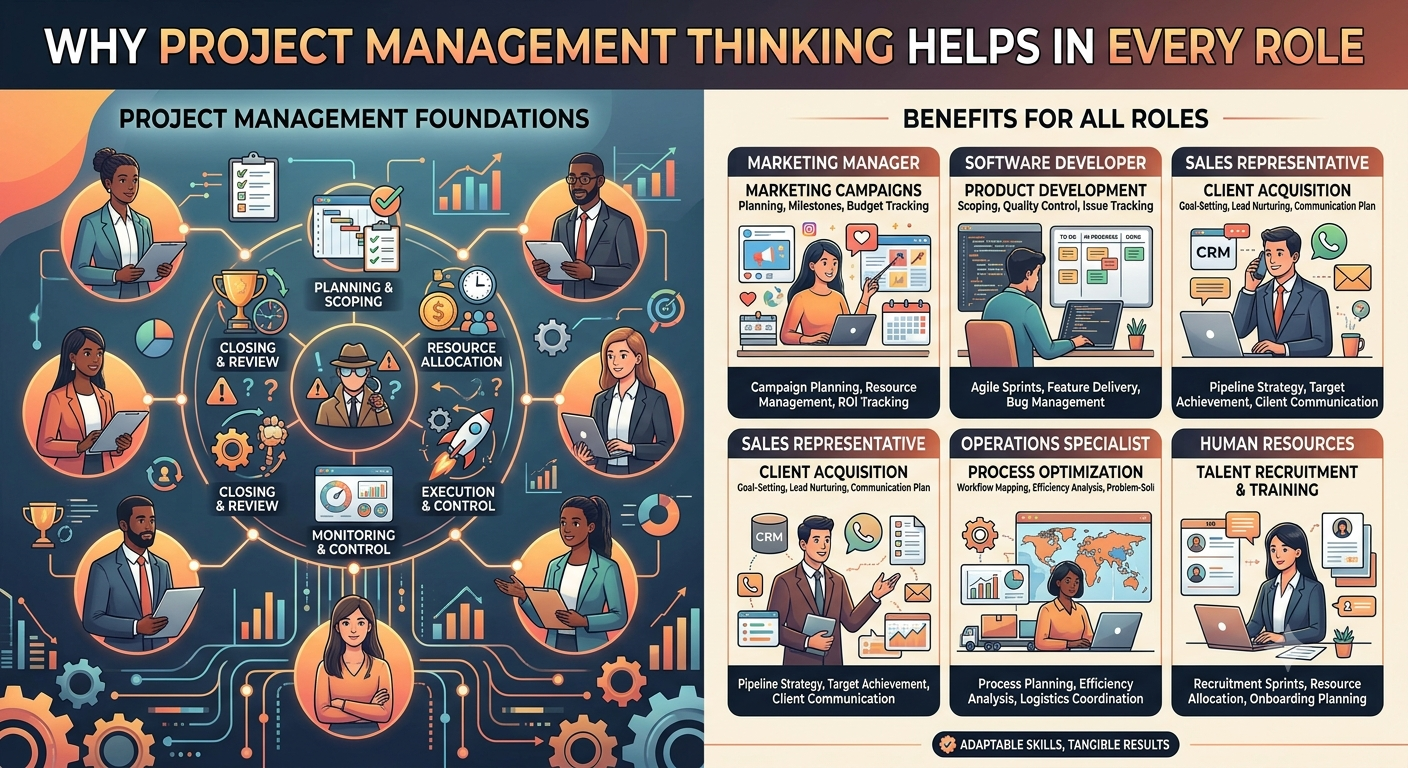
Project managers, managers, and unit heads often handle large-scale projects that require careful planning and coordination. However, the skills useful for addressing the objectives of project management can be applicable to almost every profession and every task.
For instance, when dealing with content writing, marketing, finances, human resources, sales, tech, education, or customer service, one still has to address a set of tasks related to a single objective within a specific deadline and utilize multiple tools to perform them.
Professionals in diverse fields should understand why project management thinking helps in every role because it enables them to think strategically about their objectives, set priorities, communicate effectively, and consider all essential components.
What Is Project Management Thinking?
Project management thinking does not require specific tools or large-scale planning; instead, it takes a holistic approach by treating each objective as a single task that professionals must complete within a specific deadline using a variety of supporting activities. Project management thinking does not require specific tools or large-scale planning; instead, it takes a holistic approach that treats each objective as a single task and requires professionals to complete it within a specific deadline by managing a variety of related duties.
In other words, project management thinking prompts professionals to consider not only the task at hand but also the duties required to complete it, the tools they can use, the time they need, and the potential issues they may encounter.
For instance, a content writer who has to produce a piece of writing within a particular deadline can consider all the duties involved in delivering the finished product (e.g., research, outlining, writing, editing, optimizing for SEO), the tools needed for them (time, language tools, SEO tools), and potential issues (running out of time, failing to deliver within the word limit).
Why It Helps You: The Benefits of Project Management Thinking:-
1. It Helps You Set Clear Goals
One of the basic concepts of project management involves setting the objective or goal that professionals need to achieve. Many professionals across the diverse fields of activity encounter difficulties with establishing what exactly they need to achieve, which makes them ineffective in their attempts at fulfilling the objective.
Project management thinking allows the thinkers to establish the result that they have to deliver rather than focusing on the tasks themselves because, once the objective is clear, every other aspect (tools, duties, time, risks) becomes clear as well.
For instance, when preparing a presentation for a meeting, one might have a general idea of “preparing a presentation,” but one needs to think about what the presentation has to achieve (deliver certain information, persuade the audience) to ensure that the result meets the criteria.
2. It Improves Time Management
Time management plays a central role in every professional or personal endeavor because deadlines matter, but employees and managers often miss them when they fail to account for the time required to complete specific tasks.
Project management thinking encourages the thinkers to address larger objectives as multi-stage processes where each stage utilizes certain tools and requires a certain amount of time.
For instance, when preparing a report for submission, professionals must complete several smaller tasks, such as gathering data, analyzing it, and writing the report. Since each task takes time, they should plan the submission date accordingly.
3. It Helps You Prioritize Responsibilities
Many professionals feel overwhelmed by the duties they have to perform but fail to consider that not all of these duties are equally important. Project management thinking encourages the thinkers to prioritize the tasks with the consideration of their tools, time requirements, importance, and other factors.
For instance, you can postpone replying to a non-critical email while addressing an overdue task that another person needs to move their project forward.
4. It Strengthens Communication
One of the essential aspects of project management is ensuring that every party communicates effectively. While this aspect can be highly complex in many fields, project management thinking encourages professionals to clearly communicate their responsibilities, expectations, and concerns to others.
For instance, when delegating one’s own task to a co-worker, providing this co-worker with the information about the objective, deadline, and concerns (if any) would facilitate the process immensely.
5. It Helps You Manage Risks
Professionals may not always have a clear understanding of the duties required to achieve their objectives, and they may need to resolve various issues along the way. Project management thinking helps the thinkers establish potential concerns and problems that might occur and incorporate them into the planning process.
For instance, when fulfilling one’s professional obligation, one can consider such questions as “What can go wrong?” “Is there a part of the task that can fail?” “How can I address this issue?” “Do I need more time and/or tools?”
One does not necessarily have to consider every issue, but contemplating the primary risks can make the thinker more prepared.
6. It Encourages Accountability
Being accountable does not necessarily mean being judgmental towards one’s collaborators but being clear about one’s responsibilities and concerns and communicating them effectively.
Project management fosters accountability between the involved parties. When every party clearly understands what it has to contribute to the project, it becomes more responsible in its attempts to deliver on time and in accordance with the client’s expectations.
This principle can also be useful in professional fields because one’s accountability can help build strong connections with co-workers, managers, clients, and other stakeholders.
7. It Makes Collaboration More Effective
When addressing one’s task, one almost always relies on the responsibilities of others, even when one works alone, such as when writing a paper for school as an individual, but still relying on the proofreading and marking assistance provided by another person.
Project management thinking encourages professionals to consider both their own responsibilities and those of others to ensure that everyone delivers their work on time. Project management thinking encourages the thinkers to consider not only their responsibilities but the responsibilities of others as well to ensure that everything can be delivered on time.
For instance, when a designer works on a project that has to be delivered soon, they should understand that they rely on the content creator’s ability to provide the textual component by the due date.
8. It Helps You to Track Your Progress
Project management thinking helps professionals to regularly stop and reflect on how much they have accomplished instead of rushing toward the deadline trying to review everything. It allows them to assess their progress, recognize what tasks are left, and see if everything is going well or not. For instance, if I have a report to write, it is easier to track how much time and effort I have put into collecting information, writing the first draft, editing, and proofreading.
Conclusion: Project Management
When it comes to professional growth, project management thinking is an essential skill because it covers fundamental principles that are applicable to every role. Setting realistic goals, effective time-management, enhanced communication, proactive approaches to challenges, accountability, and the ability to coordinate with others can improve one’s performance in any field. Every role entails multiple responsibilities, and one should be able to prioritize them based on deadlines, attainable outcomes, and interrelations. One should also determine the most realistic approach to complete a task, set specific goals to measure their progress, and make the necessary adjustments.
Ultimately, Why Project Management Thinking Helps in Every Role can be answered with a simple statement: every professional is responsible for turning ideas and demands into reality. One can achieve greater professional success if they learn to manage projects. When one realizes how specific responsibilities contribute to the bigger picture and how they can be organized, prioritized, and completed, they can make the meaningful changes in their professional development.
Ready to manage your work more effectively? Explore the best job tools to organize tasks, improve productivity, manage deadlines, and build stronger professional skills. Start applying project management thinking to your everyday work and take the next step toward a more successful career.



Leave a Reply