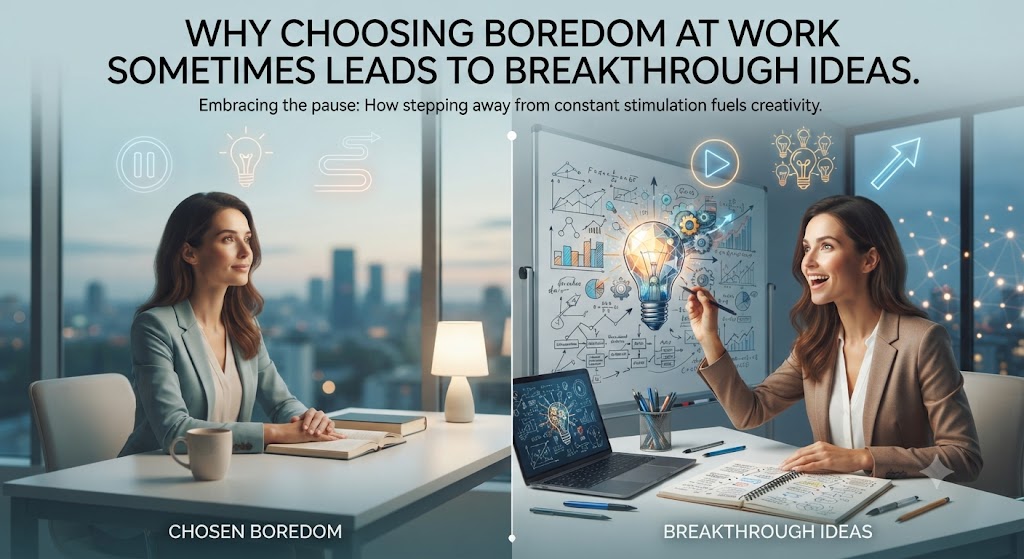
Modern workplaces often treat constant activity as a sign of productivity. Employees move between meetings, emails, notifications, deadlines, and digital platforms throughout the day. When there is a quiet period, many professionals immediately fill it with Boredom another task.
However, uninterrupted stimulation can leave little room for reflection.
Boredom at work is not always a sign of low engagement or poor performance. When it occurs during an otherwise productive career, a short period without active stimulation can give the brain an opportunity to connect information, reconsider problems, and generate new ideas.
Choosing boredom does not mean deliberately avoiding responsibilities. Instead, it means allowing small periods of unstructured thinking after essential work is complete. For professionals working remotely, traveling, managing multiple projects, or planning their next career move, these periods can become useful opportunities for reflection.
The objective is not to become less productive. It is to create enough mental space for deeper thinking alongside execution.
1. Understand Why Constant Stimulation Can Limit Creative Thinking
Many professionals spend most of their working day responding to information.
Emails arrive. Messages require replies. Meetings create new tasks. Notifications interrupt concentration. Social media provides another source of stimulation.
This creates a reactive work pattern.
Instead of asking:
“What should I think about?”
the professional repeatedly asks:
“What needs my attention right now?”
These are very different questions.
Creative work often requires the first type of thinking. When there is no immediate task demanding attention, professionals can step back and examine broader problems.
For example, a marketing professional might notice that a campaign’s results are declining but remain too busy with daily reporting to investigate why. A short period away from immediate tasks may create enough mental space to recognize that the audience, message, or distribution strategy needs to change.
The insight does not necessarily come from doing nothing. It can come from having enough mental space to connect existing information.
2. Create Deliberate Periods Without Digital Distractions
Boredom becomes more useful when it is intentional.
You do not need to spend an entire afternoon doing nothing. Start with short periods.
Try:
- Taking a 10-minute walk without checking your phone
- Drinking coffee without opening social media
- Sitting quietly after completing a major task
- Taking a short break between meetings
- Traveling without continuously consuming content
- Writing down ideas before checking notifications
- Spending part of your commute without entertainment
These moments can help separate focused work from constant information consumption.
Remote workers can build this into their schedules by creating short gaps between meetings rather than filling every available minute with another task.
The purpose is not to eliminate technology. It is to prevent technology from occupying every moment when you are not actively working.
3. Use Boredom to Revisit Problems From a Different Perspective
When professionals are deeply involved in a problem, they can become attached to the first solution they developed.
A pause can create distance.
After working on a difficult problem, ask:
- What assumption am I making?
- Is the original problem still the right problem?
- What would happen if we removed one major constraint?
- What would a customer see differently?
- Is there a simpler solution?
- What information are we ignoring?
These questions can lead to ideas that are difficult to generate while responding to immediate tasks.
For example, an operations team might spend weeks trying to make a complicated process more efficient. During a period of reflection, someone may realize that the process itself could be eliminated.
That is a different type of improvement.
Instead of optimizing the existing system, the team questions whether the system needs to exist in its current form.
4. Protect Boredom During Remote Work
Remote work offers flexibility, but it can also create a workplace environment where the computer is always nearby.
Professionals may move directly from a video meeting to email, then from email to messaging, and finally to another browser tab.
Without intentional boundaries, there may be almost no mental downtime.
A simple remote-work routine can help.
For example:
Morning:
Complete the most important focused task before checking unnecessary notifications.
Midday:
Take a genuine break away from the screen.
Afternoon:
Handle meetings, communication, and collaborative work.
End of day:
Review priorities and write down unresolved problems for the next day.
A short walk after work can also create separation between professional responsibilities and personal time.
The same principle applies when working while traveling. If you are testing a new location for remote work, do not fill every free period with sightseeing, social media, or entertainment. Allow some quiet time to observe how the environment affects your concentration and ideas.
5. Turn Quiet Time Into an Idea-Capture System
Boredom alone does not guarantee useful ideas. Professionals need a simple way to capture them.
Keep an accessible note system for:
- Problems you notice
- Questions you cannot answer
- Customer frustrations
- Process improvements
- Content ideas
- Product concepts
- Career opportunities
- Skills you want to develop
Do not evaluate every idea immediately.
Capture first. Review later.
For example, during a quiet walk you might think of a better process for handling customer inquiries. Write it down rather than trying to fully develop the idea immediately.
At the end of the week, review the notes and identify ideas with practical potential.
This creates a two-stage process:
Stage 1: Generate
Allow thoughts to emerge without immediately judging them.
Stage 2: Evaluate
Later, determine which ideas are realistic, useful, and worth testing.
This separation can make creative thinking more productive.
6. Avoid Confusing Boredom With Disengagement
There is an important distinction between productive mental downtime and persistent workplace disengagement.
Occasional boredom can create space for reflection. However, constant boredom may indicate that your responsibilities are not challenging enough, your skills are underused, or your career direction needs reconsideration.
If you regularly feel disengaged, examine the situation.
Ask:
- Am I learning anything new?
- Does my work use my strongest skills?
- Are there opportunities for greater responsibility?
- Can I contribute to more challenging projects?
- Is my current role aligned with my long-term goals?
If the answers are consistently negative, the solution may not be more downtime. It may be a new project, additional responsibilities, professional development, or a different career opportunity.
A global job platform such as a https://www.bestjobtool.com/best job tool can help professionals research alternative roles and compare opportunities when their current position no longer provides sufficient development.
7. Connect Creative Thinking With Long-Term Career and Financial Planning
Ideas become valuable when they lead to action.
A new idea might become a process improvement, portfolio project, freelance service, business concept, or career transition.
However, professionals should evaluate opportunities carefully before committing significant time or money.
Consider:
- Potential career value
- Required skills
- Time investment
- Financial cost
- Expected return
- Market demand
- Compatibility with existing responsibilities
For example, if a quiet period inspires you to develop a new professional service, research potential customers before spending heavily on tools or training.
Similarly, if you discover an interest in a new career path, review relevant job descriptions to understand the actual requirements.
Financial planning is particularly important during career transitions. Maintain an emergency reserve and evaluate recurring expenses before reducing stable income.
Creative thinking can identify opportunities, but practical planning determines whether those opportunities are sustainable.
Conclusion
Boredom is often treated as something professionals should eliminate. Yet small periods of mental quiet can have practical value when they create space for reflection, problem-solving, and new connections between ideas.
The key is intentionality.
Do not use boredom as an excuse to avoid important work. Instead, complete your responsibilities and deliberately create short periods without constant digital stimulation. Take a walk. Sit quietly. Travel without filling every moment with content. Let your mind revisit problems from a different perspective.
Then capture useful ideas and evaluate them later.
For remote professionals, these quiet periods can also improve the boundary between focused work and constant digital availability. For people considering a career transition, reflection can reveal which skills, roles, or industries deserve further exploration. A best job tool, as a global job platform, can support that next stage by helping professionals research relevant opportunities based on their emerging career goals.
Breakthrough ideas do not always appear during brainstorming sessions or meetings. Sometimes they emerge when there is finally nothing demanding your attention.
Creating that space may be one of the simplest ways to give better ideas a chance to appear.





Leave a Reply