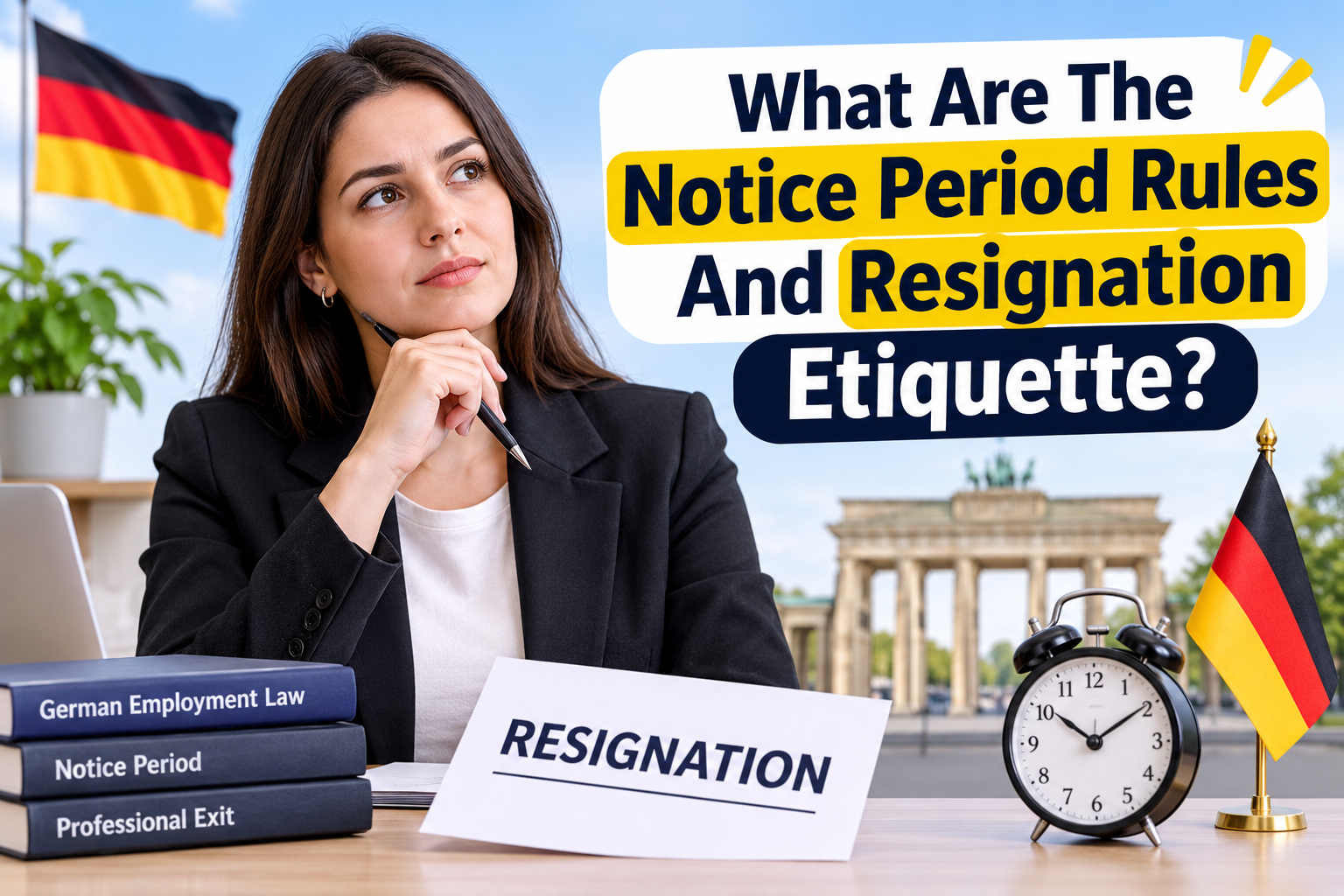
Introduction: Notice Period Rules and Resignation Etiquette
Leaving a role requires careful consideration and professional handling. Staff within Germany must adhere to particular employment rules and contract terms. Awareness of Notice Period Rules and Resignation Etiquette can therefore help employees to both comply with the law and retain good working relationships. It can also aid a successful transfer to a new career move.
Whether you work locally or internationally or plan to change jobs, you must understand the resignation procedures in Germany. From writing a letter of resignation to carrying out work during your notice period, knowledge of these processes can be beneficial.
What Are The Notice Period Rules And Resignation Etiquette?
1. Notice Period in Germany
German law requires employees to give notice before leaving their jobs. Typically, employees must provide four weeks’ notice. Employees can submit their resignation effective on the 15th or the last day of the calendar month under Section 622 of the German Civil Code (BGB). Although German law generally establishes the standard notice period, individual employment contracts and industry-wide collective agreements (Tarifverträge) can specify different notice periods.
For example, some businesses require staff, particularly those in higher or specialised roles, to give two or even three months’ notice. Hence, it is important for employees to analyse their contract of employment. Awareness of Notice Period Rules and Resignation Etiquette enables staff to identify the correct end date for their employment and thus helps to avoid disputes.
2. Probation Notice Period
Many German companies implement a ‘probation’ period for newly recruited staff. Both the employee and employer usually use this period to assess whether the person suits the role. If both parties agree to a probationary period, either the employer or employee can usually terminate the employment contract by giving two weeks’ notice during this period. Crucially, in contrast to the normal notice period, there is no requirement for the end of employment to fall on the 15th or last day of the month.
Those wishing to resign during their probationary period should still review their contracts of employment to ascertain relevant terms. Observing appropriate Notice Period Rules and Resignation Etiquette is important even if staff have only recently commenced working for a company.
3. Review Employment Contract
It is key to analyse your employment contract so that you are aware of the terms relevant to resignation. This includes aspects such as the notice period, how to end employment, and entitlement to holidays. There may also be further contractual provisions which are pertinent. Where an employee is bound by an industry-wide agreement, this may detail particular terms relating to resignation.
Different sectors, for example, manufacturing, healthcare, construction and public services, can be subject to such contracts. Furthermore, it is key to analyse whether your contract includes provisions regarding reimbursement for training, relocation and/or other support. Should there be areas of ambiguity within your contract, it may be wise to seek specialist legal guidance. Awareness of Notice Period Rules and Resignation Etiquette can initially be attained by analysing relevant legal provisions.
4. Write a Letter of Resignation
Within Germany, there are stringent processes to be followed when an employee resigns. An original hand-signed letter must be presented (Section 623 of the German Civil Code). An emailed, WhatsApped or faxed resignation is not legally acceptable. Your letter should state that you are resigning. It should include your full name, your employer’s details and the date on which it is being given.
If you have ascertained the correct end date of your employment, it may also be appropriate to state this. It is recommended that you retain a signed version of your letter and also receive confirmation that your employer has received it. Again, this is underpinned by an awareness of Notice Period Rules and Resignation Etiquette and can help to avoid confusion concerning when your employment is ending.
5. Convey Resignation to Line Manager
Whilst it is legally essential to present your employer with a letter of resignation, many believe it is also important to additionally convey your resignation to your line manager. Ideally this should be done in a private setting. Whilst it is not mandatory to share the personal motivation for your resignation, conveying this in a polite manner can be favourable for sustaining good working relationships with both your manager and colleagues.
Avoid speaking negatively about the company, work related issues or fellow employees. Good communication is a key element of Notice Period Rules and Resignation Etiquette and is especially important if you wish to continue to sustain good working relationships in the future.
6. Fulfil Employment Obligations
Throughout your notice period it is generally expected that you will continue to perform your work-related duties. It is also beneficial to support colleagues by preparing them for your absence. Staff should collate information on current work, systematically store key material and share vital information. Where appropriate, particularly if you deal with clients or business accounts, liaise with your manager to ensure that there is a seamless handover of duties.
Whilst you no longer wish to remain in your role, it is important not to see your productivity decline. Adherence to Notice Period Rules and Resignation Etiquette exemplifies an employee’s dependability, accountability and respect for their employer.
7. Analyse Outstanding Holiday Entitlement
Within Germany, staff are entitled to annual paid leave as stipulated by relevant employment legislation. When resigning, it is key to analyse how this leave will be dealt with. It may be possible for individuals to utilise their remaining holiday entitlement during their notice period. Should this not be feasible due to the ending of employment, it may then be necessary to receive financial renumeration for this outstanding leave.
Nevertheless, employees should not presume that they can use their holiday at any time during their notice period. Analysis of your current holiday entitlement and discussion with the HR department to gain permission should therefore occur. Awareness of this facet of Notice Period Rules and Resignation Etiquette can assist in avoiding dispute concerning final pay and holiday entitlement.
8. Obtain Employment Reference
An employment reference (Arbeitszeugnis) is key for those working within Germany, in furthering their careers. Generally, workers are entitled to legally obtain a paper-based reference upon the conclusion of their employment. References can be basic, providing details of an employee’s role and dates of employment.
Alternatively, they can be more detailed and assess both an individual’s performance and behaviour. Such references can be highly valuable in furthering a career, particularly if continuing to work within Germany. It is also favourable to seek a reference prior to leaving so that the HR department can effectively source and prepare relevant information.
Conclusion: Notice Period Rules and Resignation Etiquette
Within Germany, the process of resigning from a role is far more complex than merely advising an employer of an individual’s decision to end employment. Employees need to be cognisant of their contract terms and successfully navigate the legal resignation process. Furthermore, they must handle communication in a professional manner during their notice period.
Awareness of Notice Period Rules and Resignation Etiquette enables staff to both fulfil their work duties and safeguard their professional reputation. It also facilitates the maintenance of favourable relations with previous employers. With adequate preparation and professionalism, therefore, resigning can be positively utilised to further career progression.
Planning to change jobs in Germany? Explore new career opportunities, discover leading employers, and use the Best Job Tools to find positions that match your skills and professional goals. Start your next career journey with confidence!





Leave a Reply