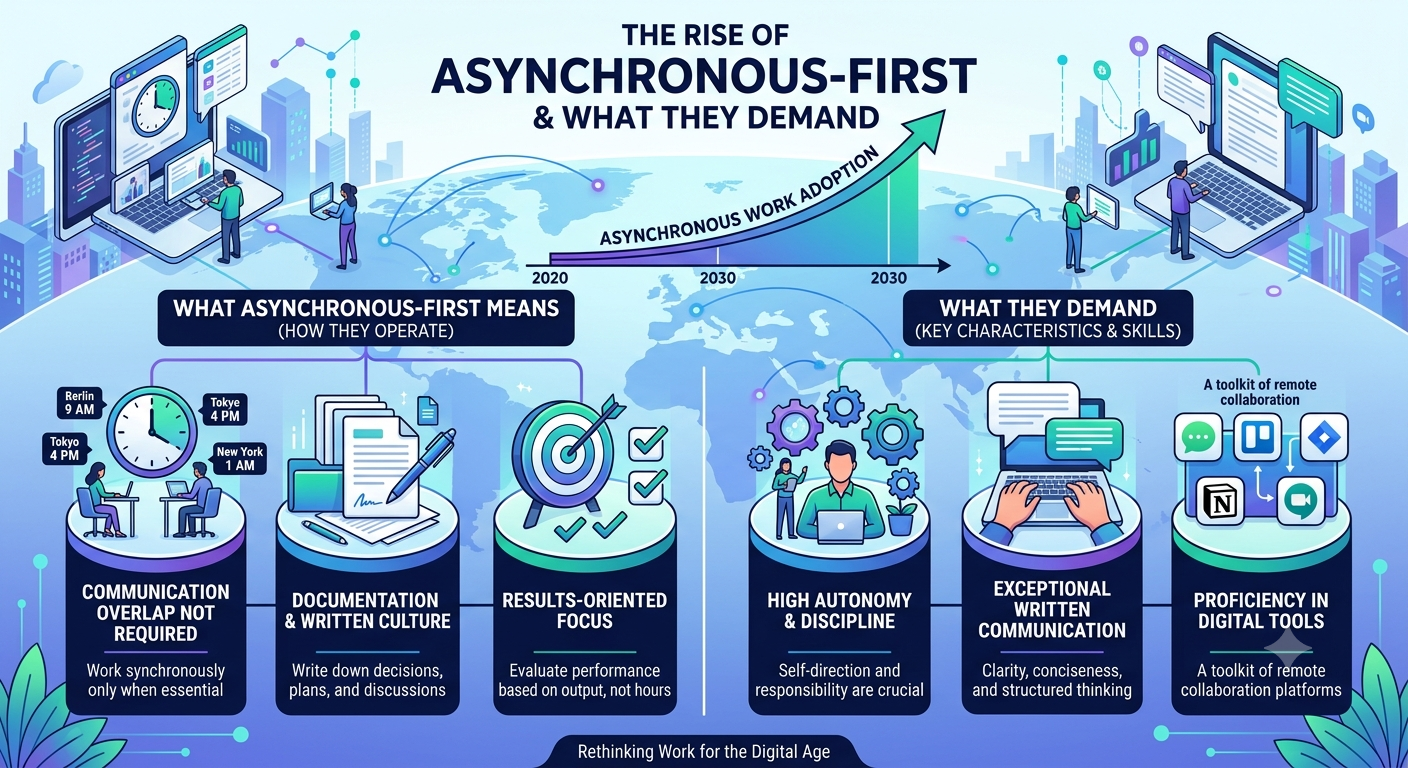
Introduction: Asynchronous-First Companies
The modern workplace is changing. While many companies have embraced flexible, remote-friendly work arrangements, asynchronous-first work is an emerging alternative. Asynchronous-first companies prioritize asynchronous communication and collaboration, leaving employees free to perform their work and communicate in their preferred manner and schedule.
The rise of the asynchronous-first companies and what they demand represents a change in how businesses approach productivity, collaboration, and employee performance. For professionals, understanding how asynchronous-first work environments function and what skills will be in demand is critical to preparing for the future of work.
The Rise of Asynchronous-First Companies and What They Demand?
1. Understanding Asynchronous-First Work
Asynchronous work arrangements enable employees to collaborate and communicate without requiring everyone to be available at the same time. Instead of having meetings to exchange information, employees can use documents, project management systems, email, video recordings, messaging tools, and other means of communication. An asynchronous-first company does not completely eliminate meetings, but any synchronous communication is reserved for situations when it is truly necessary.
For instance, if a manager reviews a project plan in a meeting with ten subordinates, they could record a short video message with their feedback. The employees can view the message at their convenience, review the relevant documents, and send their approval or revision requests via email. The asynchronous-first arrangement empowers each employee to decide when they can perform work and communicate without the constraints of a meeting schedule.
2. The Rise of Asynchronous-first Companies and what They Demand
The shift toward asynchronous-first arrangements is due to several factors. First, as companies embrace distributed teams, it becomes increasingly difficult to establish a shared set of hours during which all members can be available. By enabling communication outside of meetings, asynchronous-first collaboration supports productivity and coordination among distributed teams.
The rise of asynchronous-first companies and what they demand reflects a shift in how employees and employers think about work hours, productivity, communication, and performance management. For asynchronous-first employment to succeed, companies need to rethink communication methods, documentation and reporting procedures, self-management, and managerial responsibilities.
Asynchronous-first arrangements can be much more productive than traditional in-person meetings. Constant meetings and other forms of synchronous communication can disrupt the flow of work, especially when employees need to concentrate on a complex assignment. Asynchronous communication methods such as messaging, email, and shared documents allow employees to review information at a convenient time. In addition, asynchronous communication typically involves some form of documentation, which can be helpful for reporting.
3. The Importance of Written Communication in an Asynchronous-first Workplace
Asynchronous-first arrangements place a premium on documentation and written communication. Without the ability to ask questions in person, employees need to be able to convey their ideas, concerns, and requests clearly in writing.
Professionals who work in an asynchronous-first mode should be able to explain the purpose of their message, provide relevant context, identify what they need from others, and specify any applicable deadlines. Instead of writing “Can you check this?” one could say “Could you review the first three sections and share your feedback by Thursday afternoon? I especially need your thoughts on the pricing assumptions.”
By eliminating ambiguity and identifying specific next steps, employees can communicate more efficiently and reduce the need for clarifying questions.
4. The Importance of Documentation
In many traditional workplaces, communication occurs primarily in conversation. The same information is not always captured in writing, making it challenging to refer back to the details of a discussion.
By contrast, asynchronous-first arrangements rely on documentation as the primary means of communication. As such, asynchronous employees need to ensure that all relevant information is captured clearly and concisely.
Professionals in asynchronous-first workplaces should adopt documentation practices that enable them to accomplish their objectives. In many cases, it involves asking themselves whether the document or message serves a clear purpose and if another person would be able to understand it without questions. Adopting the mindset of an end user can help in producing well-organized, clearly written materials.
5. The Role of Self-Management in an Asynchronous-first Environment
Asynchronous-first work arrangements empower employees to decide when to perform their work. However, this flexibility comes with greater responsibility, as there are no in-person meetings or other activities to dictate a shared daily schedule.
Employees in asynchronous-first workplaces need to develop time management and self-management skills to ensure that they balance their workload and meet deadlines without the structure of physical meetings. Without face-to-face meetings, asynchronous employees need to set aside time for focused work.
Like traditional meetings, asynchronous collaboration requires a clear agenda and specific instructions. Employees also need to understand which tasks take priority and which ones can wait. In asynchronous-first workplaces, time management is crucial, as employees need to schedule their work around meetings and other commitments.
6. The Importance of Responsiveness
An asynchronous-first work arrangement does not mean that employees can be available on their own schedule. In practice, asynchronous communication still requires employees to be responsive, just not simultaneously available. If one team member sends a request and another has to wait for days before receiving a response, the entire project could be set back.
Successful asynchronous-first teams understand the importance of responsiveness to requests and information. They also know that employees need to set aside time for focused work, especially on tasks that require deep concentration. Effective asynchronous-first teams develop clear response and communication guidelines based on the nature of the request.
For instance, employees could use project management tools for general correspondence and save messaging for urgent requests. Having specific procedures in place helps asynchronous teams avoid misunderstandings regarding what is considered an acceptable response window.
Conclusion: Asynchronous-First Companies
In addition, asynchronous-first employees need to learn to manage their time and workload effectively. Finally, asynchronous teams and managers need to develop procedures for communication and responsiveness. By rethinking the basic assumptions of the workplace, asynchronous-first companies are better positioned to support productivity and employee development in a new era of work.
While the shift toward asynchronous-first work can be disruptive, it also presents tremendous opportunities for employees and employers.
As companies rethink communication, collaboration, documentation, and time management, employees who develop strong written communication skills, time management, and project management skills will be well-positioned for career advancement. After all, the next big thing in the workplace is not about putting everyone on the same page – it is about empowering individuals to accomplish their goals in their preferred manner.
Ready to adapt to the future of work? Explore new opportunities with the Best Job Tools, strengthen your communication and time-management skills, and find companies that match the way you want to work. Take the next step toward building a career that offers flexibility, autonomy, and meaningful growth.



Leave a Reply