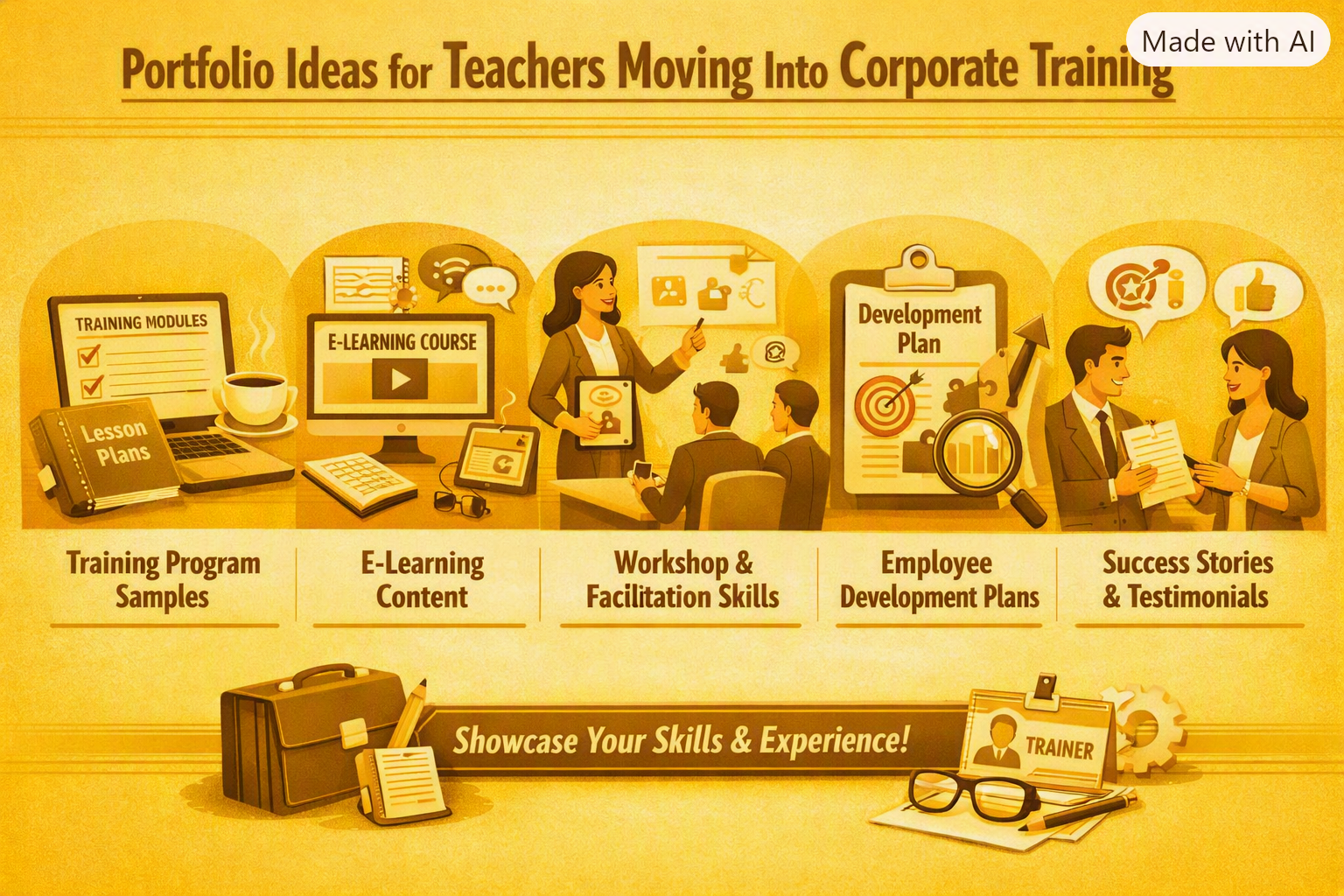
Introduction: Portfolio Ideas
Moving from teaching to corporate training can be a great career move. Teachers can bring a variety of skills with them, such as communication, presentation, planning, mentoring, and being able to explain complex topics simply and concisely. The one skill that many teachers lack, however, is the ability to showcase their talents in the corporate world. This is where a portfolio can be great for both the employer and for the teacher.
A portfolio can show an employer what you are capable of, not only from a general standpoint but from what you teach the employees and how you approach the problems. You do not need to have an already lengthy career or presence in the corporate world to create a portfolio. You just need to be able to take your existing teaching job and convert it to something that is presentable for the corporate world you wish to enter.
Portfolio Ideas for Teachers Moving Into Corporate Training
1. Create a Corporate Training Presentation
One of the easiest ways to demonstrate your experience is to design a sample training presentation. Choose a topic that is relevant for the corporate world, such as communication, teamwork, time management, leadership, customer service or workplace etiquette.
Develop a 10-15 slides presentation and make sure it is interactive.
Try to use questions, activities, examples and exercises. For instance, if you have selected “Effective Workplace Communication” as the topic, include the most common mistakes, examples from the workplace, Q&A session, role-play exercise and others.
Such an approach will help you to demonstrate that you are consistent in developing training modules that is not only informative but engaging.
2. Create a Sample Corporate Training Module
Sometimes, companies require more than a presentation. They may want you to develop a full-pledged training course. To demonstrate your organizational skills, you can create a sample training module. Make sure to add the following information:
- Learning objective
- Target audience
- Duration
- Content
- Activities
- Discussion points
- Assessment
- Learning outcome
As an example, you may select “Managing Workplace Conflict” and create a 60 minutes training module. Describe what the audience will learn during the session, how the information will be delivered and how the knowledge retention will be measured. This will give the recruiters an insight into your training capabilities.
3. Turn Your Teaching Experience Into Case Studies
Your teaching experience can be transformed into case studies that could serve as a great portfolio piece if you present it in the right way. Think of a situation where you helped somebody master a concept, improved their performance, taught them a new skill, or resolved a problem.
Put it all together in a case study form and discuss what you did and what results you saw. For instance, you can talk about how you realized that students participate less and less as time goes and decided to implement group activities to make them more engaged in the process.
Also, remember to relate your experience to the corporate training environment. Think of the same principles that you applied as a teacher and how they could be used in a corporate setting, perhaps with a similar issue of low participation during workshops.
You would address such a problem the same way by making the training sessions more interactive.
4. Create an Employee Workshop
Another great idea for your portfolio is to design a whole employee training workshop around a chosen topic and prepare a set of instructions for it. The topic should be something general and relatable like “Giving and Receiving Feedback,” “Presentation Skills,” or “Confidence Building,” for example. Outline what you would include in the workshop, its objectives, agenda, activities, discussion parts, and assessment.
Moreover, you could also record a brief video for your portfolio showcasing a snippet of the workshop. The video does not have to be professional-grade; a simple recording of you presenting and demonstrating some techniques would be enough to showcase your skills and voice.
5. Show Your Assessment Skills
Teachers often have to conduct various assessments and tests to determine how much information their students learned. Corporate trainers, however, should also possess assessment expertise. Therefore, it might be a good idea to include some quizzes, tests, feedback forms, and other assessment tools in your portfolio.
For instance, you can create five multiple-choice questions and two scenario-based inquiries after completing a particular training course. Additionally, you should describe how you would assess whether the participants learned the information during your training sessions.
6. Include E-Learning Samples
Numerous companies now utilize e-learning tools to organize and provide training courses for their employees. Therefore, you may need to demonstrate your knowledge of virtual learning environments.
It would be a good idea to include some brief e-learning sample that consists of a few written or visual tasks, a video, and a quiz. You can also describe the e-learning software you used for creating your sample. Remember that you do not need to master all e-learning tools; instead, you should demonstrate that you are able to leverage your teaching/training skills to learn and use new programs.
7. Add Testimonials and Feedback
If you have any positive testimonials from students, parents, colleagues, or school management, be sure to add them to your portfolio. You can also ask participants of your sample workshops for feedback and include some of their comments. Keep testimonials brief and centered on the skills that you will want to highlight, such as communication, patience, clear explanations, organization, and enthusiasm.
Final Thoughts: Portfolio Ideas
Teachers possess many skills necessary for a corporate trainer today, but most of them lack the required experience, and even the presence of certain abilities must be proved to employers. Thus, the best portfolio ideas for teachers moving into corporate training are examples of training design, communication, engagement, assessment, and technology application.
In addition, one should not wait for having a corporate trainer job to create a portfolio, as there are plenty of examples from past practice that might be used as samples for future employers. Several presentations, training programs, workshops, assessments, and cases studies make a solid portfolio that can help to convince a potential employer in hiring a former teacher.
A well-built portfolio can help teachers show that their classroom experience is valuable in corporate training. Highlight skills like communication, presentation, mentoring, and lesson planning through practical examples. Showcase your strengths and explore new career opportunities with Best Job Tool.



Leave a Reply