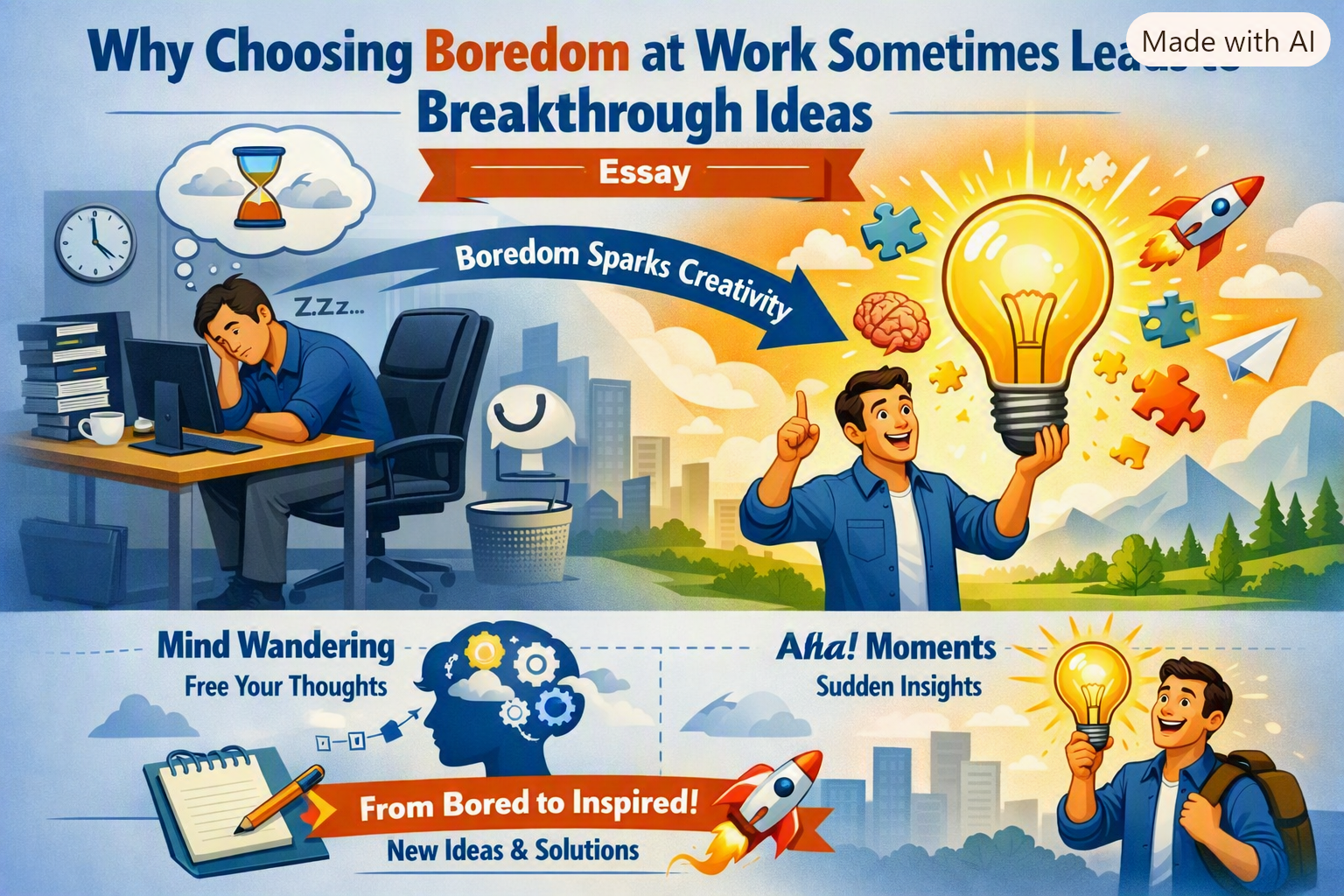
Introduction: Breakthrough Ideas
Workplace productivity is often considered a virtue, and employees are frequently encouraged to be engaged and focused on generating value. But being busy does not always mean being efficient. Sometimes, to give the mind needed rest, it is good to step back and allow oneself to be bored.
Why choosing boredom at work sometimes leads to breakthrough ideas is an important message for modern workers caught in the middle of the maelstrom of activity that typifies today’s businesses. Breaking the relentless pace allows the mind to relax and can lead to epiphanies.
Why Choosing Boredom at Work Sometimes Leads to Breakthrough Ideas Essay?
1. Constant Communication Can Suffocate Innovation
Modern workers are always connected, always engaged. Colleagues are on email, social media, and chat services, and meetings punctuate the workday, leaving little or no time to oneself. However, this sort of nonstop activity can be incredibly grueling to the mind. Having someone constantly sending messages or making requests can stifle original thinking.
Being busy also means that there is less time to stop and consider the bigger questions, leaving one racing to keep up with the next request. Boredom gives the mind a much-needed break and allows it to explore other topics and ideas. One’s thoughts can move from their usual patterns and engage in new, sometimes surprising, ways, leading to novel insights.
2. Boredom Can Lead to Curiosity, Which Can Then Generate Innovative Ideas
One of the chief signs of boredom is that the mind begins searching for something interesting to engage with. A worker who is caught in the endless cycle of communications and meetings may find that their normally fertile imagination is dulled by the effort it takes just to keep up with the workload. However, being unoccupied can lead right into the opportunity to explore and learn something new.
The employee’s thoughts may turn to a vexing problem that has lingered at the back of the mind and consider it in new ways. An idea that was previously inaccessible can begin to germinate. This fertile curiosity does not necessarily arise from a conscious decision to think about something specific: it may simply arise from the mind needing to make connections. This is why not every great idea is formed in a brainstorming session. Sometimes, inspiration finds us while we are not looking for it.
3. How to Make Time for Boredom at the Workplace
It is not necessary to make the whole workday boring, as such an approach can lead to the mind becoming numb and ideas drying up. Instead, carve out little pockets of time to yourself where you are not preoccupied with work. After completing a major task or meeting, make sure to take some time off afterward. This could include going for a walk, sitting down in a quiet room, or even just getting a drink of water while away from the office computer.
The objective is not leisure, but rather to give the mind a much-needed respite. If new ideas or potential solutions to an issue arise during this downtime, make sure to record them for later reference.
4. Boredom Can Help to Solve Problems
Sometimes problems become unsolvable due to the pressure and the mind’s need to find an immediate solution. However, when working on a challenging presentation, spreadsheet, or business proposal, stepping away to allow oneself to become bored can help to find the needed spark of inspiration to see the issue in a new light.
The mind may come up with a different way to lay out the information, streamline the process, or reorganize the material in a manner that makes more sense. It is not always necessary to work on a thorny issue from one’s desk, staring at the same sheet of paper over and over again. The solution may become obvious once the mind has had a chance to unwind, and it may be found right after the break is concluded.
5. How to Distinguish Between Productive and Counterproductive Boredom
It is also helpful to remember that there is such a thing as unproductive boredom. Letting a pressing issue slide while a major deadline is approaching will not be good for anyone. Boredom is valuable as a respite, but only after a break in the action has allowed the mind to unwind.
Like muscles that must be rested to continue providing power and endurance, the mind has limits in how much it can do. Constant overuse can lead to fatigue, which then impacts performance. A brief pause can have a surprisingly beneficial effect on the ability to function. Even a five-minute walk after spending too much time glued to a screen can make a world of difference.
6. Make Time to Be Bored and Explore New Ideas Today
It is possible to begin exploring new issues today by making little pockets of time for one’s self. Taking short walks whenever possible, eating away from the computer, and sitting at a quiet desk at the end of a workday instead of immediately heading to the next meeting can all provide opportunities for innovative ideas to develop. A little boredom goes a long way.
Why choosing boredom at work sometimes leads to breakthrough ideas is an important reminder that the mind is not always at its most creative when its busiest. While the workplace has long championed the virtues of productivity and engagement, innovation is a fickle beast that requires downtime to thrive. Making small pockets of unproductivity throughout the day can lead to major rewards.
Conclusion: Breakthrough Ideas
Choosing boredom at work does not mean avoiding productivity or ambition. Instead, it can create the mental space needed to step away from constant tasks, reflect, and explore new ideas. When employees allow themselves moments of quiet, they may notice connections, question existing approaches, and discover creative solutions. Therefore, embracing occasional boredom can be a valuable part of the creative process and may lead to breakthrough ideas that improve both individual performance and workplace innovation.
Ready to turn quiet moments at work into opportunities for creativity and growth? Explore your strengths, give yourself space to think, and discover new possibilities with the right career resources. Use the Best Job Tool platform to explore job opportunities, build your career strategy, and take the next step toward work that inspires you.




Leave a Reply