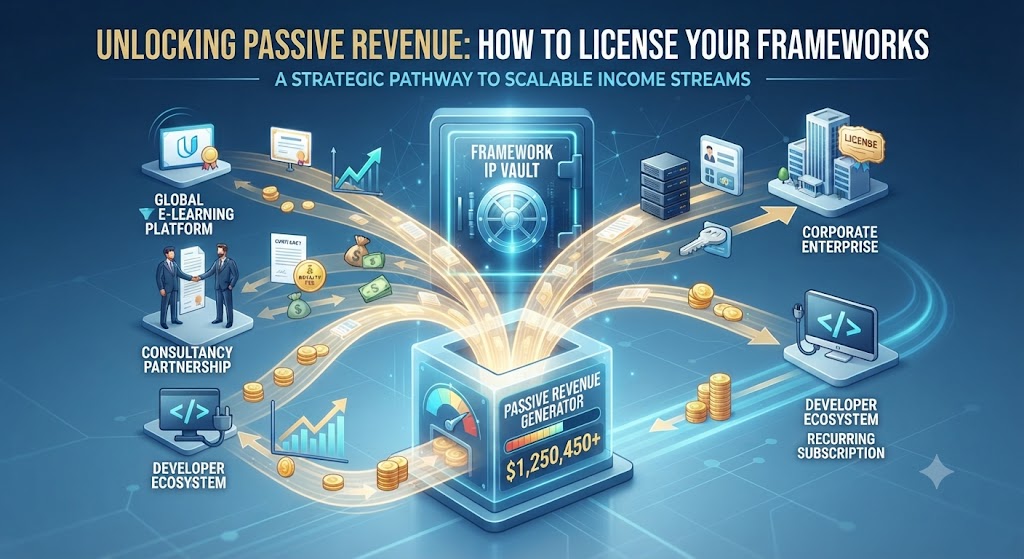
Professional experience can create valuable intellectual property. A framework you develop to solve a recurring business problem can become more than an internal process or consulting tool. With the right structure, it can potentially become a licensable asset that other professionals or organizations pay to use.Income
Frameworks can include consulting methodologies, assessment systems, training models, strategic planning processes, business tools, operational systems, educational methods, or specialized workflows. Instead of delivering every project personally, licensing allows another party to use defined parts of your intellectual property under agreed conditions.
The World Intellectual Property Organization explains that licensing allows an IP owner to authorize another party to use intellectual property while retaining ownership, with compensation potentially structured as a lump sum, recurring royalties, or both.
However, licensing should not be treated as completely passive income. A successful licensing model can reduce the amount of work required for each additional customer, but maintaining quality, monitoring usage, updating materials, and managing agreements can still require ongoing effort.
For professionals building additional income streams, this model can transform expertise into a scalable business asset. A global job platform such as best job tool can support the broader career strategy by helping professionals explore remote, hybrid, and onsite opportunities while they develop independent sources of professional income.Income
Identify a Framework That Can Be Repeated
The first step is finding a process that you already use successfully.
Think about situations where you repeatedly follow a similar sequence to solve a professional problem.
Your framework might help clients:
- Develop a business strategy
- Evaluate market opportunities
- Improve team productivity
- Plan marketing campaigns
- Assess organizational performance
- Manage projects
- Develop sales processes
- Evaluate candidates
- Plan financial operations
- Implement technology
- Improve customer experience
A framework becomes more commercially interesting when it can be explained and repeated without depending entirely on your personal involvement.
For example, a consultant might have a five-stage process for helping small businesses improve customer acquisition.
Instead of delivering that process from scratch for every client, the consultant could document the methodology, create supporting tools, establish usage guidelines, and license the system to qualified professionals.
The important question is:
“Can another trained person follow this process and achieve a reasonably consistent outcome?”
If the answer is yes, you may have the foundation of a licensable framework.
Turn Your Expertise Into Intellectual Property
Professional knowledge alone is difficult to license. It needs to be organized into something identifiable.
Start documenting the framework.
Include:
- The purpose of the methodology
- The problem it solves
- The target audience
- The stages involved
- Definitions of key concepts
- Instructions for implementation
- Templates and worksheets
- Examples
- Quality standards
- Common mistakes
- Expected outcomes
Documentation creates consistency.
It also helps you distinguish between your general Income professional knowledge and the specific methodology you are offering under license.
If your framework includes copyrightable materials, trademarks, proprietary know-how, software, or other intellectual property, determine what rights actually exist and how they should be protected. WIPO notes that licensing can cover different forms of IP and that agreements should clearly define the rights being granted.
Do not assume that every business idea or process automatically receives the same type of legal protection.
For important commercial assets, professional IP and legal advice can help determine the appropriate protection and licensing structure.
Prove the Framework Before Licensing It
A framework becomes more valuable when there is evidence that it works.
Before approaching potential licensees, test your methodology in real situations.
Document:
- The original problem
- The process used
- Implementation steps
- Measurable outcomes where appropriate
- Client feedback
- Common implementation challenges
- Improvements made over time
You do not need to reveal confidential client information.
Instead, use anonymized examples or aggregated results where appropriate.
The goal is to show that the framework is not simply a collection of theories. It is a practical system developed through experience.
This evidence can also help potential licensees understand why they should pay to use your methodology instead of creating their own.
Decide Who Should License the Framework
Not every professional or company will be the right licensee.
Your potential licensees might include:
- Consultants
- Coaches
- Training companies
- Agencies
- Professional associations
- Educational organizations
- Software companies
- Corporate training departments
- Franchise operators
- Industry specialists
Consider who already has access to the audience you want to reach.
For example, a career development framework could potentially be licensed to career coaches or professional training organizations.
A sales methodology could be licensed to sales consultants or training companies.
A workplace productivity framework could be licensed to corporate learning providers.
WIPO notes that licensees can include businesses, distributors, manufacturers, research organizations, and other entities depending on the IP and commercial arrangement.
The right partner can therefore be more valuable than simply finding the largest possible number of licensees.
Choose the Right Licensing Model
There is no single licensing model that works for every framework.
You can structure agreements around different combinations of scope, duration, territory, exclusivity, and payment.
Common approaches include:
Non-exclusive licensing
Multiple organizations can receive permission to use the framework.
Exclusive licensing
A particular licensee receives exclusive rights within a defined market, territory, or field of use.
Practitioner licensing
Qualified professionals receive permission to use your methodology with their own clients.
Corporate licensing
A company receives rights to use the framework internally across a defined organization.
Training licensing
An education or training company receives permission to incorporate the framework into courses or workshops.
Certification licensing
Qualified practitioners can be trained and authorized to deliver the methodology under defined standards.
WIPO identifies exclusive, non-exclusive, and sublicensable arrangements as possible licensing structures. The specific rights should be defined in the agreement rather than assumed.
Create a Clear Revenue Structure
Licensing revenue can be structured in several ways.
For example, you could use:
- One-time licensing fees
- Annual licensing fees
- Monthly access fees
- Per-user fees
- Per-client fees
- Revenue-sharing arrangements
- Royalties based on sales
- Certification fees
- Upfront fees plus ongoing royalties
WIPO describes licensing arrangements in which payments may include lump sums, royalties, or combinations of both.
For example, a training company might pay an initial licensing fee to access your framework and then pay an agreed royalty based on revenue generated from products using that methodology.
Another business might pay an annual fee for internal use.
The appropriate structure depends on the value of the framework, the licensee’s business model, the level of support required, and the negotiating position of both parties.
Do not choose a royalty percentage simply because another industry uses one. Licensing economics vary considerably, so commercial and legal advice may be appropriate for significant agreements.
Protect the Quality of Your Framework
Scaling a framework through licensing creates an important challenge: other people are now representing your methodology.
Poor implementation can affect your professional reputation.
Therefore, create clear quality standards. Income
Your licensing system could specify:
- Approved materials
- Training requirements
- Usage guidelines
- Branding rules
- Certification requirements
- Customer experience standards
- Reporting requirements
- Update procedures
- Prohibited uses
For example, if consultants are licensed to deliver your methodology, you may require them to complete training before using the framework commercially.
You can also provide standardized materials so that licensees do not unintentionally change the methodology.
This is especially important when your personal reputation is closely connected to the framework.
A licensing agreement can define what the licensee may do, where and for how long they may use the IP, and under what conditions.
Build a System That Requires Less Direct Delivery
The biggest advantage of licensing is scalability.
Traditional consulting often works like this:
You find a client → you deliver the work → you receive payment → you start again.
A licensing model can work differently:
You develop the framework → another professional receives usage rights → they implement it → you receive agreed compensation.
The second model can reduce your involvement in every individual customer engagement.
However, it is still important to maintain the system.
You may need to:
- Update the framework
- Train licensees
- Answer questions
- Review usage
- Monitor quality
- Manage renewals
- Track royalty reports
- Develop new materials
Therefore, think of licensing as a scalable income model rather than completely hands-off income.
Over time, strong documentation and automation can reduce the amount of ongoing work required.
Include Financial Planning Before Scaling
Licensing revenue can be irregular, particularly during the early stages.
Therefore, do not immediately depend on it for essential expenses.
Track:
- Licensing revenue
- Legal expenses
- Professional advisory costs
- Training costs
- Platform expenses
- Marketing costs
- Administrative time
- Renewal revenue
- Royalty payments
Separate business revenue from personal spending.
You should also maintain an appropriate emergency fund and avoid making major career decisions based solely on expected licensing revenue.
A practical approach is to develop the framework alongside your existing career.
Remote, hybrid, and onsite employment can provide stable income while you test whether organizations are willing to license your methodology.
A global job platform such as best job tool can support this broader strategy by helping professionals explore employment opportunities while building independent intellectual property assets.
Turn One Framework Into a Larger Intellectual Property Portfolio
A successful framework can become the foundation for additional products.
For example, one consulting methodology could eventually support:
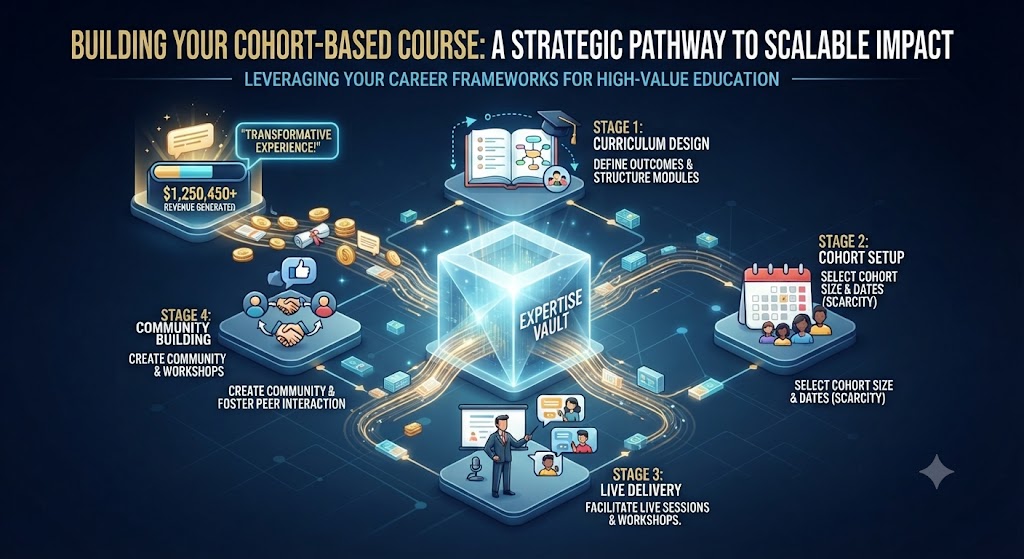
- Licensed practitioner programs
- Corporate training
- Online courses
- Certification programs
- Workbooks
- Templates
- Workshops
- Speaking engagements
- Consulting services
- Subscription resources
This creates a professional ecosystem around one core area of expertise.
You can also create different licensing packages for different audiences.
For example, an individual professional might need a basic practitioner license, while a large organization may require a broader enterprise license with multiple users and additional support.
The key is to maintain a clear connection between each product and the original methodology.
Build a Sustainable Revenue Stream From Your Expertise
Licensing professional frameworks can provide a way to monetize knowledge without personally delivering every instance of the service. The model works because you create an identifiable methodology and grant other parties defined rights to use it under agreed terms.
Start by identifying a repeatable process that solves a meaningful problem. Document it carefully, test it in real situations, collect evidence, and improve it.
Then identify potential licensees and determine which licensing structure fits your goals. Define usage rights, duration, territory, exclusivity, payment terms, quality standards, reporting requirements, and termination conditions clearly.
Most importantly, do not confuse licensing with effortless passive income. A well-designed licensing model can make revenue more scalable, but maintaining intellectual property, relationships, quality, and contracts still requires professional attention.
The best job tool approach to career development can include finding employment while simultaneously building intellectual property that creates additional opportunities.
Ultimately, the value of a professional framework is not limited to the clients you personally serve. When your knowledge can be documented, protected, taught, and licensed responsibly, it can become a long-term professional asset that generates recurring revenue while expanding the reach of your expertise.




Leave a Reply