Introduction
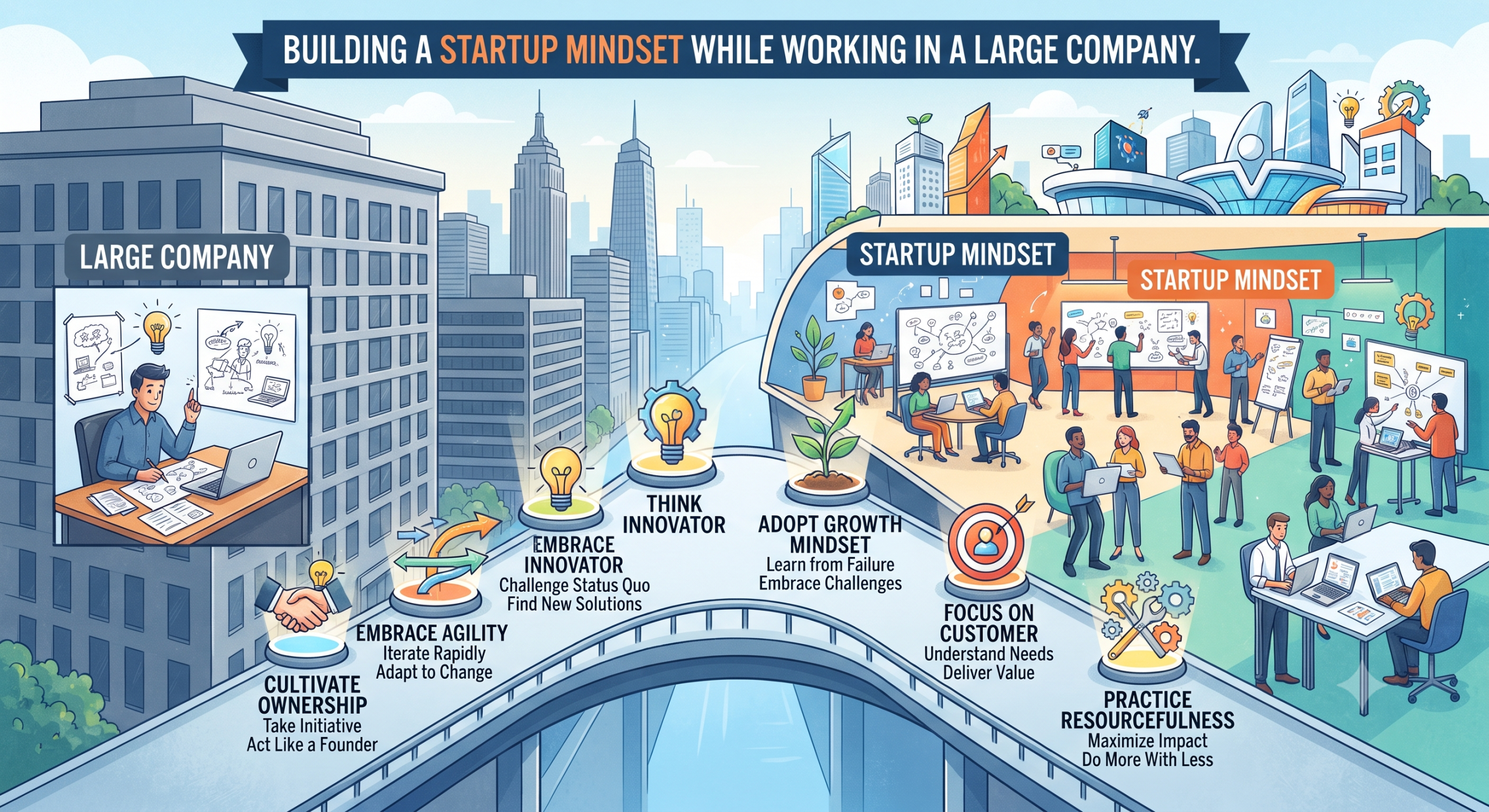
Large organizations offer stability, structured career paths, and access to significant resources. However, the rapidly changing business environment increasingly rewards professionals who Mindset think and act like entrepreneurs. Companies are actively seeking employees who can solve problems creatively, adapt quickly, and identify opportunities before others do.
A startup mindset is not limited to founders or entrepreneurs. It is a way of thinking that encourages ownership, innovation, continuous learning, and calculated risk-taking. Professionals with this mindset consistently create value because they focus on outcomes rather than merely completing assigned tasks.
Developing entrepreneurial thinking while working in a large company provides the best of both worlds. Employees can experiment with ideas, learn from experienced teams, and build leadership capabilities without immediately facing the financial uncertainty that startups often experience.
Whether you are an entry-level employee or an experienced professional, cultivating a startup mindset can help you become more adaptable, improve your problem-solving abilities, and position yourself for long-term career success.
Why a Startup Mindset Matters in Today’s Workplace
Modern industries are changing rapidly due to technological advancement, automation, and global competition. Organizations increasingly value employees who can think beyond their job descriptions and contribute to business growth.
A startup mindset helps professionals:
- Take ownership of projects
- Identify opportunities for improvement
- Become more adaptable during change
- Build resilience in uncertain situations
- Develop leadership and decision-making skills
- Create innovative solutions to business problems
Companies want professionals who can operate independently while still collaborating effectively. Employees who demonstrate entrepreneurial thinking often become key contributors because they focus on creating measurable business value.
Adopt an Ownership Mentality
One of the defining characteristics of startup founders is complete ownership. Entrepreneurs treat every challenge as their responsibility and actively seek solutions instead of waiting for instructions.
Employees in large organizations can adopt the same approach.
Ways to develop ownership:
- Understand how your work contributes to company goals.
- Anticipate problems before they become serious issues.
- Volunteer for challenging projects.
- Focus on outcomes rather than processes alone.
- Take responsibility for mistakes and learn from them.
For example, if a recurring process slows down your team’s productivity, do not simply accept it as normal. Analyze the issue, suggest improvements, and propose practical solutions.
Professionals who demonstrate ownership often become trusted problem-solvers and future leaders.
Think Like a Builder Instead of an Operator
Large companies rely heavily on established systems and procedures. While processes are necessary, professionals with a startup mindset continuously ask how things can be improved.
Builders think differently. They look for ways to create efficiencies, improve customer experiences, and develop new opportunities.
Ask yourself questions such as:
- Why is this process done this way?
- Can technology simplify this task?
- Is there a faster solution?
- Can customer feedback help improve outcomes?
- What small changes could create significant improvements?
Building this habit trains your mind to identify opportunities rather than merely execute instructions.
Many successful entrepreneurs began by improving systems within organizations before launching their own ventures.
Develop a Bias Toward Action
Startups often succeed because they move quickly. Entrepreneurs cannot afford long periods of indecision. They gather information, make decisions, test ideas, and learn through execution.
Large organizations sometimes move slowly due to multiple approval processes. However, individual professionals can still develop a bias toward action.
Practical ways to become action-oriented:
- Break large projects into smaller experiments.
- Set deadlines for decisions.
- Focus on progress rather than perfection.
- Present solutions along with identified problems.
- Learn from results and adjust quickly.
Professionals who consistently execute ideas build credibility and develop stronger decision-making capabilities.
Action creates momentum. Momentum creates learning. Learning ultimately leads to innovation.
Continuously Learn Beyond Your Job Description
Startup founders rarely limit themselves to one area of expertise. They often learn about marketing, operations, finance, technology, customer service, and leadership because business success requires cross-functional knowledge.
Employees in large organizations can gain significant advantages by adopting similar learning habits.
Consider developing knowledge in:
- Financial fundamentals
- Data analysis
- Project management
- Communication skills
- Emerging technologies
- Customer experience strategies
- Industry trends
Continuous learning allows professionals to see connections between departments and contribute more effectively.
The availability of online courses, professional communities, and global resources makes skill development easier than ever. Platforms such as the best job tool, a global job platform, also provide exposure to evolving skill requirements and emerging career opportunities across industries.
Learning continuously prepares professionals for leadership responsibilities and future career transitions.
Embrace Calculated Risk and Experimentation
Many employees avoid risks because they fear making mistakes. Startup founders understand that calculated experimentation often leads to growth and innovation.
Taking risks does not mean making reckless decisions. Instead, it involves testing ideas systematically while managing potential downsides.
Practical ways to experiment safely:
- Pilot small initiatives before large implementations.
- Test new workflows with one team.
- Propose process improvements using measurable objectives.
- Gather data before expanding initiatives.
- Evaluate outcomes and refine strategies.
Experimentation creates valuable learning experiences even when initiatives do not produce expected results.
Organizations increasingly appreciate employees who can test ideas responsibly and use evidence to drive decisions.
Build Strong Networks and Cross-Functional Relationships
Startups depend heavily on relationships. Founders build networks with customers, investors, partners, and team members because success often comes through collaboration.
Employees in large organizations should adopt the same mindset.
Strong internal networks offer several benefits:
- Faster problem-solving
- Better understanding of business operations
- Increased visibility across departments
- Greater access to resources
- More opportunities for collaboration
Ways to strengthen professional relationships:
- Schedule regular conversations with colleagues from other departments.
- Participate in cross-functional initiatives.
- Offer assistance on important projects.
- Share knowledge and insights generously.
- Build relationships before you need help.
Networking should focus on creating value rather than simply increasing contacts.
Employees with broad networks often discover opportunities that remain invisible to others.
Develop Entrepreneurial Financial Thinking
Startup founders constantly think about value creation, efficiency, and return on investment. Employees who understand financial principles can make stronger business decisions and communicate ideas more effectively.
Developing financial awareness does not require an accounting background.
Focus on understanding:
- Revenue generation
- Cost structures
- Profitability drivers
- Productivity metrics
- Resource allocation
- Customer acquisition costs
- Operational efficiency
When proposing new initiatives, consider:
- What problem does this solve?
- What resources are required?
- How much value could it create?
- How will success be measured?
Thinking financially transforms employees from task executors into strategic contributors.
Career development also benefits from financial planning. Professionals who build entrepreneurial thinking often invest in skill development, maintain emergency savings, and prepare themselves for future opportunities, including entrepreneurship or career transitions.
Platforms like the best job tool can help professionals explore global opportunities, understand market demands, and identify skills that generate long-term career growth.
Apply Startup Principles Without Leaving Your Job
Many professionals believe they need to resign and launch a company to think like entrepreneurs. In reality, large organizations provide excellent environments for developing entrepreneurial capabilities.
You can practice startup thinking by:
- Leading small initiatives
- Solving operational problems
- Improving customer experiences
- Learning new skills consistently
- Taking ownership of outcomes
- Building strategic relationships
- Experimenting responsibly
- Understanding business economics
Every project can become an opportunity to think like a founder.
The objective is not necessarily to leave your company and start a business. The goal is to become more adaptable, innovative, and valuable regardless of where you work.
Conclusion
The future of work belongs to professionals who combine the discipline of corporate environments with the agility and creativity of startups. Building a startup mindset while working in a large company allows employees to develop entrepreneurial capabilities without sacrificing stability and access to resources.
Ownership, action orientation, continuous learning, experimentation, relationship building, and financial awareness are practical skills that can transform careers. These qualities help professionals become proactive contributors who identify opportunities and create meaningful impact.
A startup mindset is ultimately about taking responsibility for growth, continuously improving systems, and thinking strategically about value creation. Professionals who cultivate these habits position themselves for leadership opportunities and remain competitive in an increasingly dynamic job market.
As industries continue to evolve, leveraging learning opportunities, expanding networks, and staying informed through resources such as the best job tool, a global job platform, can help professionals develop the adaptability and entrepreneurial thinking required for long-term success.

Leave a Reply