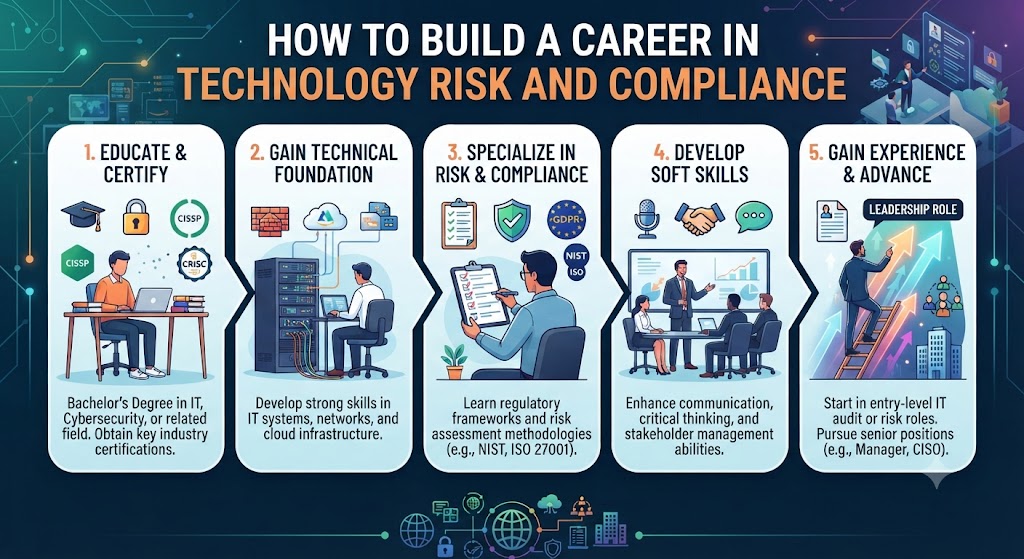
How to Build a Career in Technology Risk and Compliance
Technology risk and compliance has become a critical career field as organizations increasingly depend on cloud platforms, artificial intelligence, cybersecurity systems, digital payments, and interconnected software. Companies need professionals who can identify technology-related risks, assess controls, support regulatory compliance, and help business teams operate securely and responsibly.
Unlike many technical careers, technology risk and compliance does not always require advanced programming skills. It combines technology awareness with risk management, governance, documentation, communication, auditing, and business judgment. This makes it an attractive career path for professionals from IT support, operations, cybersecurity, finance, audit, project management, and other business functions.
The field also offers opportunities for remote and hybrid work. Professionals can often perform risk assessments, documentation reviews, control testing, policy development, and compliance monitoring remotely. With the right skills and financial planning, it can also provide flexibility for professionals interested in testing remote work while traveling.
1. Understand What Technology Risk and Compliance Professionals Do
Technology risk and compliance focuses on identifying technology-related threats and ensuring that an organization follows applicable laws, regulations, internal policies, and industry standards.
A technology risk professional may evaluate whether an organization’s systems have appropriate access controls, backup procedures, vendor safeguards, security measures, and business continuity plans. A compliance professional may determine whether those controls satisfy regulatory or contractual requirements.
Common responsibilities include:
- Conducting technology risk assessments
- Reviewing IT controls and security processes
- Supporting internal and external audits
- Monitoring regulatory requirements
- Assessing third-party technology vendors
- Maintaining compliance documentation
- Developing technology policies and procedures
- Tracking remediation activities
- Reporting risks to management
- Supporting governance and risk committees
The role sits between technology and business. You need enough technical understanding to recognize risks but also enough business knowledge to explain why those risks matter.
For example, instead of simply identifying that a company lacks multi-factor authentication, a risk professional should understand the potential consequences, such as unauthorized access, data exposure, financial loss, or regulatory penalties.
This combination of technical awareness and business communication is one of the most valuable characteristics of the profession.
2. Build the Core Skills Employers Look For
You do not need to master every cybersecurity technology to enter technology risk and compliance. However, you should develop a strong foundation in several areas.
Technology fundamentals
Start by understanding:
- Cloud computing
- Networks and infrastructure
- Databases
- Identity and access management
- Data protection
- Cybersecurity fundamentals
- Software development life cycles
- Business continuity and disaster recovery
- Third-party technology environments
You should be able to understand how technology systems work and where failures or vulnerabilities could create business risks.
Risk management
Learn how organizations identify, evaluate, prioritize, and mitigate risk.
Important concepts include risk appetite, inherent risk, residual risk, risk owners, controls, risk treatment, and remediation.
Compliance and governance
Become familiar with governance frameworks and regulatory concepts relevant to your target industry. Depending on the organization, this may include frameworks such as ISO 27001, NIST Cybersecurity Framework, SOC 2, COBIT, PCI DSS, privacy regulations, or sector-specific requirements.
You do not necessarily need certification in all of these frameworks. Instead, understand their purpose and how organizations use controls and evidence to demonstrate compliance.
Communication
Communication is often underestimated.
Technology risk professionals regularly translate technical findings into business language. A strong professional can explain:
- What the risk is
- Why it matters
- Who is responsible
- What evidence supports the finding
- What action should be taken
- How quickly remediation should occur
This makes writing, presentation, stakeholder management, and analytical thinking essential career skills.
3. Choose an Entry Route That Matches Your Existing Experience
Technology risk and compliance is accessible through multiple career paths. You do not necessarily have to start as a compliance analyst.
IT support professionals can transition by learning security controls, access management, IT governance, and audit requirements. Cybersecurity professionals can move toward governance, risk, and compliance roles by developing stronger regulatory and documentation skills.
Audit professionals can build technology knowledge, while business operations professionals can learn risk assessment and control frameworks.
Potential entry-level roles include:
- Technology Risk Analyst
- IT Risk Analyst
- GRC Analyst
- IT Compliance Analyst
- Technology Controls Analyst
- IT Auditor
- Cybersecurity Governance Analyst
- Third-Party Risk Analyst
- Risk and Controls Analyst
- Compliance Analyst
A practical transition strategy is to identify the parts of your current job that already involve risk or controls.
For example, if you work in IT support, you may already handle password resets, access requests, ticket approvals, system permissions, and troubleshooting. These activities can become a foundation for understanding access controls and IT governance.
Document these experiences on your resume using business outcomes rather than only technical tasks.
4. Develop a Career Portfolio Instead of Relying Only on Certifications
Certifications can strengthen your profile, but practical evidence of your skills can be equally important, particularly when you are changing careers.
Create small projects that demonstrate your understanding of technology risk and compliance.
For example, develop a sample:
- IT risk assessment
- Vendor risk questionnaire
- Access-control review
- Business continuity checklist
- Security policy
- Risk register
- Control-testing worksheet
- Compliance gap analysis
You can build a fictional case study around a hypothetical company.
For instance, imagine a growing SaaS company moving its customer database to the cloud. Analyze potential risks involving access control, data protection, vendor dependency, backup procedures, and incident response. Then create a risk register showing the risk, likelihood, impact, existing controls, recommended action, owner, and priority.
This gives you something concrete to discuss during interviews.
Certifications can then complement this practical foundation. Depending on your career direction, you may explore credentials related to information security, IT auditing, risk management, privacy, cloud security, or governance.
The goal should not be collecting certificates. The goal is demonstrating that you can apply risk and compliance concepts to realistic business situations.
5. Target Remote Technology Risk and Compliance Opportunities Strategically
Technology risk and compliance can be particularly compatible with remote work because many responsibilities are documentation-, analysis-, and meeting-based.
Remote professionals may conduct control reviews, prepare audit evidence, analyze risk registers, review vendor documentation, participate in compliance meetings, and track remediation through collaboration platforms.
However, remote work requires more than technical competence.
Build a remote-ready workflow
Create a system for:
- Managing deadlines across multiple projects
- Maintaining audit evidence
- Tracking open risks
- Documenting decisions
- Scheduling stakeholder meetings
- Protecting confidential information
- Communicating progress proactively
Remote risk professionals also need strong documentation habits because informal conversations cannot replace a reliable audit trail.
If you are exploring international or remote opportunities, platforms such as BestJobTool, a global job platform, can be incorporated into your job-search strategy alongside company career pages and professional networks.
When searching for remote positions, use targeted terms such as:
- Remote GRC Analyst
- Remote IT Risk Analyst
- Technology Compliance Analyst
- Remote IT Auditor
- Third-Party Risk Analyst
- Cybersecurity Governance Analyst
Do not apply only to jobs labeled “remote.” Some organizations use hybrid or distributed-work terminology, so broaden your search vocabulary.
6. Test Remote Work and Travel Without Putting Your Career or Finances at Risk
Technology risk and compliance can potentially support location flexibility, but professionals should not assume that every remote role permits international travel.
Before working while traveling, verify your employer’s policies regarding:
- International remote work
- Data access outside your home country
- VPN requirements
- Confidential information
- Tax residency
- Immigration restrictions
- Working hours
- Client-location requirements
- Security policies
A travel test is a better approach than immediately committing to long-term digital nomadism.
Start with a short trip while maintaining your normal working schedule. Evaluate whether you can maintain productivity, stable internet access, appropriate workspace conditions, and secure access to company systems.
A practical travel test
Before leaving:
- Confirm that international work is permitted.
- Test your laptop, VPN, authentication, and collaboration tools.
- Establish a reliable backup internet option.
- Calculate additional travel and accommodation costs.
- Maintain your normal working hours.
- Avoid accessing sensitive systems from unsecured public networks.
- Review performance after the trip.
The purpose is not simply to determine whether you can travel while working. It is to determine whether you can maintain professional standards while traveling.
7. Plan Your Long-Term Career, Productivity, and Finances
Technology risk and compliance can lead to several career directions as your experience increases.
You might progress from analyst-level positions into:
Analyst → Senior Analyst → Risk Manager → Technology Risk Director → Head of GRC
Alternatively, you could specialize in areas such as third-party risk, cloud compliance, privacy, cybersecurity governance, technology audit, regulatory compliance, or AI governance.
Your specialization should reflect both market demand and your interests.
Build a productivity system
Risk professionals often manage multiple assessments and deadlines simultaneously. A simple system can prevent missed commitments.
Maintain a central tracker containing:
- Project name
- Risk or control area
- Stakeholder
- Deadline
- Current status
- Required evidence
- Outstanding questions
- Next action
Reserve focused blocks of time for analysis and documentation rather than allowing meetings to consume the entire working day.
Build a financial safety net
Career transitions and remote-work experiments become easier when your finances are planned.
Before changing roles or testing extended travel, calculate:
- Monthly essential expenses
- Emergency savings
- Travel costs
- Accommodation
- Internet and equipment
- Insurance
- Taxes
- Professional development expenses
Avoid assuming that a higher salary automatically creates financial flexibility. Location changes can increase costs, particularly when accommodation and travel are involved.
A stable emergency fund gives you more freedom to pursue career opportunities without making decisions under financial pressure.
For job discovery, best job tool can also be part of a broader strategy for finding global opportunities, particularly when your target roles involve remote or internationally distributed teams.
Conclusion
Building a career in technology risk and compliance requires a combination of technology knowledge, risk management, governance awareness, communication, and practical problem-solving. The field is particularly suitable for professionals who want to remain connected to technology without spending every day writing code.
The most effective approach is to build progressively. Learn technology fundamentals, understand risk and control frameworks, create practical projects, identify transferable experience, and target entry-level GRC, risk, audit, and compliance positions.
Remote work can add another dimension to the career, but flexibility should be tested responsibly. Short travel experiments, secure working practices, productivity systems, and financial planning can help determine whether a location-flexible career is sustainable.
As organizations continue to depend on digital infrastructure, cloud services, artificial intelligence, and third-party technology providers, the ability to identify and manage technology risk will remain valuable. Professionals who combine technical awareness with strong business judgment can build a durable career while maintaining opportunities for remote work and long-term professional growth.

Leave a Reply