Healthcare is becoming increasingly data-driven. Hospitals, clinics, pharmaceutical companies, insurance providers, research organizations, and digital health companies rely on data to improve patient outcomes, manage costs, monitor quality, and make operational decisions. As healthcare systems generate more information, professionals who can Clinical organize, analyze, and interpret healthcare data are becoming increasingly valuable.
This growth has created several career options in healthcare data and clinical analytics. Importantly, not every healthcare analytics role requires a medical degree or advanced programming skills. Professionals with backgrounds in data analysis, healthcare administration, business, statistics, information technology, finance, and operations can build careers in this field by developing the right combination of analytical and healthcare knowledge.
Healthcare analytics also offers opportunities across hospitals, technology companies, research organizations, insurance businesses, and remote teams. However, professionals must understand data privacy, regulatory requirements, accuracy, and ethical considerations before working with sensitive healthcare information.
Whether you are transitioning from another analytics role or starting your career, understanding the different healthcare data career paths can help you choose the right specialization and develop a practical career plan.
1. Understand What Healthcare Data and Clinical Analytics Involve
Healthcare analytics is the process of using healthcare-related data to identify trends, measure performance, support decisions, and improve outcomes.
Healthcare data can include:
- Patient records
- Treatment information
- Laboratory results
- Hospital operations
- Claims data
- Medication information
- Clinical research data
- Appointment records
- Patient satisfaction data
- Financial and billing information
Clinical analytics has a more specific focus on information related to patient care and clinical outcomes.
For example, a clinical analytics team may analyze readmission rates to identify patterns associated with patients returning to a hospital after discharge.
Healthcare operations analysts may instead analyze appointment scheduling, staffing levels, patient wait times, or resource utilization.
This means healthcare analytics is not one single profession. It includes multiple career paths with different responsibilities.
The strongest professionals understand both what the data says and why it matters to healthcare organizations.
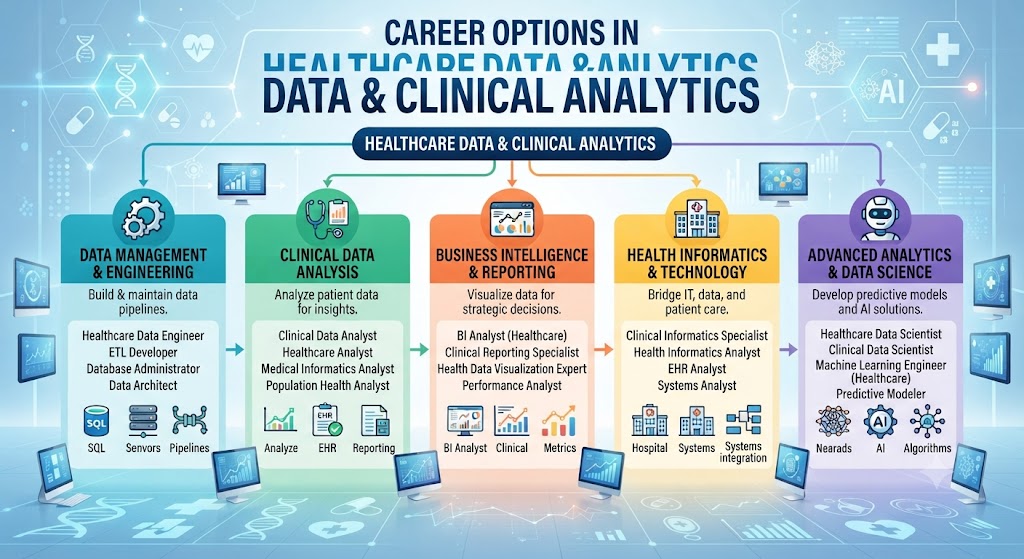
2. Explore the Major Healthcare Data Career Paths
Before developing skills, determine which type of healthcare analytics interests you most.
Healthcare Data Analyst
Healthcare data analysts collect, clean, analyze, and present healthcare information. They may create reports and dashboards for hospitals, insurers, healthcare companies, or public health organizations.
Common responsibilities include:
- Data cleaning
- Reporting
- KPI analysis
- Dashboard development
- Trend identification
- Performance measurement
- Stakeholder reporting
Clinical Data Analyst
Clinical data analysts work more closely with patient-care and clinical information.
They may analyze:
- Clinical outcomes
- Treatment patterns
- Patient populations
- Readmission rates
- Quality measures
- Clinical performance
This career can be particularly suitable for professionals interested in the intersection of healthcare and data.
Health Informatics Analyst
Health informatics combines healthcare, information systems, and data.
Professionals may work with electronic health records, healthcare applications, clinical workflows, and information systems.
Healthcare Business Intelligence Analyst
BI professionals in healthcare build dashboards and reporting systems that help organizations monitor financial, operational, and clinical performance.
Healthcare Data Scientist
Data scientists use advanced statistical and machine-learning techniques to solve complex healthcare problems.
This path typically requires stronger programming, statistics, and mathematical skills.
Healthcare Operations Analyst
Operations analysts focus on improving the efficiency of healthcare organizations.
They may analyze:
- Patient flow
- Staffing
- Scheduling
- Capacity
- Resource utilization
- Wait times
Other career options include:
- Healthcare reporting analyst
- Clinical research analyst
- Healthcare quality analyst
- Population health analyst
- Healthcare informatics specialist
- Healthcare BI developer
- Healthcare analytics consultant
Understanding these options helps you identify the skills you need rather than learning technologies without a clear career direction.
3. Build the Essential Healthcare Analytics Skills
A healthcare analytics career requires a combination of technical, analytical, and healthcare knowledge.
Start with data fundamentals.
You should understand:
- Data cleaning
- Data validation
- Descriptive statistics
- Trend analysis
- Data visualization
- KPI development
- Spreadsheet analysis
- Basic database concepts
Excel remains useful for many healthcare reporting tasks, particularly for smaller datasets and operational analysis.
Next, learn SQL.
SQL allows analysts to retrieve information from databases and is particularly valuable when working with large healthcare datasets.
Focus initially on:
- SELECT
- WHERE
- GROUP BY
- ORDER BY
- JOIN
- CASE
- Aggregate functions
- Subqueries
Then develop visualization skills using tools such as Power BI or Tableau.
You should be able to transform complex information into dashboards that healthcare managers can understand quickly.
Develop healthcare knowledge
Technical skills alone are not enough.
Learn basic concepts such as:
- Healthcare workflows
- Clinical terminology
- Healthcare quality measures
- Patient outcomes
- Claims
- Healthcare operations
- Electronic health records
- Data governance
- Privacy and security
You do not necessarily need to become a clinician. However, understanding the environment in which the data is generated will improve your analysis.
4. Learn Healthcare Data Privacy and Compliance
Healthcare data requires a higher level of responsibility because it can contain highly sensitive personal information.
Professionals working with healthcare data need to understand applicable privacy, security, and organizational requirements.
Depending on the country and organization, this can involve healthcare privacy laws, security standards, contractual requirements, and internal data-governance policies.
Learn the principles of:
- Data minimization
- Access control
- Secure data handling
- Data anonymization
- Audit trails
- Data governance
- Confidentiality
- Appropriate data sharing
You should never use real patient information in a personal portfolio.
Instead, use public, anonymized, synthetic, or fictional datasets.
This is particularly important when creating projects for job applications.
A strong healthcare analytics professional understands that data accuracy and confidentiality are just as important as analytical ability.
5. Build a Healthcare Analytics Portfolio
If you are entering healthcare analytics without direct industry experience, portfolio projects can demonstrate your capabilities.
Choose projects that solve realistic healthcare problems.
Hospital readmission analysis
Analyze a public or synthetic dataset to investigate:
- Readmission patterns
- Patient demographics
- Length of stay
- Risk factors
- Department-level differences
Then create a dashboard and explain potential operational implications.
Hospital operations dashboard
Build a dashboard showing:
- Patient volume
- Average wait time
- Bed utilization
- Appointment volume
- Staff utilization
The objective is to identify potential operational bottlenecks.
Healthcare claims analysis
Use an appropriate public or synthetic dataset to examine:
- Claim volume
- Cost trends
- Service categories
- Geographic patterns
- Utilization
For each project, explain:
Business Problem → Dataset → Method → Finding → Recommendation
Do not simply show a Power BI dashboard.
Explain what decision the dashboard could support.
For example:
“If appointment cancellations are significantly higher during certain time periods, the organization could evaluate reminder systems, scheduling practices, or staffing requirements.”
This demonstrates business thinking.
6. Target Healthcare Analytics Jobs and Remote Opportunities
Once you have developed foundational skills, begin targeting healthcare analytics jobs that match your experience.
Potential job titles include:
- Healthcare Data Analyst
- Clinical Data Analyst
- Healthcare BI Analyst
- Health Informatics Analyst
- Healthcare Reporting Analyst
- Healthcare Operations Analyst
- Clinical Research Analyst
- Healthcare Quality Analyst
- Population Health Analyst
- Healthcare Analytics Consultant
Read job descriptions carefully.
Some positions may prioritize healthcare knowledge, while others focus more heavily on SQL, dashboards, statistics, or business intelligence.
If you already have analytics experience outside healthcare, emphasize transferable skills.
For example, experience analyzing customer or operational data can demonstrate:
- Data cleaning
- Dashboard development
- KPI analysis
- Reporting
- Stakeholder communication
- Trend identification
Then supplement this experience with healthcare-specific knowledge.
For professionals searching for international remote opportunities, best job tool, a global job platform, can be part of a broader strategy alongside company career pages, LinkedIn, professional networks, and referrals.
However, verify location requirements carefully. Healthcare organizations may have strict restrictions concerning where sensitive data can be accessed.
7. Build a Sustainable Remote Career With Travel, Productivity, and Financial Planning
Healthcare analytics can include remote positions, particularly in reporting, business intelligence, research, data analysis, and certain informatics functions.
However, remote healthcare work can involve additional security requirements.
Before working remotely, understand:
- Data-access policies
- Device-security requirements
- VPN requirements
- Authentication procedures
- Confidentiality rules
- Employer location restrictions
- Working-hour requirements
Test remote work before traveling
If you want to combine healthcare analytics with travel, do not assume that a remote position permits international work.
Before traveling:
- Obtain confirmation from your employer.
- Verify whether international access is permitted.
- Confirm data-security requirements.
- Test your internet connection.
- Establish a private workspace.
- Prepare backup connectivity.
- Confirm time-zone expectations.
A short travel test can help determine whether you can maintain professional productivity while away from your usual workspace.
Never access sensitive healthcare information through unsecured public networks or unauthorized devices.
Maintain a productivity system
Healthcare analysts may manage recurring reports, data requests, dashboard updates, quality metrics, and stakeholder deadlines.
Use a centralized tracker for:
- Data requests
- Reporting deadlines
- Dashboard updates
- Data-quality issues
- Stakeholder questions
- Analysis status
Document assumptions and methodologies so that other team members can understand your work.
Plan your finances
Career transitions can involve costs for education, certifications, software, equipment, or specialized training.
Create a budget covering:
- Monthly expenses
- Education
- Certifications
- Equipment
- Internet
- Insurance
- Taxes
- Travel
- Emergency savings
If you plan to transition from another analytics career into healthcare analytics, avoid making the move based solely on expected salary growth. Evaluate the complete career opportunity, including skill development, stability, specialization, and long-term progression.
As you gain experience, best job tool can help you identify global job opportunities while your professional network and healthcare-specific portfolio continue to grow.
Conclusion
Healthcare data and clinical analytics offer diverse career options for professionals who want to combine analytical skills with the healthcare industry. You can pursue roles in healthcare data analysis, clinical analytics, health informatics, business intelligence, healthcare operations, quality analysis, population health, and eventually advanced data science.
The best way to enter the field is to build your skills progressively. Strengthen Excel and data analysis fundamentals, learn SQL and visualization, develop statistical knowledge, and understand healthcare workflows and data governance.
Practical projects can help bridge the experience gap. Build dashboards and case studies using public, anonymized, synthetic, or fictional datasets. Focus on realistic healthcare questions and demonstrate how your findings could support better decisions.
Remote healthcare analytics can provide flexibility, but privacy and security requirements must remain a priority. Before combining remote work with travel, confirm employer policies, test your working environment, and ensure that sensitive data remains protected.
Finally, approach career development as a long-term investment. Continue building healthcare knowledge, strengthen your technical skills, develop a specialized portfolio, maintain productivity systems, and plan your finances carefully.
For professionals who enjoy working with data and want to contribute to better healthcare decisions without necessarily becoming clinicians, healthcare data and clinical analytics can offer a practical, flexible, and increasingly valuable career path.


Leave a Reply