Introduction: Listening Skills
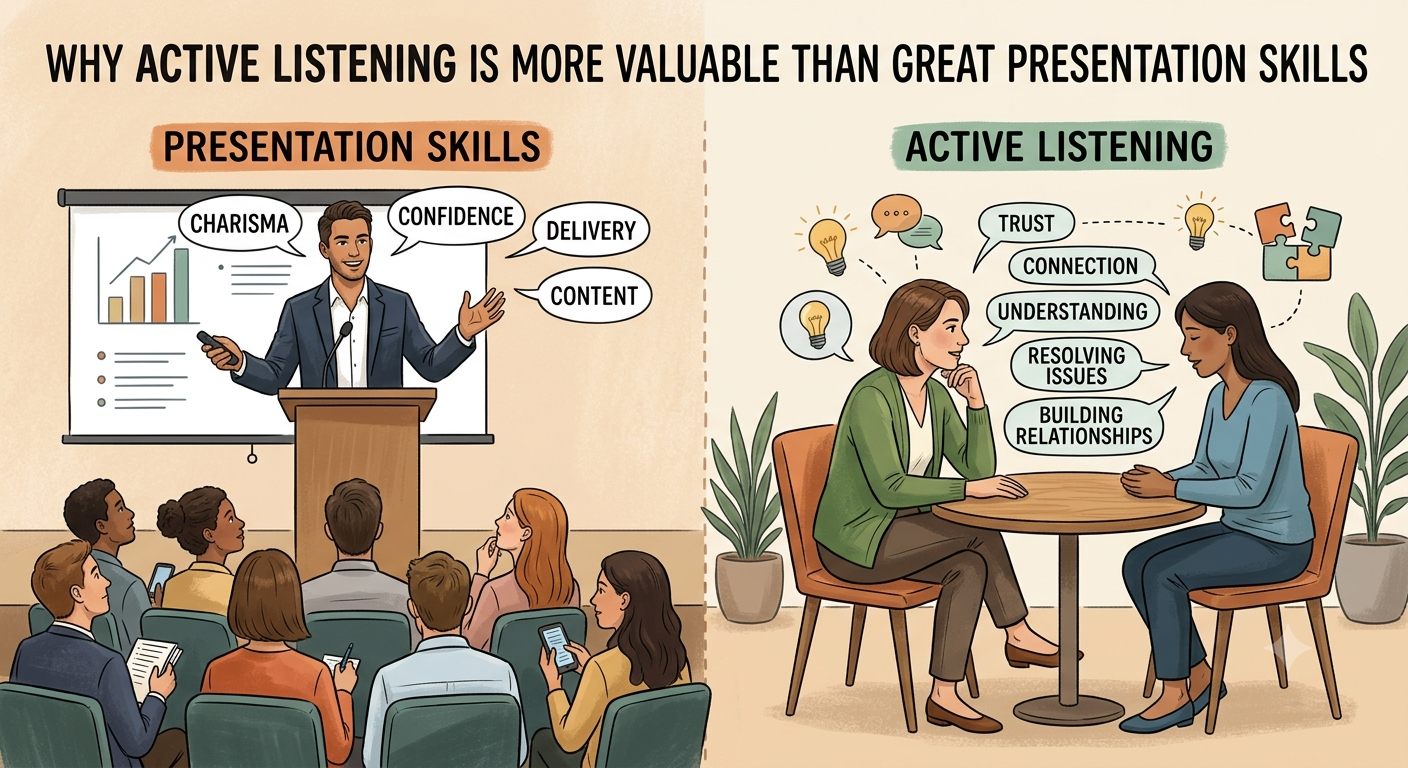
For most workers, excellent communication skills are essential to perform their job duties effectively. They should be able to express their ideas, describe their work, and present their opinions clearly and convincingly. It makes sense to focus on improving presentation skills since they are vital for job interviews, meetings with clients, conferences, and other important events. Strong listening skills help professionals understand what others are trying to communicate instead of focusing only on how they respond.
However, not all aspects of communication are related to speaking or writing. To effectively convey one’s message, a person needs to understand the audience. That is why active listening is more valuable than presentation skills because it allows people to comprehend others’ needs, requirements, and expectations.
Why Listening Is More Valuable Than Presentation Skills?
1. Presentation Skills Can Help You Present Your Ideas
Good presentation skills can make a professional competent and convincing in front of others. An effective presentation can help relay complex information, explain subtle details, and persuade the audience in general. That is why workers should practice delivering presentations regularly and perfecting this vital communication skill. For example, employees may need to demonstrate their marketing plan to the management and convince the executives that it is the best option available.
Although it is important to deliver the presentation well in order to appear competent and persuasive, workers should also pay attention to their audience. They should listen to the questions and comments that the listeners (e.g., executive management) are going to ask in order to address their concerns and doubts.
2. Active Listening Allows You to Better Comprehend the Speakers
Listening to someone does not mean waiting for your turn to talk. Active listening includes understanding the speakers’ ideas, concerns, and intentions. This communication skill is vital in the workplace because it helps avoid misinterpretation and unnecessary disputes. For example, when a manager criticizes the employee’s work, the latter can first repeat the key points in order to see what exactly the critique is about. Effective listening skills allow employees to understand instructions, feedback, and concerns more accurately.
When delivering feedback, many leaders and managers tend to list multiple concerns and demands. For example, a manager can give instructions to an employee, pointing out several issues that the worker should adjust. When such a person tries to explain their position, they may fail to relay the details accurately under pressure and convey the wrong information.
3. Listening Enables You to Understand What Others Really Need
Many individuals fail to clearly articulate their problems, concerns, and demands. For example, a client may voice their dissatisfaction with the marketing company’s performance. However, the actual reason for this discontent may be that the company has failed to understand the target audience. Similarly, a manager may express their concern with the quality of a particular report, but the underlying issue may be that the information presented is incomplete.
Active listening enables professionals to learn the true problems and goals of others. Instead of trying to guess the interlocutor’s intention, it is better to ask specific questions in order to fully comprehend their position. This approach can also help avoid misunderstanding: for example, a manager can ask their employee to explain in detail what exactly they should be concerned with. This way, the two sides will share a common understanding of the issues at hand. Strong listening skills can help professionals identify the real problem instead of responding only to the information presented on the surface.
4. Active Listening Enables You to Build Better Relationships With Others
Most people feel reassured and understood when they can relay their position confidently and know that they are understood correctly. Workers should demonstrate active listening to their colleagues, managers, and subordinates in order to respect their opinions, needs, and concerns. Good listening skills also show colleagues that their opinions and concerns are valued.
For example, when having a conversation with a colleague, an employee should express their position clearly in order to be understood by the interlocutor. However, they should also listen to the other person’s opinion in order to see it from their perspective. Even if they do not accept the colleague’s stance, it is essential to acknowledge and respect it. Doing so will ensure better understanding on both sides and help avoid disagreements.
By constantly interrupting others and insisting on one’s own ideas, a person may become disliked by their colleagues and subordinates. That is why it is important to practice active listening in order to preserve positive relationships with everyone in the workplace.
5. Listening Is Needed to Understand the General Idea of a Meeting
Sometimes, meetings can be unproductive since the attendees have different demands, expectations, and priorities. A worker with strong presentation skills will be able to convey their idea to others clearly. Meanwhile, active listening can help understand each side’s stance, the common concerns, and how these demands can be unified.
During a conversation, an active listener focuses on the ideas, arguments, and questions that the interlocutors are raising. When engaged in a group discussion, a person may notice that some of the participants are talking about the same general subject. Furthermore, an active listener can also discover unaddressed concerns and spot unfulfilled demands.
By having these communication skills, a person can have a comprehensive understanding of their audience and deliver a presentation that addresses multiple issues. In this way, listening skills help employees understand different perspectives and contribute more meaningfully to workplace discussions.
6. Active Listening Enables You to Become a Better Leader
Any manager should be able to explain their demands clearly in order to guide the employees toward achieving the company’s goals. However, the same managers should also be aware of the needs and expectations of their staff. An executive leader who fails to consider their workers’ opinions cannot be successful. Furthermore, constant interruptions in the middle of a conversation by a superior may be disheartening for an employee.
That is why it is important for leaders and managers to practice this crucial communication skill. Doing so will help them understand their staff, address their concerns, and accommodate their demands.
For example, a superior can ask their employees for the issues that they experience when trying to perform their work duties. The things that the workers point out will serve as a reference for the manager’s subsequent recommendations and actions. In this case, listening to the audience can help address some of the problems.
7. Listening Lets You Improve Your Presentations Tool
Interestingly, active listening does not cancel out the importance of presentation skills. Actually, the two communication skills complement each other.
By listening to one’s audience, a person can better understand their concerns and questions. For example, when a presenter sees that the listeners are asking the same questions over and over again, they can recognize the common concerns and address them in the future presentations.
In this way, an active listener can become a better presenter too.
8. How to Practice Active Listening Skills?
Like any other skill, active listening can be trained. Developing better listening skills requires consistent practice and conscious attention during conversations. People can start practicing it by avoiding interruptions and letting the interlocutors finish their sentences. Furthermore, a person should ask questions or seek clarification rather than guess the meaning of what they just heard.
Before responding to the interlocutor, a worker should make sure that they have understood the speaker correctly. They can request a repetition of the key points and even repeat some of the most important ideas back to the speaker. An active listener should also avoid planning their response while the interlocutor is speaking.
Conclusion: Listening Skills
Presentation skills appear to be more important to most people, including hiring managers and recruiters. However, active listening is vital to comprehend the interlocutor’s needs, questions, and concerns. That is why listening is more valuable than presentation skills because it allows a person to understand others.
It is possible to be a competent speaker without possessing strong listening skills. However, it is impossible to be an active listener without presentation skills. People who can deliver their ideas clearly and convincingly are more likely to be effective communicators.
After all, the best speakers do not speak at all. Ultimately, strong listening skills can make communication more meaningful because they help people understand before they respond.
Want to strengthen your communication skills and become more effective at work? Explore the best job tools and career resources to improve your active listening, presentation, and workplace communication skills. Start building the skills that can help you stand out and grow your career.





Leave a Reply