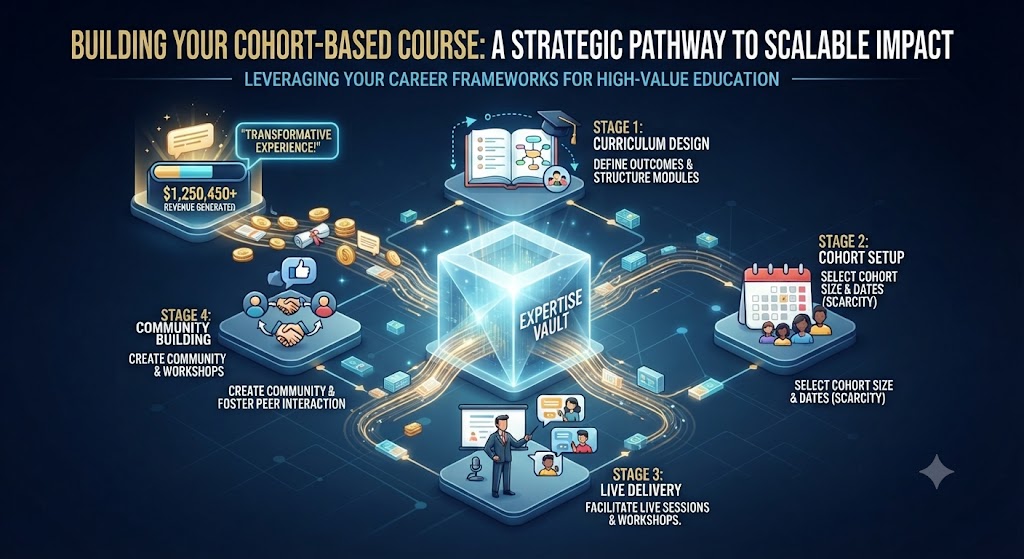
Your professional experience can become a valuable educational product when it is organized around a clear outcome. A cohort-based course is one way to turn career expertise into a structured learning experience where a group of participants learns together over a defined period.
Unlike a self-paced course, a cohort-based course creates a shared schedule. Participants attend sessions, complete assignments, discuss challenges, and interact with instructors and peers. As a result, the learning experience can feel more interactive and accountable.
For professionals, this model can create opportunities beyond traditional employment. It can support personal branding, consulting, speaking, coaching, and additional income. However, a successful cohort requires more than simply recording presentations. It needs a clear audience, practical curriculum, strong communication, and an organized delivery system.
A global job platform such as best job tool can complement this strategy by helping professionals explore remote, hybrid, and onsite opportunities while they build independent educational products around their expertise.
Choose a Specific Skill You Can Teach
The first step is identifying the expertise that can become a useful learning outcome.
Your professional knowledge may cover a large area, but your course should focus on one specific transformation.
For example:
- A marketer could teach professionals how to build a B2B content strategy.
- A recruiter could teach structured interview techniques.
- A project manager could teach practical project planning.
- A sales professional could teach enterprise prospecting.
- A financial professional could teach business financial analysis.
- A designer could teach portfolio development for career transitions.
Avoid building a course simply because you have experience in a particular field.
Instead, ask:
“What can participants realistically learn or accomplish by the end of this program?”
The answer should be measurable.
Participants might finish the course with a completed portfolio, marketing plan, project proposal, sales strategy, financial model, or career development plan.
A clear outcome makes the course easier to design and easier to market.
Define the Right Participant
A cohort works best when participants have something meaningful in common.
Your audience could be:
- Recent graduates
- Career changers
- Junior professionals
- Mid-career specialists
- New managers
- Freelancers
- Entrepreneurs
- Industry professionals learning a new skill
Avoid trying to serve everyone.
For example, “Learn Digital Marketing” is too broad for a focused cohort. A stronger concept could be “B2B Content Marketing for Early-Career Marketers.”
This narrower positioning allows you to understand participant needs more clearly.
Before creating the curriculum, talk to potential learners.
Ask them:
- What are you struggling with?
- What have you already tried?
- What would you like to accomplish?
- What prevents you from reaching that goal?
- How much time can you realistically dedicate each week?
Their answers can help you design a course around real needs rather than assumptions.
Design a Cohort-Based Curriculum
Once the outcome is clear, divide the learning experience into manageable stages.
Each week should have a clear objective.
Participants should know what they ned to learn, what they need to complete, and what they should be able to do afterward.
Include a mixture of:
- Live teaching
- Practical assignments
- Group discussions
- Peer feedback
- Case studies
- Templates
- Q&A sessions
- Final projects
This structure creates accountability.
It also prevents the course from becoming a series of long lectures.
Build Around Practical Projects
Professional learners often want to apply knowledge immediately.
Therefore, design the cohort around a project rather than only information.
For example, participants in a marketing cohort could build a complete campaign strategy. Participants in a project management cohort could develop a project plan. Career-focused learners could create a professional portfolio.
A project-based structure can follow this sequence:
- Learn a concept
- Apply it to a real problem
- Receive feedback
- Improve the work
- Present the final result
This approach allows participants to leave with something tangible.
It also gives you an opportunity to demonstrate the practical value of your expertise.
If participants can show their completed work to an employer, client, or professional network, the course becomes more useful beyond the classroom.
Create a Strong Live Learning Experience
Live interaction is one of the major differences between a cohort-based course and a self-paced program.
However, live sessions should not become long presentations.
Break sessions into different activities.
For example:
- 15 minutes of teaching
- 15 minutes of demonstration
- 20 minutes of practical work
- 15 minutes of discussion
- 10 minutes of Q&A
- 5 minutes of assignment briefing
The exact structure can vary.
Encourage participants to ask questions and share experiences. However, maintain clear boundaries so that one participant does not dominate every conversation.
You can also use smaller discussion groups when the cohort is large.
For remote cohorts, technology preparation is essential. Test your camera, microphone, internet connection, screen-sharing setup, and backup connectivity before every important session.
If you plan to teach while traveling, conduct travel testing beforehand. Confirm that your workspace is quiet enough, your internet is stable, and your time zone works for participants.
Create Accountability Between Sessions
A cohort becomes more valuable when participants continue working between live sessions.
Give them manageable assignments rather than excessive homework.
For example:
- Complete one worksheet
- Apply one framework
- Analyze one case study
- Prepare one presentation
- Submit one project milestone
- Review another participant’s work
Use deadlines to maintain momentum.
You can also create a shared progress system where participants can see upcoming milestones and expectations.
Accountability can come from several sources:
- Instructor feedback
- Peer review
- Group discussions
- Weekly check-ins
- Progress tracking
- Final presentations
However, avoid creating unnecessary pressure.
The objective is to help participants maintain consistent progress while balancing their professional responsibilities.
Price the Course Around Value and Delivery
Pricing should reflect the learning experience rather than simply the number of hours you spend teaching.
A cohort-based course may include live instruction, feedback, resources, community access, and personalized guidance. Therefore, its pricing can differ from a self-paced digital course.
Before setting a price, calculate your costs.
Consider:
- Teaching time
- Curriculum development
- Platform fees
- Marketing
- Administrative work
- Guest speakers
- Course materials
- Technology
- Customer support
Then consider the value of the outcome.
For example, a course helping professionals develop a specialized business skill may have a different value proposition from a general introductory course.
You can also start with a smaller pilot cohort.
A pilot allows you to test the curriculum, gather feedback, identify weak sections, and improve the experience before expanding.
This reduces the risk of investing heavily before you understand what participants actually need.
Build a Community Around the Cohort
A strong cohort can create relationships that continue after the course ends.
Participants may help each other with:
- Career opportunities
- Professional introductions
- Industry knowledge
- Projects
- Freelance work
- Business ideas
- Skill development
Therefore, consider creating a private community where participants can continue interacting.
The community could include:
- Monthly discussions
- Alumni sessions
- Expert Q&As
- Networking events
- Resource sharing
- New workshops
This can also create additional revenue opportunities.
For example, successful alumni may later purchase advanced courses, workshops, memberships, or consulting services.
However, the community should continue providing genuine value rather than becoming a constant sales channel.
Connect the Course With Your Career Strategy
A cohort-based course can strengthen your professional reputation because teaching demonstrates expertise.
Your course can become evidence that you can:
- Explain complex ideas
- Lead groups
- Develop educational material
- Communicate clearly
- Provide professional feedback
- Solve practical problems
- Build communities
These capabilities can support career transitions and independent work.
You can also repurpose lessons into professional content.
For example, one cohort session could become:
- A LinkedIn article
- A newsletter
- A webinar
- A short video
- A professional checklist
- A downloadable guide
This creates a content system around your expertise.
At the same time, continue developing your primary career. A global job platform such as best job tool can help you explore relevant remote, hybrid, and onsite opportunities while your educational business grows.
Plan the Financial Side Carefully
A cohort-based course can generate meaningful revenue, but income is usually tied to enrollment cycles.
Therefore, financial planning is important.
Track:
- Enrollment revenue
- Platform expenses
- Marketing costs
- Payment processing
- Teaching hours
- Contractor costs
- Refunds
- Administrative expenses
Calculate the actual profit from each cohort.
You should also maintain a financial buffer because enrollment can vary between cohorts.
If the first cohort produces strong results, avoid immediately increasing expenses. Instead, reinvest carefully in areas that improve the participant experience or make future delivery more efficient.
You can eventually introduce multiple levels.
For example:
- Standard cohort
- Premium cohort with additional feedback
- Advanced program
- Alumni membership
- Corporate training
This allows your expertise to support multiple revenue streams without forcing every participant into the same product.
Turn Your Expertise Into a Repeatable Learning Business
Building a cohort-based course starts with knowledge, but successful delivery depends on structure.
Choose a specific skill, define the participant, establish a measurable outcome, and design a curriculum that moves learners toward that result.
Then make the experience practical through projects, feedback, peer interaction, and accountability.
Start with a small pilot rather than trying to build a large educational business immediately. Learn from participants, improve the curriculum, and document the process.
Over time, your cohort can become part of a broader professional ecosystem that includes courses, workshops, consulting, speaking, digital products, and community programs.
The best job tool approach to career development can include traditional employment alongside independent professional projects. Building a course does not require abandoning your existing career. Instead, it can become another way to package your expertise and create new opportunities.
Ultimately, a cohort-based course is valuable when participants leave with more than information. They should leave with practical skills, completed work, stronger professional connections, and a clear next step. When your career expertise can create that kind of transformation, it can become a sustainable professional and business asset.





Leave a Reply