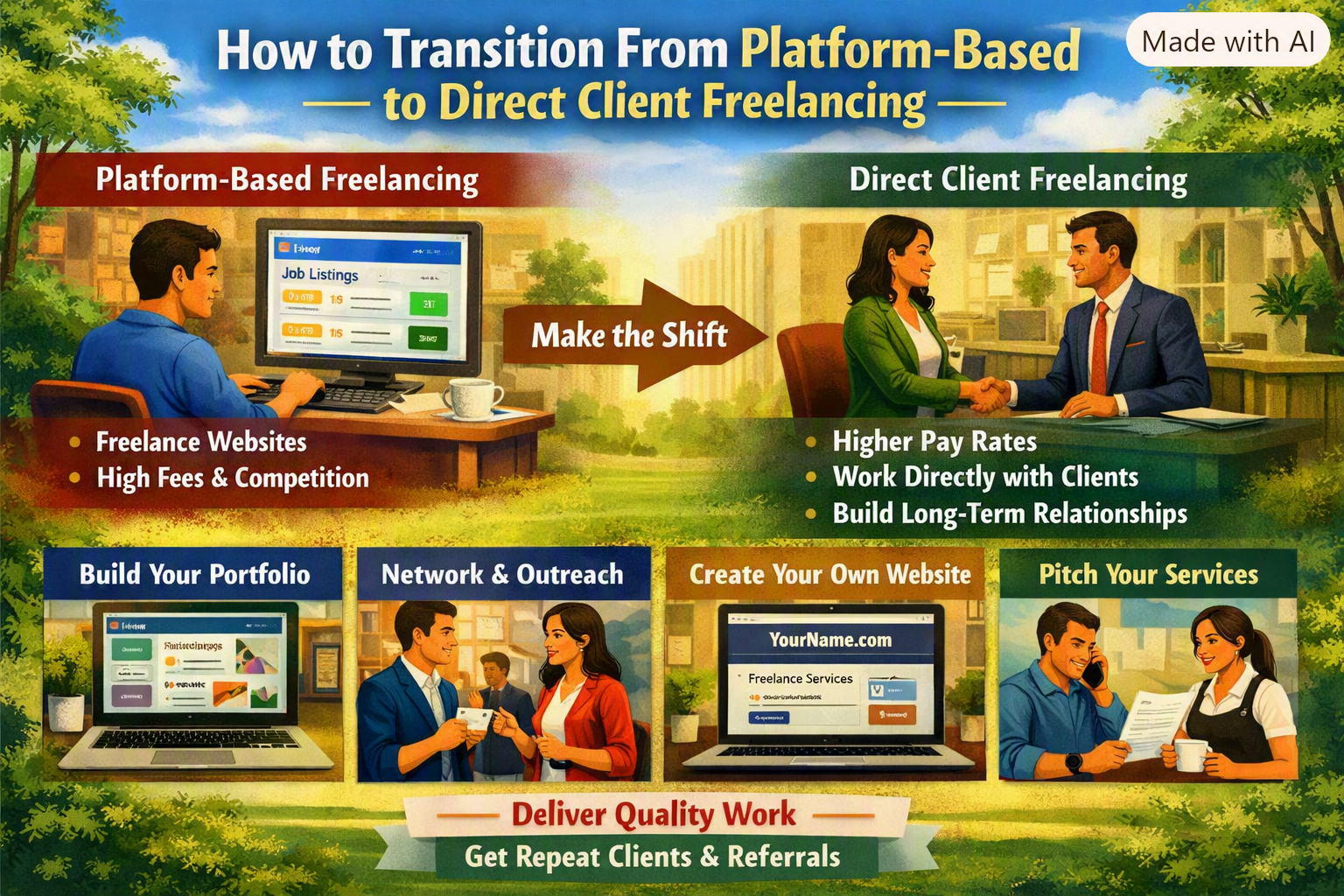
Introduction: Platform-Based to Direct Client Freelancing
Freelancing platforms can be a great start for independent professionals. The websites that connect freelancers with clients give opportunities to accumulate experience, collect reviews and a portfolio, and earn stable income. Yet, the more experience a person gathers, the less attractive freelancing platforms may become due to their cut, competition, algorithm-driven visibility, and other factors.
That is why many experienced freelancers eventually seek to transition from platform-based to direct clients. How to transition from platform-based to direct client freelancing offers to help professionals get more control over their business, increase income, and build long-term relationships with clients.
How to Transition From Platform-Based to Direct Client Freelancing?
1. Understand Why Direct Clients Matter
The first step to transitioning to direct clients is to comprehend why they are beneficial for further career growth. While working on a platform, a freelancer does not have much control over collaboration conditions because the website moderates interactions and takes a significant cut of profits. Moreover, most platforms make it impossible to build long-term relationships with clients because they are built to keep professionals engaged in constant competition.
Yet, working directly with clients means negotiating terms freely and having the ability to impact all aspects of cooperation. A significant advantage of going direct is that it is usually easier and more profitable to establish long-term relationships with clients rather than work as an independent contractor for a single project.
Therefore, freelancers interested in long-term collaboration should transition from platforms to direct clients. For example, content writers rarely fulfill one-page brief and leave; they usually strive to build long-term relationships with companies and provide them with regular content.
2. Build a Strong Professional Portfolio
Before contacting direct clients, a freelancer must ensure that their portfolio impresses potential employers. First and foremost, it is critical to put the most impressive projects, rather than all completed ones, on the portfolio website. Besides, the projects should represent the type of work that the freelancer wants to attract.
For instance, a graphic designer aiming to work with tech companies should put projects that demonstrate their understanding of the needs of technology startups. Similarly, a writer targeting businesses to publish articles on their behalf should display business-related writing samples.
Moreover, testimonials are sometimes an essential element of a portfolio. The reactions of past clients to a freelancer’s performance may serve as proof of the quality of work and reduce the chance that a potential client will be unsatisfied with the service.
3. Start Building Your Personal Brand
The transition from platforms to direct clients also means that a freelancer is no longer dependent on the platforms in terms of visibility. Therefore, they must ensure that their professionalism is well-promoted outside the websites. A freelancer should have a website or a page on a portfolio platform that introduce their services and provide a way for contacting.
A professional appearance on social media is also a must for freelancers who target clients beyond the platforms. LinkedIn, in particular, is an excellent tool for building relationships with potential employers. While platforms like Upwork put prospects in the same pool of competitors, LinkedIn allows finding decision-makers in the target companies.
Instead of spamming LinkedIn with requests for work, a freelancer should provide useful information for their target audience. For example, they can publish educational content, project descriptions, and other materials pertinent to their field to attract the attention of clients.
4. Use Existing Relationships Carefully
For many freelancers, transitioning to direct clients means utilizing existing relationships. Colloquies, friends, past clients, and even business connections can be excellent sources of employers because they usually know someone who needs the services of the freelancer.
Besides, if a freelancer used to work via a platform, they can contact the previous clients to offer long-term collaboration. However, spamming LinkedIn and other websites with job applications is not advisable. Instead, a freelancer should contact a few most promising past clients and offer direct cooperation.
The message should be professional and straightforward: ‘Hi, I am a freelance [expert], and I am available for [project/service].’ The letter should not contain any unnecessary information or hard-selling lines because it can appear spammy.
5. Develop a Clear Service Offer
Direct clients require a different approach as compared to platform-based employers. While the websites put job seekers in the same pool of competitors, direct employers are usually seeking a specialist who can address a specific need. Therefore, instead of saying ‘I am a writer,’ a freelancer should describe the benefits that a client will bring if they hire the performer.
For instance, instead of advertising themselves as a writer, a specialist can say that they help SaaS companies to increase traffic by publishing SEO articles. A clear value proposition is critical to attract direct clients because they usually have a choice of thousands of freelancers on platforms.
6. Learn Client Acquisition
Working directly with clients requires the necessary skills to be developed. The good news is that there are several proven ways to find direct clients, including networking and cold outreach. The latter refers to contacting potential clients via LinkedIn messages, emails, or even phone calls. While cold outreach is a part of sales, it should not be confused with hard-selling.
When contacting a client, a freelancer should not send a standard message to everyone, such as ‘I need a job.’ Instead, they should research the needs of the employer and mention that they can resolve the problem. For example, a cold outreach message to a startup founder may look like this: ‘Hi [Name], I am a content writer with experience in creating SEO articles for SaaS companies. I understand that your business needs more visibility, and I am available to help.’
Conclusion: Platform-Based to Direct Client Freelancing
Building a direct-to-client business means that a freelancer transitions from platforms to independent work. How to transition from platform-based to direct client freelancing is a guideline that helps to take this leap and manage all associated responsibilities. The gradual transition, along with the improvement of the portfolio and sales skills, allows creating long-term relationships with employers and maximizing income.
Experienced freelancers who seek to leave the competition of the websites behind can greatly benefit from direct-to-employer collaboration. While platforms limit profit, rates, and control, direct clients offer full customization of terms. Therefore, freelancing can be much more profitable and fulfilling in the long run as a direct client, especially when managed correctly.
Moving from freelance platforms to direct clients can give you more control, stronger relationships, and better earning opportunities. Build a professional portfolio, reach out to potential clients, communicate your value clearly, and create a reliable client system. Take control of your freelance career and find better opportunities with Best Job Tool.


Leave a Reply