
Introduction: Turn a Rejection Into a Future Opportunity
Has this ever happened to you that you received a rejection email and you just saw it and ignored it? If yes, then this is not the right way to handle rejection. You can actually turn a rejection into a future opportunity in the same company if you treat it as a smart strategy.
In this article, we will talk about that smart strategy through which you can turn a rejection into a future opportunity in the same company.
How to Turn a Rejection Into a Future Opportunity at the Same Company?
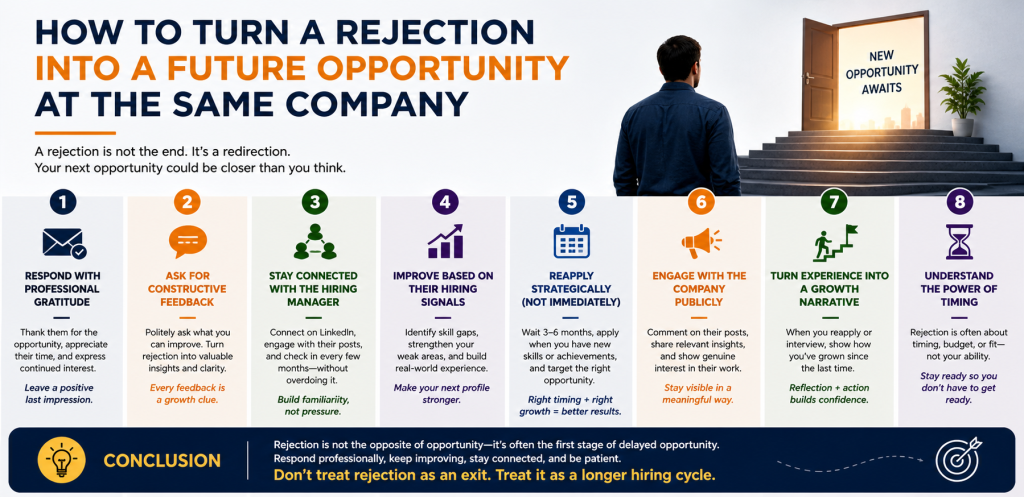
1. Respond With Professional Gratitude
Many candidates, when they receive a rejection email or message, either ignore it after seeing it or reply emotionally so that the company understands their situation and gives them an opportunity. But both of these ways are not the right way to handle rejection.
If you want to turn a rejection into a future opportunity, you just need to take one simple step. Whenever you receive a rejection email, instead of ignoring it, reply to the company with a short message. Thank them for the opportunity, appreciate their time, and express your continued interest.
This small step will keep your name in a positive category internally.
2. Ask for Constructive Feedback (Politely)
The second effective way to turn a rejection into a future opportunity at the same company is to ask for constructive feedback.
When you receive a rejection email or message, you can politely ask the company for feedback. This will help you understand how you can improve yourself.
It is not necessary that every company will reply to your message. Some companies may ignore it, but some may give you useful and constructive feedback. You only need to ask once.
You can ask questions like what skills were missing or how you can improve for future roles. This will turn rejection into a learning data point, which also shows your maturity.
3. Stay Connected With the Hiring Manager or Recruiter
Staying connected with the hiring manager or recruiter is another powerful way to turn a rejection into a future opportunity at the same company.
One big mistake many candidates make is that after a rejection, they completely disappear. But you should not do that. Instead, stay connected with the hiring manager or recruiter so that in the future, if any opportunity comes up, they remember your positive behavior and maturity.
To stay connected, you can connect with them on LinkedIn, occasionally engage with their posts, and send a polite check-in after a few months. But remember, do not message too often, otherwise your presence may start feeling like pressure instead of professionalism.
4. Improve Based on Their Hiring Signals
If you want to turn your rejection into a future opportunity at the same company, then it is very important to improve yourself.
First, try to understand the reasons for rejection. After that, work on them. To find these reasons, you should carefully review the job description, identify your skill gaps, notice the interview questions you struggled with, and understand industry expectations.
After analysing all these points, you need to upgrade your skills and portfolio. Whatever improvements are required, focus on them and work consistently.
5. Reapply Strategically to Turn a Rejection Into a Future Opportunity
To get an opportunity in the same company after a rejection, it is very important to be patient. You should not reapply immediately after getting rejected, because doing so may lead to the same result again.
Instead, you should reapply with a better strategy. An effective approach is to wait for 3 to 6 months and only reapply when you have clearly improved yourself.
Work on your skills every day, improve your weaknesses, and make your profile stronger. Also, target a slightly better or more specific role so that you can present yourself as a more prepared and relevant candidate.
6. Engage With the Company Publicly
The last step to turn your rejection into an opportunity at the same company is to engage with the company publicly.
Most candidates either don’t know about this or ignore it, but it is actually a very powerful strategy to turn rejection into future success.
You can engage with the company in different ways, such as commenting on their LinkedIn posts, sharing insights related to their industry, or showing genuine interest in their work. This way, you stay visible in a professional manner without needing direct contact.
Conclusion
Rejection from a company is not the end of your opportunity—it is often just a delay in the timeline. What matters most is how you respond after it. When you stay professional, seek feedback, improve your skills, and maintain a respectful connection, you keep the door open for future roles.
Many hiring decisions are influenced by timing, requirements, and fit at that moment—not just capability. By continuing to grow and staying visible in a thoughtful way, you position yourself to be reconsidered when the right opportunity appears again.
“Turn every rejection into a future opening — explore smarter opportunities on Best Job Tool where persistence and preparation lead to better outcomes.”




Leave a Reply