Introduction
Breaking into product management without prior experience can be challenging. Employers expect practical understanding of product thinking, Project user research, prioritization, and execution. Side projects bridge this gap by demonstrating real-world capability beyond theory.
Instead of waiting for an opportunity, aspiring product managers can create their own experience through structured projects. These projects help build a strong portfolio, showcase decision-making ability, and prove ownership mindset.
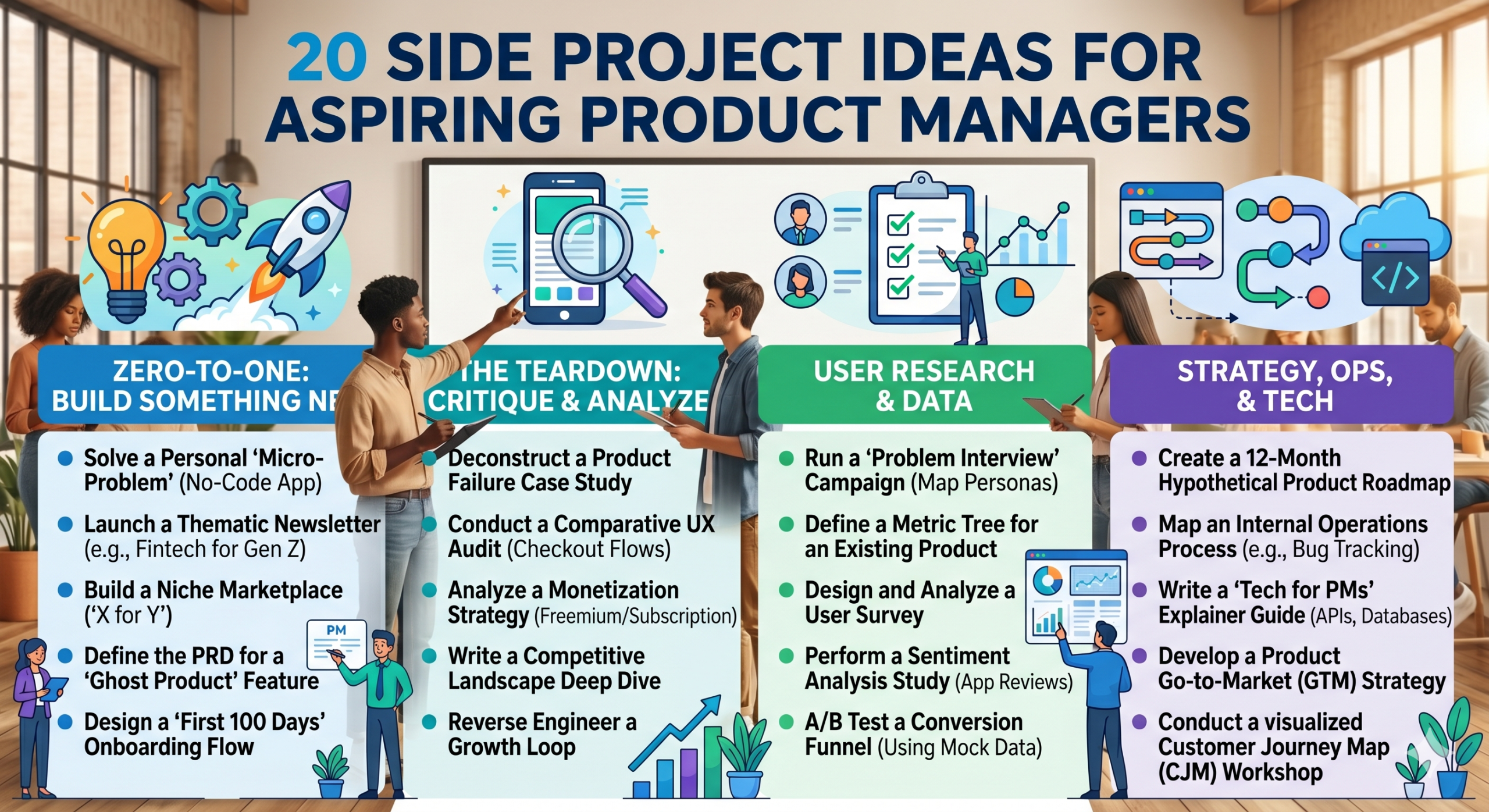
Below are 20 practical and high-impact side project ideas designed to help you develop core product management skills.
Product Research and Analysis Projects
These projects focus on understanding users, markets, and product gaps.
- Conduct a detailed teardown of a popular app and suggest improvements
- Analyze user reviews of a product and identify key pain points
- Perform competitor analysis for a specific product category
- Create a market entry strategy for a new digital product
- Build a feature comparison framework across competing tools
These projects help you develop analytical thinking and user-centric decision-making.
Product Design and UX-Focused Projects
These ideas focus on solving user problems through design thinking.
- Redesign an existing app interface with improved user flow
- Create wireframes for a new product idea
- Conduct usability testing with real users
- Design onboarding flows for better user retention
- Build a prototype for a niche problem
You can use tools like Figma or Notion to present your work professionally.
Data and Metrics-Based Projects
Understanding metrics is critical for product managers.
- Define key performance indicators (KPIs) for a product
- Create a dashboard to track user engagement metrics
- Analyze user behavior patterns using sample datasets
- Build a growth experiment and track results
- Design an A/B testing framework
These projects demonstrate your ability to make data-driven decisions.
Execution and Strategy Projects
Execution is where product management truly comes to life.
- Create a product roadmap for a startup idea
- Write a product requirements document (PRD)
- Prioritize features using frameworks like RICE or MoSCoW
- Plan a product launch strategy
- Build a go-to-market plan
These projects showcase your ability to turn ideas into structured execution plans.
Real-World Simulation Projects
These projects simulate actual product management scenarios.
- Collaborate with developers or designers on a small product
- Build a simple digital product (app, website, or tool)
- Manage a community-driven product initiative
- Launch a micro SaaS or newsletter product
- Document the entire product lifecycle from idea to launch
Using systems like the Best Job Tool can help you track project progress, organize documentation, and present your work effectively in a portfolio.
How to Present These Projects
Creating projects is only half the work. Presentation determines how they are perceived.
Ensure that each project includes:
- Problem statement
- Research insights
- Decision-making process
- Execution steps
- Final outcomes or learnings
Focus on storytelling rather than just deliverables. Employers want to understand how you think, not just what you built.
Conclusion
Side projects are one of the most effective ways to break into product management. They demonstrate initiative, practical knowledge, and the ability to solve real problems.
By working on diverse projects across research, design, data, and execution, you build a well-rounded portfolio that reflects true product thinking. With structured tracking and tools like the Best Job Tool, you can organize your work professionally and present it with clarity.
Consistency matters more than complexity. Even small projects, when executed well, can significantly strengthen your path into product management.




Leave a Reply