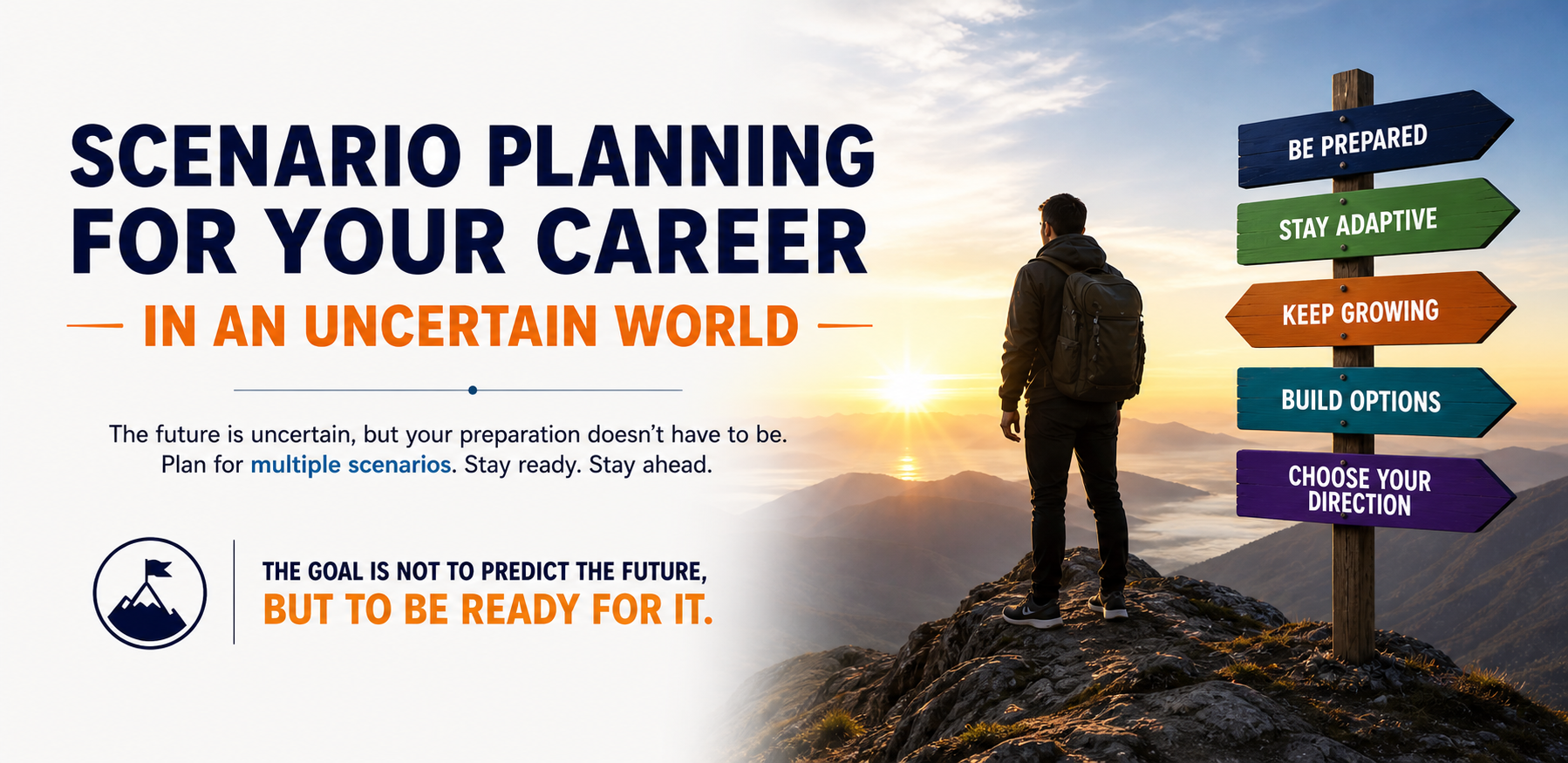
Introduction: Scenario Planning
As we all know, nothing stays constant. In today’s job market, changes happen very fast—sometimes new technologies come, sometimes new tools, and sometimes completely new roles are created. When a person thinks in advance about possible future situations and prepares themselves according to those situations, it is called scenario planning.
Scenario planning is very important for everyone, no matter which field they are working in. Because if you don’t plan ahead and don’t prepare yourself, you can become outdated or fall behind.
In this article, we are going to understand how you can do scenario planning for your career in an uncertain world.
Scenario Planning for Your Career in an Uncertain World
Step 1: Identify Key Uncertainties
The first step in scenario planning is identifying uncertainty.
Every person works in a different field, and each field has its own way of working with different tools. So before predicting situations, you need to understand which factors can affect your career. Based on that, you can prepare yourself accordingly.
Some common factors include AI and automation, industry growth or slowdown, remote or office work trends, and changes in required skills.
If you identify these factors and prepare yourself in advance, you can create a strong and effective plan for your career.
Step 2: Create 3 Career Scenarios
The next step is to create three career scenarios.
The benefit of creating three scenarios is that if you only depend on one and it doesn’t happen in the future, you may feel confused and frustrated. That’s why having three possible scenarios is important.
First is the best-case scenario.
In this situation, everything is in your favor. Your skills are in high demand, you are getting promotions, and your income is growing. In this case, your strategy should be to maximize your growth. You can do this by building your personal brand and taking advantage of opportunities.
Second is the most likely scenario.
This means things are normal—some things are going well and some are not. Your job is stable, salary growth is moderate, and competition is increasing. In this case, your focus should be on upgrading your skills and building a strong network so that you can find better opportunities.
Third is the worst-case scenario.
In this situation, things are not going well. There may be job loss, industry slowdown, or unstable income. In such cases, it is important to have a backup plan, like freelancing or a side income, so that you can stay financially stable.
Step 3: Build “No-Regret Skills”
Another important and useful step is to build no-regret skills.
No-regret skills are those skills that are useful in every field and in every scenario. They do not become outdated quickly and always add value to your career.
Now you might be thinking, which skills are useful in every field? The answer is: communication, writing, problem-solving, digital literacy, and personal branding.
These skills form a strong foundation for your growth. They help you become more adaptable and confident. If you make these skills strong, you can adjust and succeed in any career scenario.
Step 4: Create Flexible Income Streams
A big mistake that many people make is depending on only one source of income. Whether their growth is happening or not, they still rely on a single income, which is very risky. No one knows when a job can become outdated or end. After that, if you don’t have another way to earn money, you may feel stressed and frustrated.
That’s why it is important to plan in advance and not depend on just one income source. Try to create multiple sources of income.
Having more than one income source can help you a lot in the worst-case scenario and makes you feel more secure and stable.
Step 5: Review Every 6 Months
Scenario planning is not a one-time activity. You need to update your plan every 6 months because the job market and industries change very fast.
Today, many new things are introduced, and many things become outdated quickly. That’s why you should keep updating your plan according to industry changes. Stay aware of what is changing, what new opportunities are coming, and what your priorities are.
This will help you handle any situation more easily and stay prepared for the future.
Conclusion: Scenario Planning
In today’s uncertain world, a safe career doesn’t mean having a “stable job,” but having the ability to adapt.
When you prepare for multiple scenarios, you make decisions with clarity instead of fear. Whether the situation is best, average, or worst—you always have a direction.
Relying on a single plan is risky.
But a flexible mindset + strong skills + backup options keep you stable in every situation.
“Prepare for every possibility — explore opportunities on Best Job Tool and build a career that stays strong in any situation. You can read more such blogs here.”



Leave a Reply