Introduction: Data and analytics jobs in Canada
Canada presents excellent career opportunities for professionals in technology, business intelligence, and data analysis. Moreover, as data becomes increasingly important to organisations, professionals can explore opportunities across a variety of industries. For instance, companies in the financial, healthcare, and retail sectors utilise data to identify trends, improve decision-making, and solve business problems. “Moreover, data and analytics jobs in Canada are attracting candidates who want to build careers in technology and data-driven decision-making.”
There are lots of opportunities to become employed in data and analytics roles in Canada. Whether you are a graduate, data professional or international candidate with relevant qualifications you will need to have some technical knowledge and experience. Understanding what skills are required for these roles, what salary to expect and opportunities will help you prepare for your job search.
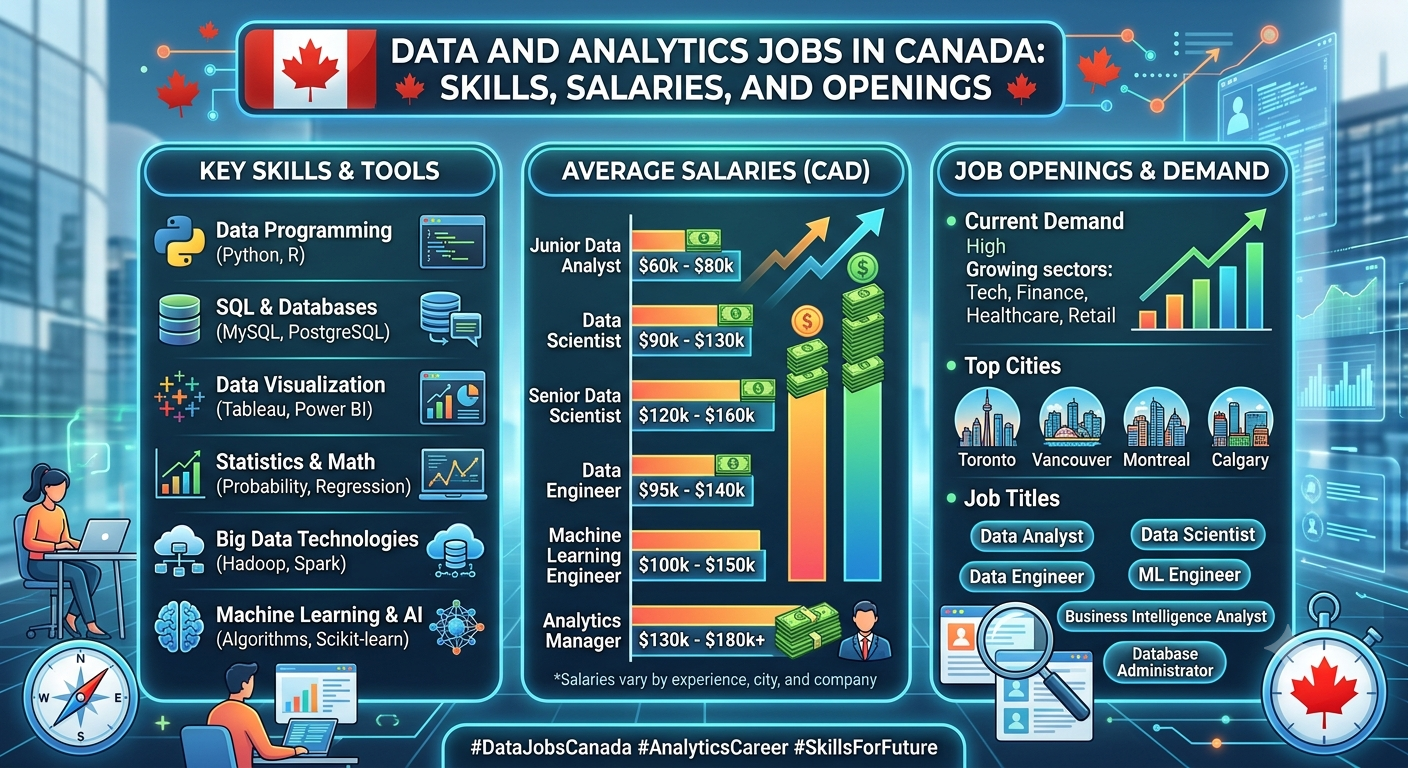
Data and Analytics Jobs in Canada: Skills & Salaries.
1. Popular Data & Analytics Roles in Canada
There are a variety of roles within the data industry.
Data Analyst – Collect, clean and interpret data to find patterns. Commonly use Excel, SQL and visualisation tools like Power BI/Tableau.
Data Scientist – Using statistics, coding and machine learning techniques to analyse complex data sets. Develop predictive models to help make informed decisions.
Data Engineer – Build and maintain systems to collect, store and process large amounts of data. Useful to know Python, SQL, Cloud and data pipeline tools.
Business Intelligence Analyst – By turning data into dashboards and reports, professionals can track performance, understand customer behaviour, and identify improvement opportunities.
Database Analyst – Create, manage and maintain databases. “Exploring different roles can help candidates find data and analytics jobs in Canada that match their qualifications and career goals.”
Other opportunities include analytics consultants, machine learning engineers and reporting analysts. Choose an opportunity that matches your skills, experience and interests.
2. Key Skills Required for Data & Analytics Jobs in Canada
Employers will be looking for people that can work with data and clearly communicate their findings. Here are a list of skills to help you increase your chances of finding a role.
SQL & Databases – Using SQL to query, filter and organise data from databases. This is very useful for data analyst and business intelligence roles.
Python & R – Cleaning data, performing statistical analysis, automating tasks and using machine learning. Python is useful for those wanting to work in advanced analytics.
Visualisations – Using Power BI or Tableau to create visual reports.
Statistics & Maths – Understanding probability, statistical analysis and maths will help you interpret data.
Communication & Problem Solving – Being able to clearly communicate findings to non technical people.
According to Canada’s Job Bank analytical thinking, digital literacy, numerical skills and problem solving are key skills for relevant data roles. Employers may look for flexible, detailed and critical thinkers. “To qualify for data and analytics jobs in Canada, candidates should develop relevant technical skills and gain practical experience through projects.”
3. Salary Expectations for Data & Analytics Jobs in Canada
When deciding on what career to pursue salary is an important factor to consider. Salaries will vary depending on the job, experience, region, employer and technical skills. Below is a table showing some general salary ranges.
Role Annual Salary (CAD)
Junior Data Analyst $50,000-$70,000
Data Analyst $65,000-$90,000
Business Intelligence Analyst $65,000-$95,000
Data Engineer $85,000-$120,000
Data Scientist $85,000-$125,000
Senior Analytics Professional $100,000+$140,000
These are estimated market salary rates and can vary between employers. According to Canada’s Job Bank the median hourly rate for data analyst – informatics and systems is $40.87. This is based on data from 2023-2024. This is specific to database analysts and data administrators. “Before applying for data and analytics jobs in Canada, compare salaries across different roles and locations to understand potential earning opportunities.”
4. Where to Find Data & Analytics Jobs in Canada
There are various employers in Canada that will be looking for data professionals. Technology companies, banks, consultancies, healthcare, retail and public sector employers. However, opportunities will differ depending on the region and industry. Toronto is a great place to look for finance analytics, consultancy and technology roles. Vancouver offers opportunities within the technology and digital sectors. Montreal has roles in technology, research and AI. Calgary and Ottawa also have relevant opportunities. “Candidates can find data and analytics jobs in Canada through online job portals, company career pages, and professional networking platforms.”
Use the below resources to find current vacancies.
Job Bank Canada – Search for data analyst, data scientist and database roles.
LinkedIn Jobs – Search for vacancies, follow companies and connect with recruiters.
Indeed Canada – Search for roles based on the title, experience and location.
Company Careers – Look at the company websites for banks, technology companies, consultancies and more.
Specialist Recruitment Agencies – Use recruiters to find suitable roles.
Use different job titles when searching for roles as companies use different terminology. Filter results based on experience, location and type of work.
5. Applying for Data & Analytics Jobs in Canada
Having a clear strategy will help you to show off your skills.
Create a targeted CV – Highlight your relevant technical skills, qualifications, projects and achievements. Use keywords from the job description where relevant.
Create a portfolio – Create some projects using publicly available data to show your data cleaning, analysis and communication skills. For example create a sales dashboard or analyse customer buying behaviours.
Practice technical tests – Practice SQL queries, spreadsheet functions, statistics and problem solving. Those applying for advanced roles should also practice coding and machine learning questions.
Tailor your applications – Show how your skills match the employers requirements.
Prepare for interviews – Practice talking about your projects, analytical decisions and recommendations. “To improve your chances of securing data and analytics jobs in Canada, tailor your resume to the job description and highlight relevant projects.”
International candidates should also check if they require work permission.
6. Qualifications and Career Progression
Many data roles require you to have a bachelor’s degree in Computer Science, Statistics, Mathematics, Information Technology, Engineering or similar. Some employers will be willing to consider candidates from other backgrounds if they have strong analytical skills and experience.
Having certifications in cloud, visualisation, databases or analytics can help boost your profile. However, this will be most valuable if you have projects to back up your skills.
With experience you could progress from an entry level analyst role to a senior analyst, analytics manager, lead data engineer or data scientist role. Continuous learning is important as analytical tools and business requirements change.
7. Industries that hire data and analytics professionals in Canada
Canada has several sectors that utilise data analytics to improve business performance. For example, the banking and finance industry hires data analysts to manage financial risks, track transactions, and gain insights into consumer behaviour. Similarly, the healthcare sector uses data to evaluate patient outcomes and manage resources more effectively. As a result, healthcare organisations can identify areas for improvement and deliver better services.
The retail and e-commerce industries hire data professionals to analyse consumer purchasing trends, predict demand, and develop effective marketing strategies. Similarly, technology companies recruit data engineers, data scientists, and business intelligence analysts to support the development of digital products. Furthermore, these professionals help businesses understand customer needs and improve overall customer experiences.
Manufacturing, telecommunications, transport and government organisations also utilise data analytics to help plan operations and track performance. Identifying different industries may help you find new opportunities outside of traditional technology based companies.
8. Tips for fresh graduates
Fresh graduates can increase their chances of finding data and analytics jobs in Canada. Firstly, you want to develop your skills in SQL, Excel and Python. Develop a skill in data visualisation.
Complete two or three projects using public datasets. For example, you can analyse sales data, create a financial dashboard, or examine consumer trends. Additionally, showcase your work in an online portfolio to demonstrate your analytical skills to potential employers.
Furthermore, completing internships, co-op placements, and entry-level positions can help you gain valuable industry experience. When preparing your CV, include academic projects, relevant coursework, certifications, and quantifiable results. As a result, employers can better understand your practical abilities and the value you can bring to their organisation.
Always be persistent when applying for jobs. Tailor each application to the specific roles. Take time to review the job description to ensure you fully understand what the employer is looking for. Fresh graduates can create a solid foundation within the data industry in Canada by continuing to learn, gaining some real world experience and being persistent with their applications.
Conclusion: Data and analytics jobs in Canada
There are many opportunities in data and analytics roles in Canada. Having a good understanding of the salary expectations, finding relevant opportunities and creating a strong portfolio will help you feel more confident entering the job market. Keep the existing phrase in your opening sentence. You don’t need to add another sentence here.
Choose the right role for you, learn the relevant tools and create some projects. Use reliable job sites and company websites to find roles that match your skills. Ready to start your data analytics career? Update your CV, improve your technical skills and search for current roles in Canada.
Ready to find data and analytics jobs in Canada? Use the best job tools to explore the latest openings, connect with employers, and discover opportunities that match your skills. Start your job search today and take the next step towards your dream career!



Leave a Reply