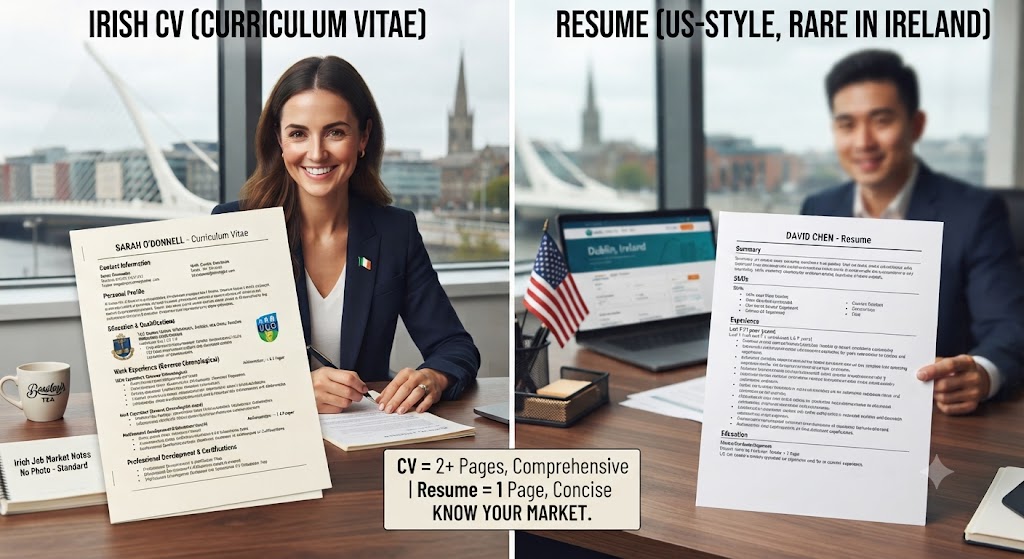
When applying for jobs in Ireland, one of the first questions international job seekers may have is whether they should submit a resume or a curriculum vitae (CV). The terminology can be confusing, particularly for candidates moving between countries where application conventions differ.
In Ireland, employers generally use the term CV for the document that summarises a candidate’s education, professional experience, skills, and achievements. The word resume is more commonly associated with the United States and some other markets. Therefore, if a job advertisement in Ireland requests a CV, you should usually submit a tailored professional CV rather than assume that a different document is required.
However, using the correct terminology is only the beginning. Employers also want an application that is easy to read, relevant to the position, and supported by evidence of your capabilities. Understanding local expectations can help you present your experience more effectively and improve your job-search strategy.
1. Resume vs CV: What Is the Difference in Ireland?
The main difference is how the terms are used in different countries.
In Ireland, a CV is the standard document for most job applications. It provides a summary of your professional background, employment history, education, skills, and relevant accomplishments. In the United States, employers generally use the term resume for a similar document, while a CV may refer to a more extensive academic or research-focused record.
For most non-academic jobs in Ireland, you do not need to prepare two separate documents simply because you have encountered both terms.
Here is a simple comparison:
- Ireland: CV is the standard term used in most job advertisements.
- United States: Resume is the usual term for most non-academic positions.
- Academic and research roles: Employers may request a more detailed academic CV, depending on the position.
- International applications: Follow the terminology and document instructions used in the specific job advertisement.
For example, if a Dublin-based employer asks for your CV, submit a document that clearly presents your relevant qualifications and experience. You generally do not need to rename it a resume to appear professional.
The most important consideration is not the document’s label but whether its content matches the employer’s requirements.
2. How Long Should a CV Be in Ireland?
CV length depends on your experience, the industry, and the type of position. However, a practical target for many Irish job applications is one to two pages.
Recent graduates and candidates with limited experience can often present their qualifications effectively on one page. Professionals with several years of relevant experience may need two pages to explain their achievements and responsibilities.
To keep your CV focused:
- Prioritise your most recent and relevant experience.
- Use concise bullet points instead of long paragraphs.
- Remove outdated information that does not strengthen your application.
- Highlight achievements that demonstrate your suitability for the role.
- Include relevant certifications, technical skills, and professional training.
- Avoid repeating the same responsibilities under multiple positions.
For example, a recent graduate applying for an entry-level marketing position could include an internship, a relevant university project, practical software skills, and a short education section.
An experienced project manager, on the other hand, may need more space to describe major projects, budgets, stakeholder relationships, and measurable results.
Avoid adding unnecessary information simply to fill a page. Equally, do not remove important achievements just to meet an arbitrary length target. Your CV should be concise while providing enough evidence for an employer to assess your application.
3. What Information Should an Irish CV Include?
A well-structured CV makes it easy for recruiters to understand your background and identify the qualifications most relevant to the vacancy.
For most professional positions in Ireland, consider including the following sections:
Contact information: Add your name, professional email address, phone number, and an appropriate location. You can also include a LinkedIn profile or portfolio link when relevant.
Professional summary: Write a short introduction explaining your experience, strongest skills, and career focus. Tailor it to the position rather than using the same generic statement for every application.
Work experience: List your current or most recent role first, followed by previous positions in reverse chronological order. Include employer names, job titles, employment dates, and relevant achievements.
Education and qualifications: Include your degrees, relevant training, professional certifications, and other qualifications that support your application.
Skills: Highlight relevant technical abilities, software knowledge, industry expertise, and transferable skills.
Additional sections: Depending on the role, you may include languages, professional memberships, volunteer work, projects, awards, or relevant interests.
Official Irish employment guidance also recommends presenting work experience and qualifications clearly, tailoring applications to the vacancy, and checking for errors before submitting. You can review the guidance on <Link url=”https://jobsireland.ie/en-US/TipsandAdvicePage” title=”JobsIreland’s CV and job application advice”/>.
Not every candidate needs every section. Select the information that helps demonstrate your suitability for the role.
4. What Formatting Do Irish Employers Prefer?
A professional CV should be easy to scan, consistent, and readable on a computer screen. You do not need an elaborate design to make a strong impression.
For most traditional professional roles, a straightforward layout is a sensible choice. Use clear headings, readable fonts, consistent spacing, and bullet points to organise information.
Follow these formatting practices:
- Use a simple layout with clearly defined sections.
- Keep font styles and sizes consistent.
- Use bold formatting selectively for headings and job titles.
- Present employment dates consistently.
- Avoid spelling and grammar errors.
- Save the document in the file format requested by the employer.
- Check that the document remains readable when opened on another device.
A photograph is generally unnecessary unless the employer specifically requests one. Likewise, personal information such as age, marital status, and religion is usually not required for a standard professional CV.
Candidates should also avoid adding decorative graphics that make important details difficult to read. Creative portfolios may be appropriate for design-related positions, but the presentation should still support the application rather than distract from it.
Applicant tracking systems are used by some employers to manage applications. A clear layout and relevant terminology can help ensure that your experience is easy to interpret, although no particular format guarantees that a CV will pass every screening system.
5. How to Tailor Your CV to Irish Job Advertisements
One of the most effective ways to improve your application is to customise your CV for each position.
Irish employers want to see evidence that your experience and skills match the role. A generic CV may contain all your qualifications but fail to make the most relevant information stand out.
Begin by reading the job description carefully. Identify the main responsibilities, required qualifications, technical skills, and experience level. Then compare those requirements with your own background.
For example, suppose you are applying for a business analyst position in Cork. The advertisement mentions data analysis, stakeholder communication, process improvement, and reporting tools.
If you have experience in those areas, highlight relevant projects and accomplishments near the top of your CV. If you used a particular tool or improved a process, explain how you applied that skill rather than simply listing it.
You can improve relevance by:
- Adjusting your professional summary to the target role.
- Prioritising experience that matches the advertised responsibilities.
- Using accurate keywords from the job description.
- Including measurable achievements where possible.
- Removing unrelated details that take attention away from your qualifications.
- Checking that all information is accurate and consistent.
For example, instead of writing “Responsible for preparing reports,” you could write “Prepared weekly performance reports to identify trends and support management decisions,” provided that this accurately describes your work.
Tailoring does not mean exaggerating your qualifications or copying the job advertisement word for word. It means presenting your genuine experience in a way that makes its relevance clear.
6. What Should International Candidates Know About Applying in Ireland?
International candidates may need to make additional adjustments when preparing a CV for Irish employers.
First, explain your qualifications and work experience clearly. If you earned a degree outside Ireland, use the official qualification title and provide the awarding institution and completion date. Where appropriate, include a concise explanation of specialised qualifications that an Irish recruiter may not immediately recognise.
Second, make your contact information practical. If you are applying from abroad, do not imply that you already live in Ireland when you do not. You can state your current location accurately and explain your relocation plans where relevant.
Third, understand that permission to work in Ireland is separate from the quality of your CV. If an application asks about your eligibility to work, answer truthfully. Check the relevant Irish government guidance if you need information about employment permits or immigration requirements.
International applicants should also avoid including unnecessary personal details or sending copies of identity documents unless a legitimate recruitment process specifically requires them.
Finally, do not assume that an unfamiliar employer or qualification will automatically be understood. Use clear language to describe your responsibilities, industry, technical skills, and achievements. This helps recruiters assess your experience without needing to interpret unfamiliar terminology.
7. Common CV Mistakes to Avoid in Ireland
Even a qualified candidate can weaken an application by overlooking basic details. Before submitting your CV, check for the following mistakes.
Using one CV for every job: Different positions may require different skills. Highlight the experience most relevant to each vacancy.
Including too much information: Long descriptions and unrelated details can make your strongest qualifications difficult to find.
Listing responsibilities without achievements: Explain what you contributed, improved, delivered, or learned instead of relying entirely on generic job duties.
Adding unnecessary personal details: A photograph, date of birth, marital status, and similar information are generally unnecessary for standard applications.
Using an unclear layout: Complicated formatting, inconsistent fonts, and long paragraphs can make the document harder to scan.
Leaving errors uncorrected: Check spelling, grammar, job titles, employment dates, and contact details before applying.
Exaggerating experience: Be honest about your skills, responsibilities, and qualifications. You should be able to discuss every claim during an interview.
Ignoring application instructions: If an employer requests a specific file format, cover letter, or application form, follow those instructions.
A final review can help you catch these mistakes before they affect your application. You may also ask a trusted colleague or career adviser to review your CV for clarity and relevance.
Conclusion
For most job applications in Ireland, a CV is the standard document employers expect. Although the term resume is common in the United States, candidates applying for Irish positions generally do not need a separate document solely because the terminology differs.
Focus instead on preparing a clear, relevant, and professional CV. Keep it concise, highlight your strongest achievements, use a straightforward layout, and tailor your content to the job description. International candidates should also explain unfamiliar qualifications clearly and provide accurate information about their location and work eligibility when requested.
Before submitting an application, check that your CV answers one important question: why are your skills and experience a good match for this particular role?
As you explore opportunities in Ireland, use a best job tool to discover relevant vacancies, compare job requirements, and focus on positions that match your experience and career goals. Combining a well-prepared CV with targeted applications can help you approach the Irish job market with greater confidence.
#JobsInIreland #CVWriting #ResumeTips #CareerAdvice #JobSearchIreland #CVTips




Leave a Reply