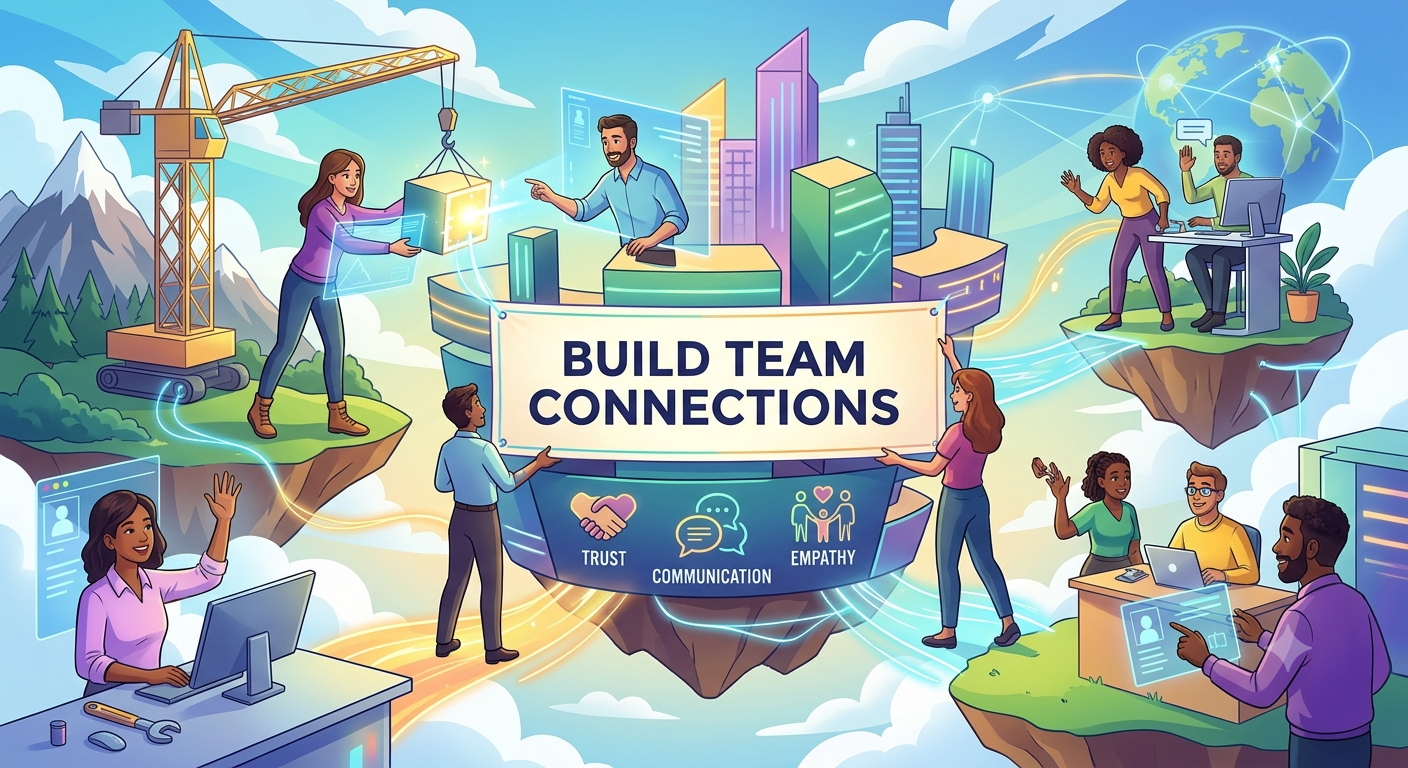
Introduction: Build Relationships
In today’s world, a company team does not necessarily work in the same office. Many organizations employ people in remote locations and work with contractors and consultants in addition to full-time staff. Colleagues in different cities and countries and operating on different time zones may collaborate on a regular basis. Working across teams provides access to diverse talent but limits personal and professional interactions. Organizations can develop relationships among teams by promoting trust, communication and respect.
How to build relationships in a team that never fully assembles is the key question in regards to such situations. Foster trust, open communication, emotional connections, and collaboration among team members.
How to Build Relationships in a Team?
1. Make Communication the Foundation of Relationships
Communication builds strong relationships, especially among colleagues who rarely work together. A team of members should communicate the specifics of a project and establish the nature of their cooperation. Modern technologies, such as digital communication and video conferencing, have offered new ways of interaction for geographically distributed teams. Open communication enables each team member to build relationships with fellow teammates by establishing expectations and exchanging ideas.
Team members should use them in ways that suit both sides and improve productivity. They should communicate openly and honestly with each other. Apart from discussing work-related issues, they should also ask and answer questions regarding their personal life. Leaders should encourage open and honest communication and help members of their team communicate with each other without hesitation.
2. Build Trust
Trust is the cornerstone of any professional relationship, and it takes time to build. Remote team members build trust through honest communication and by fulfilling commitments. Failing to communicate changes or meet expectations can damage professional relationships. To build relationships that last, team members have to show that they have honesty, reliability, and accountability.
Colloquies in turn should deal openly with concerns and avoid assigning undue blame. Leaders should always be honest and straightforward with their employees. Trust also involves allowing people to act independently. Excessive monitoring limits employee independence and reduces remote team efficiency.
3. Create Opportunities for Informal Conversation
Team members that work together in an office interact formally and informally throughout the day. Colleagues build stronger relationships by sharing meals and personal experiences. Remote and hybrid teams have fewer opportunities for such interactions, but companies can encourage connections through virtual coffee breaks, informal chats, and team celebrations. Informal chats help remote workers establish relationships that go beyond their regular duties.
The Informal conversations foster connection between colleagues, seeing each other as people rather than just professional counterparts. Informal interactions strengthen team bonds and build a sense of community. However, such interactions should be optional, with people being able to opt out if they are uncomfortable with sharing or interacting. Everyone should have an option to control who they spend their time with and who can view whom.
4. Develop Empathy
Every team member, whether remote or onsite, has unique backgrounds, personalities, communication styles, and challenges. Some will be comfortable in public settings and will share openly, while others may be more reserved. Some will speak up readily, and others – including remote colleagues – will be less vocal. People from different countries or cultures may interact differently. Empathy helps colleagues build relationship by developing an understanding and respect for differences
Empathy helps to understand that every worker is different, and not everyone behaves the same way in similar situations. In In particular, if a teammate misses scheduled meetings or does not respond promptly, it is necessary to assess their situation and not conclude that they do not want to cooperate. Leaders should encourage empathy by discussing it openly and practicing it with their colleagues and subordinates. Psychological safety helps team members express ideas, admit mistakes, and learn without fear of judgment or rejection.
5. Set Shared Goals and Vision
Teams can work independently while pursuing shared goals, but limited daily interaction can make it harder to maintain a common vision. Managers should discuss the objectives and roles of every team member in achieving the company’s strategic aims explicitly. Team members should align on shared goals and recognize each other’s contributions. Related sentence 9: Shared vision unites the team and strengthens the sense of belonging to the same professional community. Shared objectives help team members build relationships while working toward common organizational goals.
Achievements should also be celebrated, and employees should recognize each other for the successes and milestones. Colleagues should acknowledge each other publicly and offer individual recognition if their achievements were particularly meaningful to them. Recognize every team member’s contributions and give special praise for exceptional efforts.
6. Encourage Collaboration Instead of Isolation
While working with others often, whether remote or onsite, is important, it is equally critical that people collaborate rather than operate in isolation. Remote or hybrid teams are unlikely to share information freely and can function like a number of individual contractors, each fulfilling specific tasks without collaborating with each other in any capacity. Such interactions should be encouraged and facilitated, with companies fostering cooperation through peer mentoring, peer reviews, brainstorming sessions, and other collaborative initiatives. Leaders should ensure that team members interact and cooperate with each other, sharing their knowledge and experiences. Collaborative projects help employees build relationships through teamwork, knowledge sharing, and joint problem-solving.
It is important to ensure equality of opportunity. All members should have equal access to information, resources, and engagement in discussions and meetings, particularly those where major decisions are made. Remote or hybrid colleagues may feel left out if they cannot participate fully in meetings or do not have access to the latest information. Team members who feel excluded may be more likely to disengage or, if they continue working with the rest of the team, do so reluctantly.
7. Resolve Conflicts Through Respectful Dialogue
Conflicts are an inevitable part of working together, whether a team works together in an office or remotely. In the latter situation, there is the additional challenge presented by written communication, which can be misconstrued due to the lack of nonverbal queues and immediate clarifications. In any case, team members should be encouraged to confront the issue directly, calmly, and respectfully and focus on finding a solution. Discussing concerns clearly and asking clarifying questions can help to prevent misunderstandings, while ignoring them can lead to greater frustration.
A positive company culture should encourage candid and constructive feedback and avoid blaming individuals for mistakes. Once the sources of disagreement are eliminated or resolved, stronger professional relationships can be established, with the team members learning to empathize with each other. Respectful communication helps teams build relationships even after disagreements or misunderstandings.
8. Make Building Relationships Part of the Work
Building relationships in a team that never fully assembles is a process that requires time and ongoing efforts from both sides. While some events, such as regular video conferences, can strengthen the connection between colleagues, they are not sufficient, and stronger bonds will be created only if the team members truly care about each other. Companies should regularly evaluate the level of employee engagement and ensure that all members feel included, heard, and informed.
This can be accomplished by asking employees to provide feedback and discuss their experience with the team in short, regular feedback surveys. In addition, leaders should give honest and encouraging feedback to all team members in a timely manner and be available to them as a resource or sounding board.
Most importantly, building relationships should be a part of everyday work, and employees should be encouraged to express their appreciation and support. An honest message or simple thank-you can go a long way in strengthening professional connections./
Conclusion: Build Relationships
Building relationships in the team which is unable to meet can be a powerful combination of efficient communication, trust, empathy, collaboration, and purpose. Even though the members of the team are not assembled, it allows people to create professional relationships with each other by making everyone feel valued and empowered.
Professional teams operating without a collective workspace are aware that physical presence is not essential for a team to collaborate successfully. If communication is clear, misunderstandings, misinterpretations, and mistakes can be minimized. Maintaining consistency allows building trust, and being empathetic enables creating a safe environment for everyone to express their opinions and emotions. In addition, informal connection, shared accomplishments, and collaboration on projects or tasks will strengthen the relationships within the team.
As a result, teams can begin to shift from working together to collaborating with each other to achieve common goals. In other words, if people are prioritizing human relationships, then the physical workspace is no longer essential in terms of building stronger teams. A group of individuals can work remotely and be united by the common sense of purpose, empathy, connection, and inclusiveness.
Ready to build stronger workplace relationships and grow your career? Explore better job opportunities with our Best Job Tools and take the next step toward professional success.


Leave a Reply