Introduction: Recruiter Kickoff Calls
To ensure successful recruitment, it is essential to establish complete understanding of the requirements, team expectations, skills, and hiring guidelines. A well-structured kickoff meeting enables recruiters and hiring managers to build a solid recruitment strategy.
Learning How to Run Effective Recruiter Kickoff Calls With Hiring Managers can be extremely beneficial for recruiters as it helps them avoid misunderstandings, attract high-quality candidates effortlessly, and complete the recruitment process faster. In addition, recruiters can ask the most relevant questions and document all of the critical information during kickoff calls with hiring managers.
The following article will provide useful tips for conducting effective recruiter kickoff calls and hiring managers’ training.
How to Run Effective Recruiter Kickoff Calls?
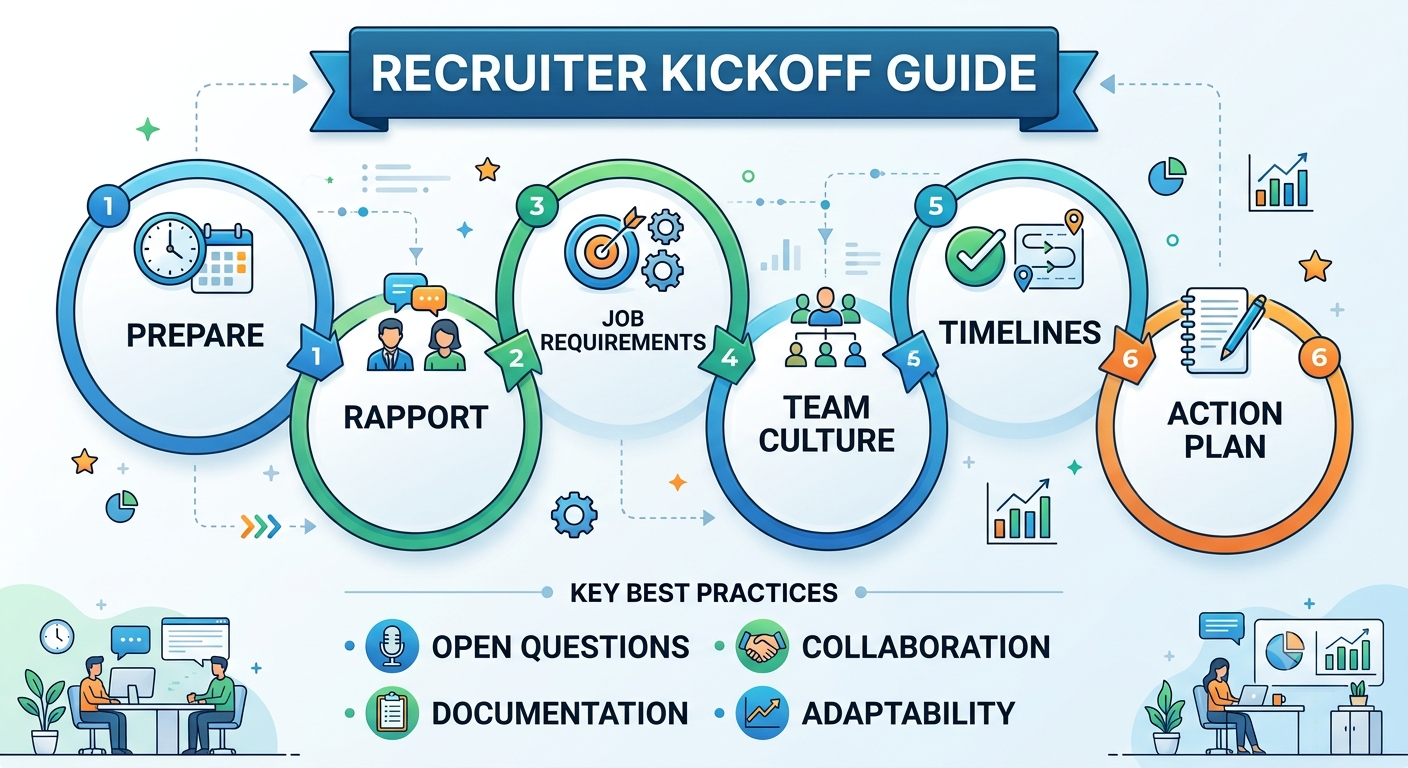
1. Prepare Beforehand
Preparation plays a vital role in all recruitment-related activities, and a kickoff meeting with a hiring manager is not an exception. Recruiters should analyze the job description, organizational structure, responsibilities, and information about the vacant position before scheduling the meeting.
Moreover, they need to prepare a list of questions to help hiring managers provide all of the required information for attracting ideal candidates. Recruiters may also want to go through the details related to previous recruitment challenges, if any.
Conducting Effective Recruiter Kickoff Calls With Hiring Managers is not only about discussing an open position. Recruiters should be knowledgeable about the requirements related to the vacant position and ready to ask all of the relevant questions during the meeting. For example, recruiters can ask hiring managers to share their expectations regarding the team’s immediate requirements, the cause of the vacancy, and the challenges the new recruit should overcome.
2. Clarify the Job Requirements
A comprehensive job description does not always contain all the details that recruiters and hiring managers should consider while finding ideal candidates. Therefore, recruiters should clarify the job requirements during the kickoff meeting.
They should ask hiring managers to share the following information:
- The required technical and professional skills;
- Years of experience (if applicable);
- Educational background or certifications;
- Daily responsibilities and performance expectations;
- Qualifications that are preferred but not required.
- Recruiters should also try to establish which requirements are mandatory and which ones can be optional. This information will help recruiters avoid shortlisting candidates with essential qualifications but without optional skills and approve those without required expertise.
During Recruiter Kickoff Calls, recruiters should encourage hiring managers to explain why this or that requirement is critical. This way, both sides will have a clear picture of the candidate that the hiring team expects to fill the vacant position.
3. Define the Ideal Candidate Profile
After discussing all the requirements, it is time to define the ideal candidate profile.
Recruiter kickoff calls with hiring managers should establish an accurate candidate profile that will help both sides analyze the skills, work ethic, and professional background that the vacant position requires. In other words, recruiters and hiring managers should try to avoid generic terms such as ‘a perfect fit’ and focus on specific actions and behaviors that the candidate should demonstrate.
For instance, a Sales Manager should have a proven ability to increase revenue, maintain the bottom line, build relationships with existing customers, and identify new selling opportunities.
Strong Recruiter Kickoff Calls with hiring managers create objective evaluation criteria. Recruiters can use this information to analyze candidates’ applications and reject those who do not match the established guidelines.
The candidate profile should also be flexible enough to consider candidates with transferable skills and nontraditional backgrounds, provided that they have the required expertise for the given position.
4. Establish Hiring Priorities and Time Deadlines
Lack of alignment between recruiters and hiring managers may result in incomplete recruitment or delays. The kickoff meeting should set realistic hiring deadlines and priorities.
Recruiters and hiring managers should discuss when the hiring manager expects to see the first candidates, how many rounds of interviews the company is willing to organize, and when the final decision should be made.
Both sides should also highlight potential show-stoppers, such as slow approval of candidates or lack of time and energy from the hiring manager. During Recruiter Kickoff Calls, recruiters should explain to hiring managers how delays in the process may affect the candidates’ engagement. For example, if the company does not shortlist candidates in time, an interested recruit may consider other employment opportunities.
Setting specific hiring deadlines and responsibilities will make everyone accountable. Recruiters should document all the discussed details and remind the hiring manager of their responsibilities.
5. Discuss Compensation and Workplace Expectations
Compensation is one of the crucial aspects that should be discussed during the kickoff meeting. Recruiters should double-check the hiring manager’s expectations concerning the salary range, benefits, incentives, and other employment-related conditions.
For example, if hiring managers require special expertise but are not ready to compensate for it, this information will allow recruiters to highlight this nuance during candidate outreach.
The discussion should also cover candidates’ expectations, such as remote or on-site work, flexible or rigid working hours, and other employment-related rules.
Effective Recruiter Kickoff Calls With Hiring Managers will replace guesses and assumptions with honest communication. As a result, recruiters will provide accurate information to candidates and avoid losing interested applicants due to misunderstandings.
6. Agree on the Interview and Evaluation Process
A properly-structured interview process enables recruiters and hiring managers to make unbiased hiring decisions. Thus, recruiter kickoff calls should set the criteria for evaluating candidates.
It is necessary to clarify what steps of the interview process will be organized, who will participate in it, and what they will assess. For example, recruiters can conduct preliminary screenings to identify candidates’ motivation, communication skills, and basic expertise, while hiring managers will assess the technical and role-specific skills.
Both sides should agree on how the feedback on candidates will be shared and set a deadline for submitting feedback. Successful Recruiter Kickoff Calls enable both sides to adopt the same evaluation criteria and make the hiring process transparent.
Recruiters should also discuss how the company will inform unsuccessful candidates and keep in touch with promising applicants after the initial screening or interviews.
7. Identify Sourcing Channels and Recruitment Strategies
Depending on the job requirements and candidate profile, recruiters and hiring managers should identify the best places to find candidates.
Potential sourcing channels include job boards, professional social networks, referrals, and communities related to the vacant position. Recruiters may also consider reaching out to candidates directly, especially if the position requires highly specialized expertise.
In addition, recruiters may look for candidates in similar industries if their skills can be easily transferred to the vacant position. During Recruiter Kickoff Calls, hiring managers should share their knowledge about competitors, related communities, and the backgrounds of successful professionals in the relevant field.
This information will help recruiters come up with a winning sourcing strategy and personalize their outreach to shortlisted candidates. Moreover, ongoing evaluations will help recruiters and hiring managers re-strategize if the current approach does not yield any results.
8. Document Decisions and Communication
The kickoff meeting should conclude with a list of all the decisions, guidelines, and expectations. Recruiters should create a comprehensive documentation of the requirements, candidate profile, compensation, deadlines, interview process, and communication rules. This document should be shared with the hiring manager to ensure that everyone understands their responsibilities and expectations.
Effective Recruiter Kickoff Calls With Hiring Managers will set the rules for communication between recruiters and hiring managers. Both sides should regularly communicate to discuss the quality of candidates, their feedback, and current challenges.
Moreover, if the requirements related to the vacant position change, both sides should document these changes and analyze how they will affect the recruitment process. Keeping accurate documentation will make it possible to go through the hiring process for similar vacancies with confidence and improve the quality of recruitment.
Conclusion: Recruiter Kickoff Calls
Effective recruiter kickoff calls with hiring managers play a critical role in setting the direction of the entire recruitment process. Understanding the hiring manager’s expectations will help recruiters come up with effective sourcing strategies, evaluate candidates accurately, and provide a positive candidate experience throughout the hiring process.
By asking the right questions, clarifying job requirements, defining the candidate profile, and establishing deadlines and responsibilities, recruiters can ensure that every kickoff meeting is a complete success. Thus, recruiters and hiring managers should always try to make the most out of their communication to make informed hiring decisions and attract the best possible candidates.
Start improving your recruitment process today by creating a helpful agenda for your next recruiter kickoff call with a hiring manager. You can also leverage a best job tool to organize your hiring-related activities.
Ready to improve your hiring process? Use the best job tool to streamline recruitment, track candidates, and make better hiring decisions with confidence.





Leave a Reply