Introduction: Staying At One Company
In the age of constant change, career shifts are becoming increasingly common. It has become more important than ever to look out for new opportunities – those who hesitate tend to fall behind. Not just higher pay or a new challenge, but even accelerated promotions are possible when an employee embarks on the thrilling adventure of job-hopping.
But what many people fail to realize is that there is a different, underestimated option. Why are employees not staying at one company for two years or more in 2026? Why have so many forgotten the value of long-term tenure? The truth is, there is no reason at all to rush.
Why Staying at One Company for 2+ Years Matters in 2026?
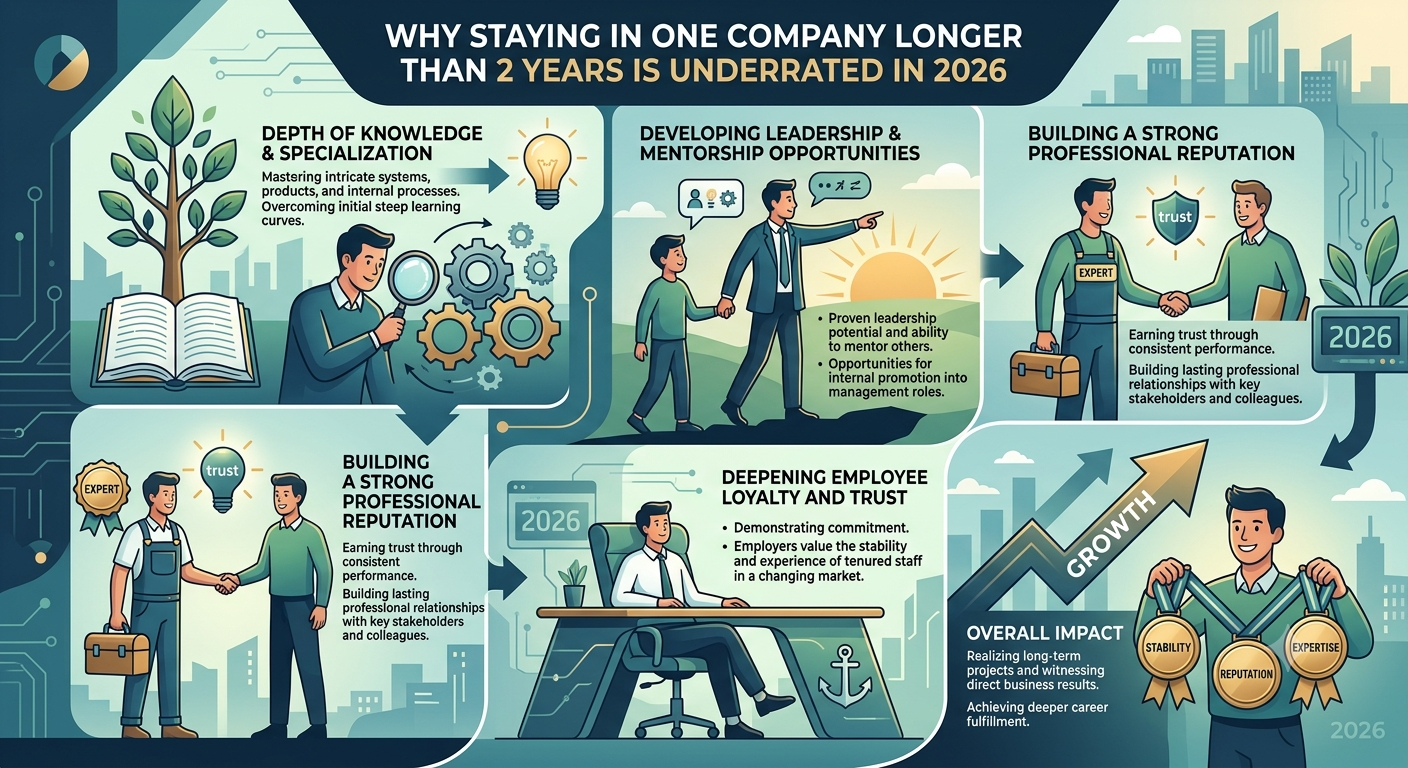
1. Experience Has Value
The advantages of staying at one company for over two years, compared to regularly searching for new employers, are numerous and impactful. Experience is what gives a person power in their field, and long-term employment fosters it in ways that a short tenure never could.
The first year is spent familiarizing with the ropes – no matter how talented the employee is, they need to find their way around. The second year, they gain confidence. And then the value of experience is fully realized with the third and fourth, when the employee grows accustomed to the workplace dynamics.
It becomes easier for them to see the consequences of their actions in broader contexts and work with different teams. Such versatility is hard to achieve when job-hopping on regular intervals.
2. Resume Can Say Little About You
A résumé is a tool, no more, no less. It is a means of conveying information, but it does so superficially. Staying at one company for several years can give an employee tremendous credibility with their colleagues and superiors.
That is, their real colleagues and superiors. People tend to forget that their résumé will only show recruiters what companies they have worked for and the positions they held. When an employee has worked somewhere for longer than five years, the people there know what they went through and the experience they have earned.
They will be able to rely on the judgment, adaptability, and other qualities such tenure implies. This, in turn, means that the long-term employee will have more influence and will be able to tackle more significant responsibilities.
3. Better Opportunities Are Closer Than They Appear
Many people believe that changing the workplace is the easiest way to improve their current situation. Sometimes it is – and not just for financial reasons. When the time comes, an employer who has been loyal to the employee may reward their dedication by offering bigger responsibilities.
As such, an extended period spent at the same workplace can be much more rewarding than a series of smaller raises across multiple companies. There is no universal answer on how to advance the career – each person must find the method that suits them the best.
If an employee stays long enough, the employer may notice and increase the pay grade. Or, alternatively, give the worker more important tasks to differentiate their performance from the rest.
4. More Than Just the Ropes
In addition to the obvious benefits of gaining experience, long-term employees also acquire another critical asset – the knowledge of the business they are working for. They learn the customers’ expectations, as well as the inner workings of the company. They understand the business better than most – and this understanding can be crucial for leadership roles.
Anyone can grow up to be a manager, but not everyone attains true leadership. And a successful leader is someone who has seen the inner workings of the company, understands its strengths, weaknesses, clients, and history. They possess a comprehensive understanding of the business, which is much harder to acquire for someone who only spends a year at the company. Such people are invaluable assets to any firm, and long-term employees have the best chance at becoming them.
5. Learning is Not Mandatory
It goes without saying that the longer one stays in a single workplace, the more opportunities they miss to gain new skills. The same goes for stagnation – if someone is not growing, staying at the same place will only harm their career.
However, such risks can be mitigated by selecting the right employer. If an employee is continuing to grow, to perform better tasks, to earn more and gain more responsibilities, such trajectory will be beneficial for them. At the same time, if the person is not developing, the stagnation will ultimately hurt them, regardless of the employer. And this, too, is a risk to consider.
6. Employers May Value Stability
In 2026, job seekers need to realize that employers prize stability just as much – if not more than flexibility. Finding the right place to stay for the long-term is essential. The truth is, there is nothing wrong with slow, steady progress.
A résumé with a series of short-term employers may not raise as many red flags as one might hope, but it is unlikely to inspire confidence. At the same time, years spent at a single workplace will demonstrate an applicant’s perseverance, versatility, and determination. In other words, it will show that this candidate can bring stability to the new employer.
However, this is not a guarantee either. The point is, when considering the advantages of staying at one company for over two years, people should realize that simply changing the workplace every year will also not help them grow. There are many ways to demonstrate loyalty and versatility – and not all of them imply a life-long commitment.
Staying does not mean standing still. It means advancing – albeit at a steady pace. A résumé will show recruiters and employers the path someone has taken – to reach a better position, to get more involved in the work, to gain more experience. It will tell the story of gradual mastery. Whether someone has held the same title throughout their tenure or climbed up the corporate ladder, they have demonstrated determination and stability.
7. Success Is Measured in Impact, Not in Numbers
Modern careers are in a constant state of flux – they evolve in ways many people fail to grasp. Someone grows up to be a manager at a prestigious tech company, only to find themselves laid off in the middle of a hostile merger. Others switch jobs every year, gaining some degree of experience but never truly mastering any of the fields they are in.
But what all of these people fail to realize is that success, in career terms, is not measured in the number of companies one has worked for.
Someone who spent over five years at the same place may have a more impressive résumé than someone who has worked for ten different firms, merely because they have achieved more. Perhaps they became a master craftsman in their field, or perhaps they moved into management. Or maybe they were a leader from the start and still had enough to offer to move into a higher position.
Regardless, all of these achievements take time – and the more the person has been at the same workplace, the more they have had the opportunity to achieve.
Conclusion: Staying At One Company
There is no shame in starting a new career at a new employer. In fact, there are many advantages that come with exploring one’s options in the job market. But people tend to forget that, in 2026, both moving around too much and staying in place have significant drawbacks.
As such, when the time comes to make a choice, the best option is often the one in the middle. Staying at the same company offers a plethora of benefits to the long-term employee. The time spent at one spot can be channeled into advancing the career or seeking more important responsibilities.
Stability, when achieved, will become one of the biggest advantages for the long-term employee. And that, in the end, is why staying at one company for over two years in 2026 can be a tremendously lucrative decision in the long run.
Whether you’re planning to stay and grow or looking for a better opportunity, Best Job Tool can help you find the right career path. Explore relevant job opportunities, compare your options, and take the next step toward your career goals.




Leave a Reply