Introduction: Remote Jobs
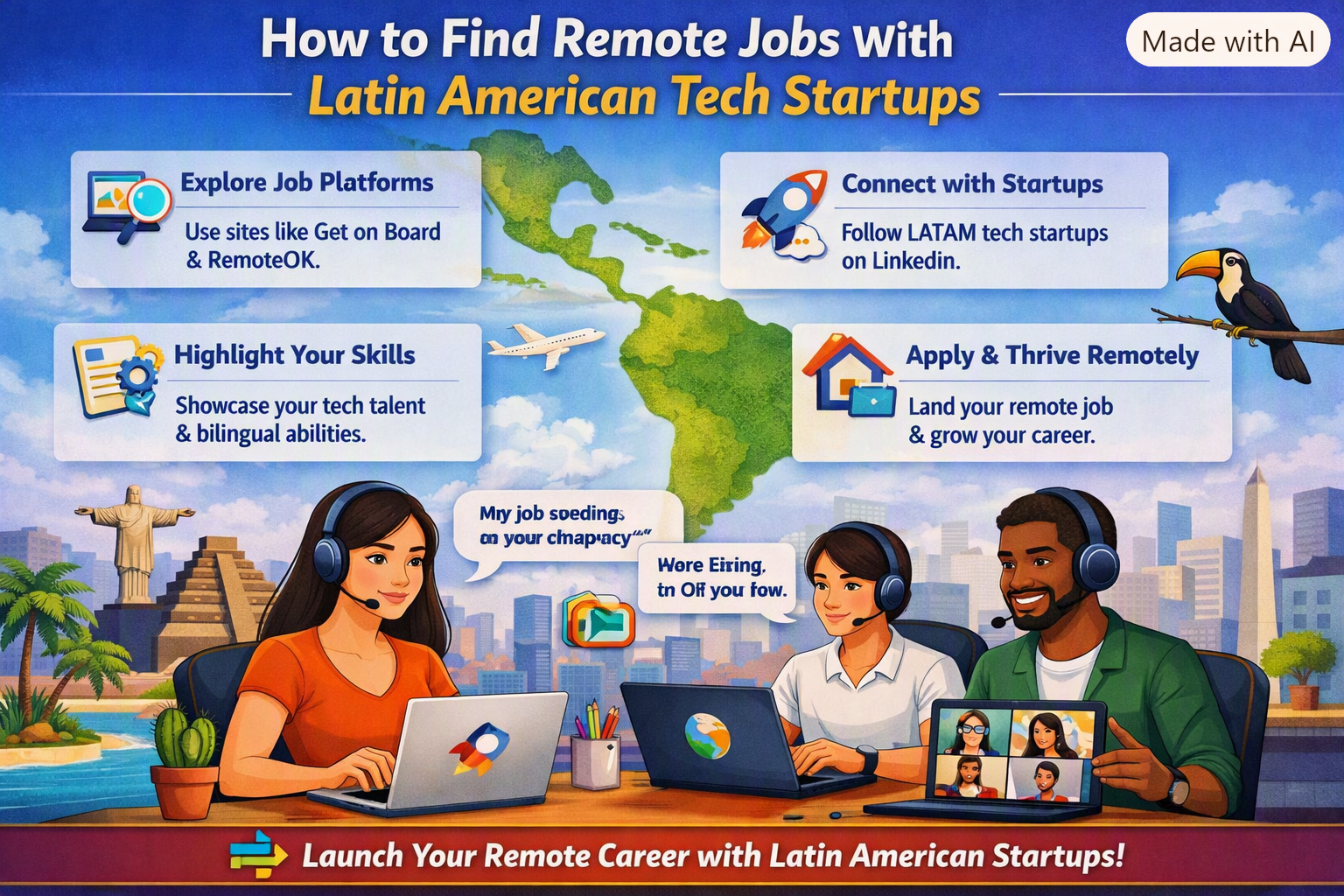
Working remotely gives professionals a chance to build experience and expertise with international employers. While anglophone job boards overflow with opportunities in the United States, Canada, and Europe, Latin American startups also offer excellent remote jobs. The region covers a vast area with many tech startups in fintech, e-commerce, software, health-tech, edtech, logistics, and other industries.
How to find remote jobs With Latin American tech startups is a relevant question for job seekers who wish to work with international employers. However, a more accurate phrasing would be How to Find Remote Jobs With Latin American Tech Startups and Other International Employers .
One cannot deny the appeal of working for familiar brands. On the other hand, unfamiliar businesses offer better opportunities, simply because they are looking for people to fill open positions. The job seeker only has to invest time and effort into researching companies and professional networks.
How to Find Remote Jobs With Latin American Tech Startups?
1. Know the Markets
The usual practice is to post job openings on monster.com or similar job sites. However, these are not the only places to look. A more thorough job search will bring far better results. First of all, one must study the Latin American tech startup market. Diverse fields include fintech, e-commerce, software, logistics, edtech, and more.
Each country has its peculiarities, but the most well-known markets are Mexico, Brazil, Colombia, Argentina, Chile, and Peru. Furthermore, it is essential to understand how Latin American companies recruit employees.
2. Avoid Large Job Boards
While searching giant job sites is not a crime, these will provide poor results. Latin American startups rarely advertise job openings on monster.com or similar sites. A more effective method is to research companies directly at websites, linkedin, and other professional networks. One can also utilize linkedin search to find firms in Mexico, Brazil, and other countries.
Next, one should go to the websites of interesting companies and inquire if they are open to international applicants. Even if there are no currently available jobs, a remote worker may still be considered.
3. Linkedln Prospecting
Linkedin is an easy way to research companies and even find recruiters. Moreover, one does not have to look for remote jobs only. Simply put, linkedin allows a person to discover companies and people in the industry. The best practice is to follow interesting businesses and communicate with recruiters, founders, HR managers, and other professionals.
One’s linkedin page should then reflect the primary purpose – finding international remote jobs. That is, a person must market themselves as capable, competent, and successful. Most importantly, they must state their availability for international remote projects.
4. Remote-Friendly Companies
The situation varies from company to company – some are friendly to remote workers, but only within a certain location. Others only accept local workers due to payroll, tax, legal, or other reasons. For this purpose, it is critical to look at job descriptions and see if they mention “remote worldwide” or “remote across LATAM”.
If this information is not available, one can ask the recruiter and request clarification. The same goes for other requirements – does the company accept applicants from all over the world?
5. Know the Skills in Demand
Typically, startups look for people who can perform various tasks. Software development, graphic design, content creation, marketing, sales, and customer service are some skills in demand. In any case, a person should know their strengths and competencies.
At the same time, one must not list their skills – they should demonstrate and prove their abilities. For example, instead of writing “social media management”, show how one has increased the number of followers, boosted their engagement, and launched new products.
6. Time Zones Are Not a Barrier
There are several time zones in Latin America that overlap with other countries. Thus, for remote workers who live in a different region, time differences are not an issue. It is worth mentioning that while it is not possible to work simultaneously with teams in Mexico, Colombia, Chile, and Argentina, it is enough to be available for meetings and collaboration.
Conclusion: Remote Jobs
Latin American tech startups are an excellent opportunity for people who want international remote experience. However, job searching in the region is more complicated than in the United States, Canada, or Europe. This comprehensive guide shows how to find remote jobs with Latin American tech startups – and not only that.
The most crucial point is to look beyond large job sites, research companies, and network. In other words, How to Find Remote Jobs With Latin American Tech Startups is not about applying to random companies. On the contrary, one must determine which employers are interesting and then find out how to apply for a job.
Ready to find remote opportunities with Latin American tech startups? Use the Best Job Tool platform to discover relevant openings, explore startup roles, and take the next step toward your remote career.




Leave a Reply