Introduction: Certification Strategically
Receiving a professional certification can enable a person to gain new skills, add it to his or her resume, and demonstrate to the employers that the individual can be a dedicated professional and increase his or her chances of salary growth. However, a certificate can help negotiate a raise only when a worker knows the right way of using the gained experience and proving its worth to the employer.
Stating that a person has received a valuable education course is not enough for salary augmentation. It is required to create a connection between a certificate and the potential contribution of a person with new competencies to the company.
How to use a certification strategically in salary negotiations is a significant issue for every professional who strives to let the acquired certificate reflect positively on their career and monetary benefits.
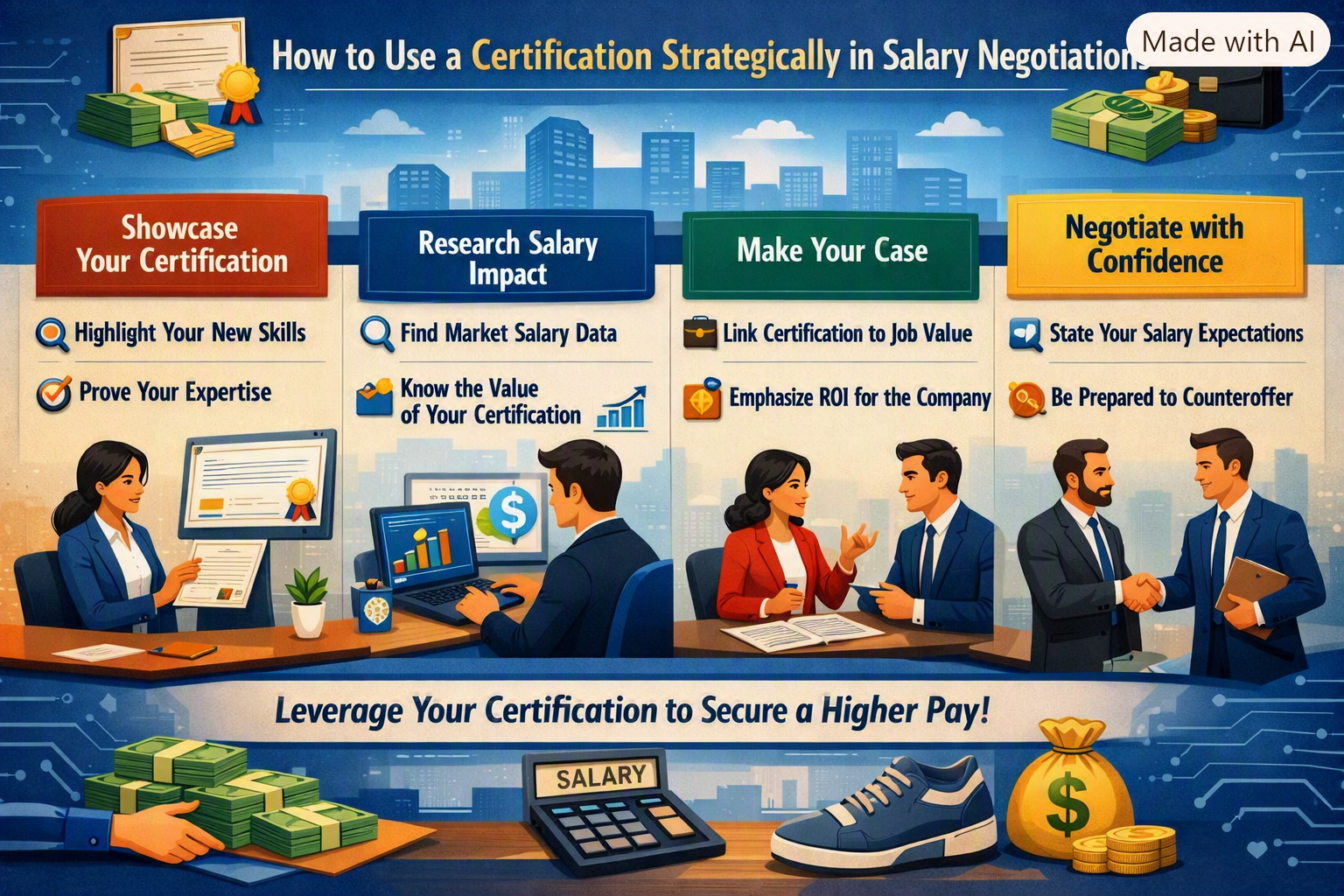
How to Use a Certification Strategically in Salary Negotiations?
1. Understand the Value of Your Certification
Before discussing a raise with an employer, it is essential to clearly understand the worth of the certificate and recognize that its cost and content may not necessarily be related to the field of work.
For example, a data analyst can demonstrate how her training in a particular analytics program has equipped her with additional skills of creating charts and databases. A project manager can share his experience of a recognized project management certification as an enhancement of his competencies in running complex projects.
In any case, it is vital to substitute the abstract idea of receiving a certificate with concrete examples of newly acquired skills or expanded competencies.
2. Connect the Certification to the Job
A certification will be of more worth if a person uses the gained experience in their current position or in the future workplace. In this way, when requesting a salary increase, it is crucial to refer not only to the existence of a certificate but also to its potential value in the workplace.
For instance, instead of simply stating that a digital marketing specialist earned a digital marketing certificate, emphasize how the certification provides specific knowledge that the employee can apply in their current role and use to support their promotion case.
3. Demonstrate the Value You Can Bring
It is a common understanding that employers care not about the personal achievements of an employee but about the specific contributions that a person can make with their skills and competencies. Therefore, in order to get a deserved raise, it is essential to demonstrate clearly how the new certificate can contribute to the success of the workplace.
If a person received a financial modeling certification, for example, they should share how the modeling skills can help optimize the finance department and work processes. In case of a cybersecurity certificate, it is possible to share how the expertise in cyber security questions can benefit the functioning of the IT department and enhance the cyber security protection of the company.
4. Use Evidence From Your Work
A certificate can only reflect the worth of the gained skills when the person not only has them but also successfully applies the new competencies in their daily work. Therefore, when an employee decides to negotiate a raise after receiving a certificate, it is crucial to have some evidence of applying the skills learned from the certificate course.
As an option, it is possible to share a short story about realizing those skills in actual work: resolving a particular issue faster and more efficiently, optimizing a certain work process, improving an important project result, and so on. A clear example of how the certificate course is used in the day-to-day work tasks will resonate positively with the employer and facilitate the discussion of salary augmentation.
5. Research the Market
Employees should not negotiate salary increases in the abstract. Instead, they should have a rough understanding of the raise they can reasonably expect based on their field, level of experience, and business location.
The certificate is not a reason for a significant salary increase, but an additional step towards a raise that is already deserved due to the augmented skills. Therefore, it is crucial to research the market and learn the average wages for similar types of work before discussing the issue with a boss.
6. Choose the Right Time
Negotiating about money is always a delicate matter that requires careful consideration. Employees should choose the right time to negotiate, such as after completing an important task, receiving praise from their manager, taking on an additional assignment, or completing a successful annual appraisal.
An employee can use the newly achieved certificate to support the request for a salary increase after realizing that their job duties have been changed and their responsibilities have been enhanced. In case of a job interview, the certificate can be mentioned as a significant step in achieving the position. At that moment, a person can ask about the starting salary and express the desire to receive a fair wage for the valuable skills and experience.
Conclusion: Certification Strategically
In conclusion, a certification can strengthen your position during salary negotiations when you connect it to the value you bring to the organization. Instead of simply mentioning the credential, highlight the skills you gained, how you apply them at work, and the measurable results they help you achieve.
Use the certification alongside your experience, achievements, and market research to make a clear and evidence-based case for better compensation. With the right strategy, a certification can become more than a qualification—it can support your professional growth and strengthen your salary negotiation.
Ready to turn your certification into stronger salary leverage? Use it strategically during negotiations, highlight its value to employers, and explore opportunities on the Best Job Tool platform to move closer to your career goals.





Leave a Reply