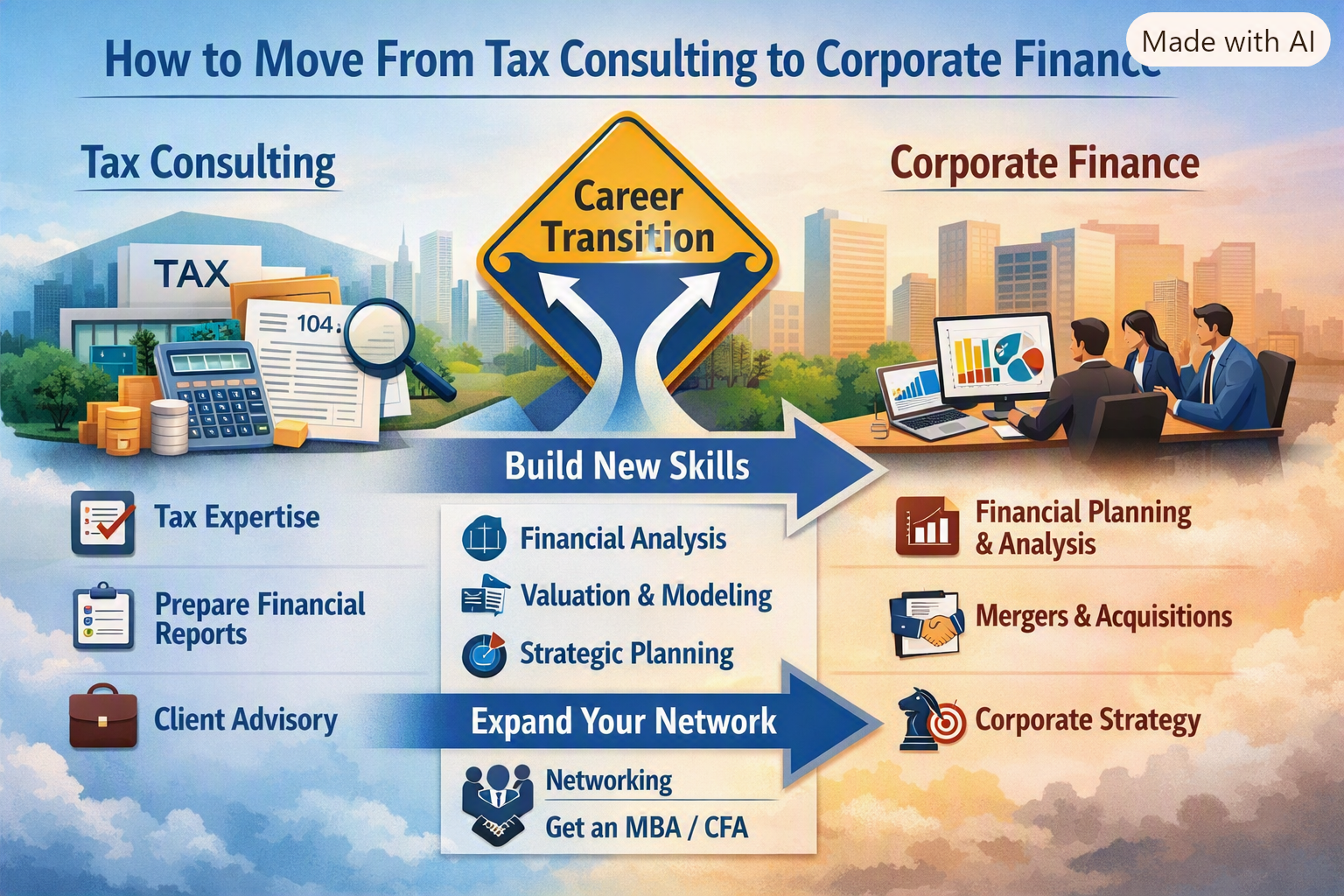
Introduction: Tax Consulting to Corporate Finance
Jumping from tax consulting to corporate finance is a smart move for those looking to pivot to make a more direct impact on the business, be involved in financial planning and strategy, or join corporate treasury. Working in tax consulting makes you knowledgeable in financial statements, regulations, business structures, and financial analysis – all of which come in handy in corporate finance.
That said, corporate finance is different from tax accounting – it is more focused on financial planning and analysis, budgeting, forecasting, cash flow management, and financial decision-making than on ensuring that financial reports are compliant with regulations. Therefore, it is worth learning the ropes of corporate finance before making the switch.
How to Move From Tax Consulting to Corporate Finance?
1. Discover What Corporate Finance Professionals Do
Before jumping into a new field, it is worth knowing what professionals in this area do on a daily basis. Typically, their responsibilities include budgeting and forecasting, financial planning and analysis (FP&A), cash flow management, preparing reports for management, analyzing business performance, and helping the company reach its financial goals.
Some of the roles you can consider include Financial Analyst, FP&A Analyst, Corporate Finance Analyst, Finance Manager, Treasury Analyst, and others. Every position has its own set of duties – so, prior to changing fields, go over the most common ones to identify skill gaps.
Your tax expertise will come in handy in corporate finance, as working in tax consulting makes you comfortable with financial reports, numbers, and calculations. All you need to do is supplement your knowledge with the skills specific to the corporate finance space.
2. Enhance Your Financial Modeling Knowledge
One of the key skills you need to build if you want to transition from tax consulting to corporate finance is financial modeling.
If you have spent most of your career working on taxes, there is a good chance that you do not have any experience working on financial models. Begin by learning Excel – the basics, such as formulas (including XLOOKUP, SUMIFS, INDEX-MATCH, and IF functions), pivot tables, charts, and data analysis, as well as some automation.
Next, move on to more complex topics, such as financial modeling – forecast modeling, revenue, expenses, cash flow, and P&L models. Once you have mastered the basics, build a few simple financial models. You do not need to invest too much time in them – just learn how to represent relevant data.
You do not need to be a level 3 investment banker to start working in corporate finance. However, you should be able to use Excel to build a simple financial model that can help you understand what drives revenues and profits.
3. Brush up on Your FP&A Knowledge
Another crucial step is to learn financial planning and analysis (FP&A) fundamentals. The corporate finance space is rife with jargon, including working capital, budgeting, forecasting, and variance analysis, to name a few. You need to know what these terms mean and how they fit into financial statements and corporate finance practices.
For example, if expenses are higher than budgeted, you need to know why it is the case (was the budget too low or were the costs too high?) and what it means for the business. In addition, you need to be able to demonstrate this to stakeholders.
While doing taxes requires a deep knowledge of regulations and laws, analyzing variances is more about scrutinizing financial reports and understanding how this affects the business. This is a completely different skill that takes practice and critical thinking to develop.
4. Leverage Your Tax Consulting Background
When changing careers, many people try to distance themselves from their previous background. However, when transitioning from tax to corporate finance, it is worth embracing your experience, as it has made you knowledgeable about regulations, financial statements, and business operations. Specifically, working in taxes exposes you to clients from different industries and business structures (C-Corp, S-Corp, LLC, LLP), financial reports (P&L, tax returns, balance sheets), and transactions.
This means that you have a good understanding of financial statements and can evaluate how a specific transaction affects P&L, balance sheets, cash flow, and taxes. This is extremely useful in the corporate finance space, where you need to analyze financial reports to identify trends and make recommendations to management.
If you are updating your resume, highlight the skills you have acquired in tax consulting, such as financial analysis, Excel skills, and report preparation, rather than focusing on tax-specific duties. Similarly, in your LinkedIn profile, make sure to update the skills section to include financial reports, Excel, data analysis, and FP&A rather than tax accounting, income tax, or VAT.
5. Get Up to Speed With Business Operations
While financial reports are important, to truly succeed in corporate finance, you need to understand the business and how it makes money. Choose the industry you want to work in and research its business model. Learn the key revenue drivers, expenses, and risks, as well as the industry’s competitive landscape.
For instance, a finance professional in the tech industry will focus on customer acquisition costs and gross margins, whereas someone in manufacturing will be concerned with production costs and working capital. Doing so will make it easier to analyze the company’s performance and prepare reports that stakeholders will find insightful.
6. Consider an Internal Transfer
If your company has a finance team, it might be worth applying for an internal transfer rather than looking for finance jobs elsewhere. Chances are, your manager or the finance team will be more receptive to your application, seeing that you already work in the company.
Ask them if there are any opportunities to contribute to the finance department’s projects or support the team in its day-to-day operations. You might be able to assist the team in budgeting and forecasting or analyze some simple financial reports to gain exposure to corporate finance. This experience will be invaluable when you begin looking for finance jobs elsewhere.
Conclusion: Tax Consulting to Corporate Finance
Moving from tax consulting to corporate finance requires professionals to build on their existing financial expertise while developing skills that align with corporate decision-making. Tax consultants already understand financial statements, regulations, risk, and business structures, which can provide a strong foundation for roles in financial planning, analysis, treasury, and corporate finance. By gaining experience in financial modeling, budgeting, forecasting, valuation, and strategic analysis, professionals can make this transition more effectively.
Ready to move from tax consulting to corporate finance? Build the right skills, highlight your transferable experience, and explore relevant opportunities with the Best Job Tool platform to take the next step in your career.






Leave a Reply