Introduction: Coach an Employee
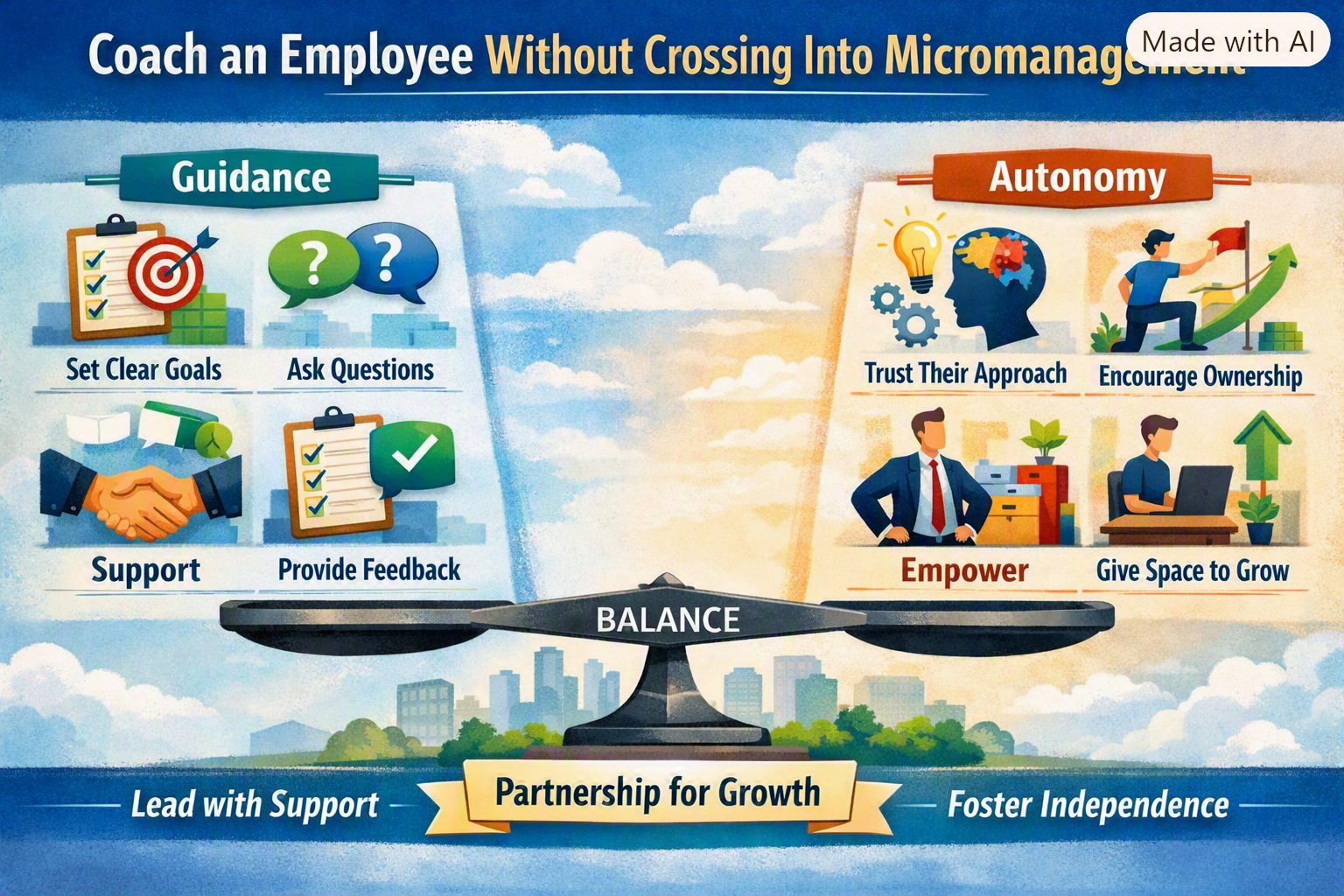
Good managers want their employees to excel at their jobs, learn new skills, and be more self-confident. Coaching is the best way to achieve this. Yet, this approach is very close to micromanagement. Once the line between coaching and micromanagement is crossed, employees feel as if they are not trusted to perform their duties.
How to coach an employee without crossing into micromanagement is one of the must-know skills every manager should master to successfully guide their underprivileged without losing their autonomy. Below are the practices that will help line leaders balance between coaching and micromanagement.
How to Coach an Employee Without Crossing Into Micromanagement?
1. Understand What Coaching and Micromanagement Are
Coaching is a process of helping an employee identify and solve problems, acquire new skills, and find solutions to recurring issues through guidance and advice. Micromanagement is a practice when a manager is excessively watching over an employee.
For instance, asking a subordinate for their opinion on how to approach a specific task and discussing possible improvements is coaching. However, constantly reminding them of actions to take and double-checking every detail is micromanagement.
The purpose of coaching is to make employees more capable, not more reliant on their managers.
2. Set Expectations
Before coaching an employee, it is essential to define what the coach expects from the subordinated. Having unclear expectations can lead to managing-by-the-minute, hence demoralizing an employee.
Make sure to explain the objective, deadline, quality level, and priorities clearly. Then, leave the rest to an employee. Instead of giving precise instructions on how to do something, define the expected outcome. For instance, say, “I need this report by Friday,” instead of, “First, do this, then send this e-mail, and finally, prepare the report in the following format.”
3. Ask Questions Instead of Giving All the Answers
The simplest and most apparent way to avoid crossing into micromanagement is to ask questions instead of making suggestions.
Instead of telling an employee what to do and how to do it, managers should ask them what they think should be done, what options they have, and what help they may need.
Such questions as “What do you think is causing the problem?” or “How would you handle it if … ?” can be asked when an employee comes to a manager for advice. Additionally, ask them what they need to succeed in performing their tasks and meet the goals.
4. Give Feedback Only When Necessary
Feedback plays an essential role in coaching communication. However, feedback should not be given on each task or project. Only comment on what the employee does right and what specifically needs improvement.
For instance, say, “I liked that you included the following points in your presentation; however, next time, try to make it more organized and easier to comprehend.” Instead of stating that the whole presentation was underwhelming, point out the positive and the negative aspects along with the changes that may be suggested.
5. Give Space for an Employee to Do Their Job
Once the managers have discussed the objectives and targets, it is time to give the underprivileged more autonomy. Only remind about the outcome that should be achieved and let an employee handle it on their own.
It may be helpful to establish some milestones, yet only follow the progress at regular intervals, not every minute. For instance, say, “We will meet next week and discuss your progress” instead of “Tell me what you did every day this week.”
6. Be Mindful of How Much Experience an Employee Has
Depending on how much work experience an employee has, the extent of a manager’s interference should vary. Newcomers may need more guidance and support since they lack the competencies and confidence experienced specialists have. Therefore, more seasoned workers will have more autonomy.
Conclusion: Coach an Employee
Managers should make sure that their expectations are clearly defined. They should make suggestions and ask lots of questions. Moreover, the managers should be ready to provide feedback only when necessary and give the employees adequate space and time to handle their tasks on their own.
The major difference between coaching and micromanagement is the level of trust. A coach helps an employee identify the outcome they need to achieve, while a micromanager wants to control how they will handle their tasks. By providing guidance, support, and encouragement, managers will make their employees better at what they do without making them overly reliant on them. In the long term, such an approach will help the managers and employees succeed.




Leave a Reply