Introduction: Exhibition Design and Spatial Branding
In the current experience-based world, the key to brands’ success is not only their recognition and visual appeal but their physical presence. That is why curating engaging events and exhibitions, designing retail spaces, museums, corporate interiors, and other objects of spatial structure has become a fascinating career choice.
If you are interested in learning how to build a career in exhibition design and spatial branding, then you should know that it will require a creative mind, design skills, and a solid understanding of spatial structure fundamentals.
What Is Exhibition Design and Spatial Branding?
Exhibition design refers to the work surrounding the conception of an exhibition, trade fair, museum, gallery presentation, event, or installation. It is concerned with presenting information or a particular narrative to the audience through space, graphics, lighting, materials, technology, and interaction.
Meanwhile, spatial branding uses spaces to convey a particular message about a brand’s identity. Be it showrooms, corporate offices, or branded events, the underlying theme communicates its message to the public.
The practice blends together themes and principles from architecture, interior design, graphic design, illustration, technology, and marketing.
How to Build a Career in Exhibition Design and Spatial Branding?
1. Develop a Solid Foundation in Design
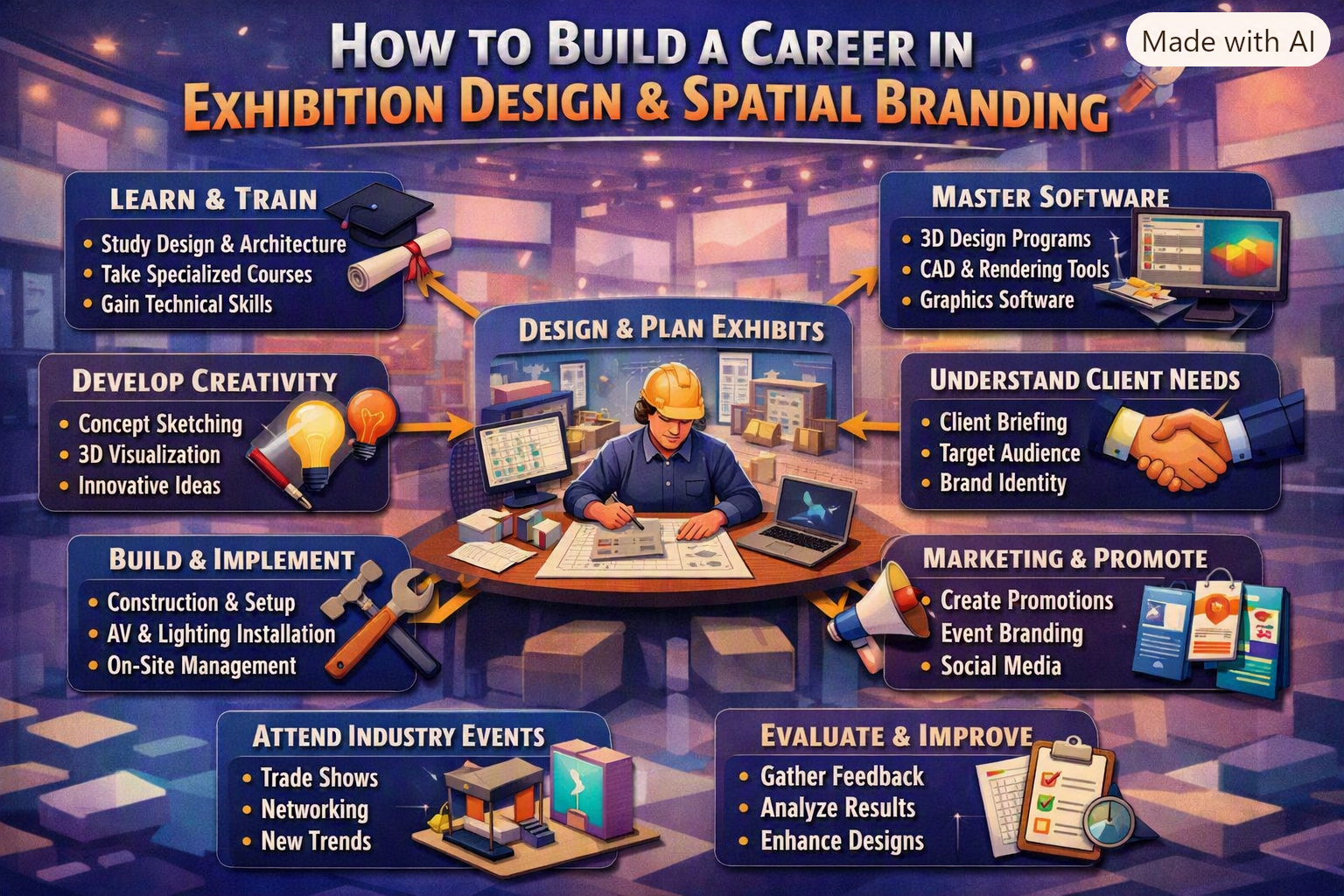
The first step towards learning design and spatial branding is to develop a solid foundation in design. It is essential to be able to identify and understand the principles of composition and color theory, typography, hierarchy, scale and proportion, materials, finishes, and lighting.
A degree in interior design or architecture or graphic design, and industrial design would be a good starting point. However, formal qualifications are not mandatory, as there are other routes that one can take to obtain similar skills, such as online design courses, workshops, internship, and experience.
It is essential to ensure that you have sufficient knowledge about the underlying principles of what makes any given space work.
2. Learn the Tools of the Trade
Most designers working in the field of exhibitions and spatial design use a combination of different software to create their designs. Gaining a good working knowledge of computer-aided design and graphic design software is, therefore, integral to a successful career in the field.
Some designers might specialize in one area over others. If one is interested in a particular field within exhibition design, it might be helpful to look into what specific software they use within their area. One might have to learn:
- 3D design and modelling software
- Computer-aided design (CAD) software
- Graphic design and 2D design software
- Rendering, animation, and presentation design
- 3D printing
- Digital presentation and portfolio design
- Virtual and augmented reality
The list of programs mentioned is by no means exhaustive, and there are dozens, if not hundreds, of different programs used in the exhibition design industry. It is vital to understand that it is not necessary to know all programs listed but to have at least some working knowledge of most. The best approach would be to start learning the ones one is most interested in and build from there.
3. Build a Strong Portfolio
A portfolio is one of the most important tools for anyone who wants to find a job in the field of exhibition design and spatial branding. Employers and clients alike are interested in seeing your thought process when you have to come up with a concept for a new exhibit or space.
Your portfolio can include academic projects, personal works, internships, freelance works, or self-initiated projects. For instance, you can make a concept for:
- A museum exhibition
- A corporate experience centre
- A retail pop-up
- A trade-show booth
- A brand activation
- A cultural installation
But do not forget to include not only the final images but also the process: research, sketches, mood boards, concept development, floor plans, material selections, 3D views, and final designs. A good portfolio will tell the employer or client about your thought-process as a designer.
4. Understand Brand Storytelling
Spatial branding is much more than only making a space beautiful. Every detail has to be considered and developed to fit the concept and communicate the intended message.
Ask yourself a few questions:
- What do you want the visitors to feel when they enter the designed space?
- What message should the space communicate?
- How should the visitors interact with the environment?
- What colours, materials, graphics, sound design, and technology will help you achieve the concept and communicate the brand’s message?
Once you learn to ask the right questions, you will become a master at spatial branding and be able to offer your services as an experience designer .
5. Gain Real-World Experience
While theoretical knowledge is essential, practical experience will teach one how the actual industry functions.
Therefore, acquiring professional experience through internships or entry-level jobs at exhibition design agencies, immersive agencies, architecture companies, event planners, museums, showrooms, retail design studios, and branding agencies can be beneficial.
In particular, one will learn how to cooperate with clients, vendors, manufacturers, project managers, and architects, as well as graphic designers and other experts.
Furthermore, through professional experience, one will learn that a successful concept is not only creative and visionary but also realistic, safe, feasible, and within the budget.
6. Improve Communication Skills
Exhibition and spatial design professionals should be able to communicate effectively and convincingly present their ideas to clients.
One may need to negotiate, clarify details, plan the logistics of a project, describe technical specifications to contractors, and perform other various communication tasks.
Therefore, it is essential to improve presentation skills, storytelling, communication with clients, collaboration, design documentation, problem-solving, and project management abilities.
The ability to communicate effectively may be vital when trying to get a job. Moreover, if one aims to work in a large organization, excellent communication skills and project management skills will be vital.
Conclusion
Thus, How to build a career in exhibition design and spatial branding? Firstly, it is crucial to build a solid foundation in design. Moreover, it is essential to learn digital tools, develop a portfolio of work, gain practical experience, and learn how brands communicate.
Most importantly, it is vital to be curious about how people experience the world and how designers can make their experience better.
Exhibition design and spatial branding could be a great career choice for those who want to merge their creative minds with architecture, graphic design, narrative, and technology. With the right approach, motivation, and a great portfolio, anybody could build a successful career in exhibition design and spatial branding.
“Exhibition design and spatial branding offer exciting opportunities for creative professionals who enjoy combining design, storytelling, and physical experiences. Build a strong portfolio, develop industry-relevant skills, connect with professionals, and turn your creativity into a rewarding career with Best Job Tool
.”



Leave a Reply