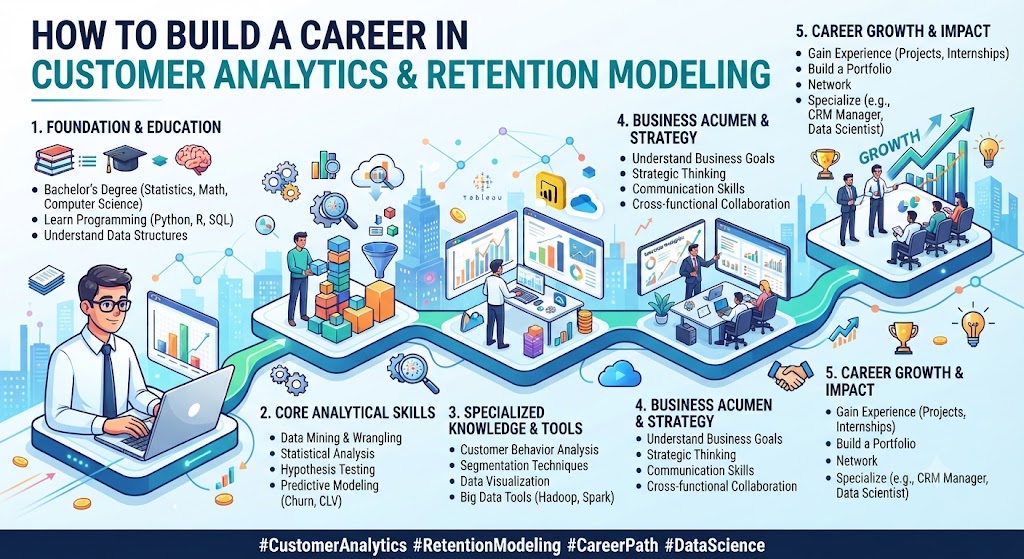
Customer analytics and retention have become critical priorities for businesses that want to increase customer lifetime value, reduce churn, and build sustainable revenue. As companies collect more customer data across websites, mobile applications, CRM platforms, social media, and support channels, they need professionals who can turn that information into practical business Modeling decisions.
A career in customer analytics and retention combines data analysis, customer behavior, business strategy, and marketing. It can be a strong option for professionals who enjoy understanding why customers buy, leave, return, or engage with a product.
Unlike highly technical data science careers, many customer analytics roles can be entered through business intelligence, marketing analytics, CRM, customer success, or reporting experience. Remote opportunities have also expanded the career path, allowing professionals to work with international teams while building analytical expertise.
Whether you are starting your career or transitioning from marketing, sales, finance, or operations, understanding the available roles and skills can help you create a practical career plan.
1. What Are Customer Analytics and Retention Careers?
Customer analytics focuses on using customer and business data to understand behavior and improve decision-making. Retention analytics is a closely related area that focuses specifically on keeping existing customers engaged and reducing churn.
Professionals in this field may analyze:
- Customer acquisition and conversion rates
- Purchase frequency and average order value
- Customer lifetime value
- Churn and retention rates
- Product engagement
- Customer segments
- Subscription renewals
- Marketing campaign performance
- Customer satisfaction and feedback
- Repeat purchase behavior
For example, an e-commerce company may discover that customers who make a second purchase within 60 days are significantly more likely to remain active. An analyst could then help the marketing team develop campaigns specifically designed to encourage that second purchase.
The goal is not simply to produce reports. The goal is to identify patterns and recommend actions that improve customer relationships and business performance.
2. Career Opportunities in Customer Analytics and Retention
Customer analytics offers several career paths depending on your background and technical ability. You do not necessarily need to become a data scientist to build a successful career.
Common roles include:
Customer Data Analyst
Customer data analysts examine customer behavior and create reports that help businesses understand performance. They may work with spreadsheets, dashboards, CRM data, and business intelligence platforms.
Customer Insights Analyst
Customer insights analysts focus on discovering trends and translating customer behavior into business recommendations. Strong communication and presentation skills are particularly valuable in this role.
CRM Analyst
CRM analysts work with customer relationship management systems to evaluate customer interactions, campaigns, segmentation, and engagement.
Retention Analyst
Retention analysts specifically focus on reducing churn and improving repeat engagement. They may analyze why customers leave and identify opportunities to increase retention.
Marketing Analyst
Marketing analysts evaluate campaigns, channels, customer segments, and conversion performance. This can be an effective entry point for professionals transitioning into customer analytics.
Customer Success Analyst
Customer success analysts use account and engagement data to help teams identify customers who may need additional support or who are at risk of leaving.
As you gain experience, potential progression can include Senior Customer Analyst, Customer Insights Manager, CRM Manager, Retention Manager, or Customer Analytics Lead.
3. Skills You Need to Build a Customer Analytics Career
The strongest candidates combine analytical capabilities with business and communication skills. You should focus on practical skills rather than trying to master every analytics technology at once.
Start with these core areas:
- Excel or Google Sheets for data cleaning and reporting
- SQL for querying customer databases
- Power BI or Tableau for dashboards
- CRM platforms and customer data systems
- Basic statistics and data interpretation
- Customer segmentation
- Cohort analysis
- Churn analysis
- Customer lifetime value analysis
- Data storytelling and presentation
SQL is particularly useful because customer information is often stored across multiple database tables. Learning how to filter, join, aggregate, and analyze data can significantly expand your job opportunities.
You should also develop business skills. An analyst who can explain what the numbers mean and what the company should do next is often more valuable than someone who can only produce technically accurate reports.
4. How to Build Practical Experience Without a New Degree
You can develop customer analytics experience through projects, freelance work, internships, internal business projects, or self-directed case studies.
A strong portfolio should demonstrate how you approach business problems.
For example, create a retention analysis project using a publicly available dataset. Analyze customer activity and answer questions such as:
- Which customer groups have the highest churn?
- When do customers typically become inactive?
- Which segments generate the most revenue?
- What characteristics are associated with repeat purchases?
- What retention strategy would you recommend?
Build a dashboard showing the most important findings. Then create a short business report explaining your recommendations.
You can also use your current job to gain relevant experience. A marketing professional could analyze campaign conversions, while a customer support employee could study ticket patterns and customer complaints.
When applying for roles, describe the business outcome rather than simply listing the tools you used.
Instead of saying:
“Created Excel reports.”
Use a stronger description such as:
“Analyzed customer engagement data to identify high-risk segments and developed reporting that supported targeted retention campaigns.”
This makes your analytical contribution clearer to recruiters.
5. Remote Work and International Career Opportunities
Customer analytics is well suited to remote work because much of the work involves digital systems, dashboards, databases, virtual meetings, and collaborative documentation.
Remote customer analytics professionals may work with teams across different countries and time zones. This creates opportunities to build international experience without immediately relocating.
To succeed remotely, technical knowledge alone is not enough. Employers often look for professionals who can work independently and communicate findings clearly.
Important remote-work habits include:
- Maintaining organized project documentation
- Communicating progress proactively
- Managing deadlines across time zones
- Presenting analytical findings through virtual meetings
- Keeping dashboards and reports updated
- Protecting customer and company data
- Using asynchronous communication effectively
Remote professionals should also build a reliable personal workflow. A simple system for tracking tasks, meetings, analysis deadlines, and follow-ups can prevent small responsibilities from becoming missed commitments.
When searching for remote opportunities, use targeted searches for terms such as “Customer Analytics Analyst,” “Retention Analyst,” “CRM Analyst,” “Customer Insights Analyst,” and “Customer Success Analyst.” A global job platform such as best job tool can also help professionals discover opportunities beyond their immediate local market.
6. Travel Testing, Productivity, and Financial Planning
Remote customer analytics careers can provide greater location flexibility, but working while traveling requires careful planning. Before adopting a travel-based work routine, test the arrangement rather than assuming that every destination will support productive remote work.
Start with a short travel test.
For example:
- Work remotely from another city for one week.
- Test your internet reliability.
- Maintain your normal working hours.
- Check whether the environment supports meetings.
- Measure your productivity compared with your normal workspace.
- Identify unexpected expenses.
This gives you practical information before committing to longer travel.
Productivity should also be measured realistically. A professional working from a different location should maintain clear working hours, protected focus periods, and reliable communication with colleagues.
Financial planning is equally important. Remote work does not automatically mean lower expenses. Travel can introduce accommodation, transportation, insurance, coworking, connectivity, and currency-related costs.
Before extended travel, calculate:
Monthly income – fixed expenses – travel expenses – emergency savings contribution = available discretionary budget
Maintain an emergency fund and avoid basing travel decisions on uncertain future income. If your employment arrangement involves working internationally, also verify company policies, tax requirements, work authorization, and data-security rules before traveling.
The objective is to make remote flexibility sustainable rather than turning it into a source of financial or professional instability.
7. How to Advance From Analyst to Customer Analytics Leader
Career growth requires moving beyond reporting toward strategic decision-making. Once you understand customer data, focus on connecting analytics with measurable business outcomes.
Develop expertise in areas such as:
- Customer lifetime value optimization
- Churn prediction
- Retention strategy
- Experimentation and A/B testing
- Customer segmentation
- Personalization
- Revenue analytics
- Customer journey analysis
You should also learn to communicate with senior stakeholders. A manager generally does not need to know every technical step behind an analysis. They need to understand the business problem, key finding, financial impact, and recommended action.
For example, instead of presenting a dashboard with dozens of metrics, explain:
“Customers who do not complete their second purchase within 45 days have a substantially higher likelihood of becoming inactive. A targeted re-engagement campaign during this period could improve repeat purchasing.”
This approach turns analytics into business strategy.
Career advancement also becomes easier when you build a professional network. Follow customer analytics leaders, participate in industry discussions, attend virtual events, and share useful insights from your projects on LinkedIn.
A global job platform such as best job tool can also support professionals who are exploring remote and international customer analytics opportunities.
Conclusion
Customer analytics and retention careers offer a practical path for professionals who want to combine data, customer behavior, and business strategy. The field includes opportunities in customer insights, CRM, marketing analytics, retention, and customer success.
You do not need to master every advanced technology before getting started. Build a foundation in Excel, SQL, dashboards, customer metrics, and business communication. Then demonstrate your abilities through practical projects and measurable business recommendations.
Remote work can expand your opportunities, while travel testing and disciplined financial planning can help you use location flexibility responsibly. As your experience grows, focus on moving from producing reports to influencing retention strategies, customer experience, and revenue decisions.
For professionals willing to continuously develop both analytical and business skills, customer analytics can provide a flexible career path with opportunities for specialization, remote work, international collaboration, and long-term leadership growth.


Leave a Reply