Introduction: Career in Singapore
Singapore is emerging as one of Asia’s most attractive destinations for skilled professionals. Due to its high economic growth, international business environment, quality of life, and infrastructure, professionals are choosing to make their career in Singapore. Though, it is important to understand the ins and outs of the local job market in order to build a rewarding career in the country. Let’s take a closer look at how to find and succeed in a job in Singapore.
Firstly, it is essential to understand the most in-demand professions in the city. Given that Singapore is a global business hub, it is no surprise that jobs in finance, insurance, and investments are among the most sought-after ones. Secondly, it is important to realize that the market is highly competitive and only talented individuals with special skills can succeed.
Moreover, there are local peculiarities that one must know about when searching for a job in the city. For example, professionals often face problems understanding the local business etiquette. And last but not least, it is important to build a network of professional contacts in order to climb up the career ladder.
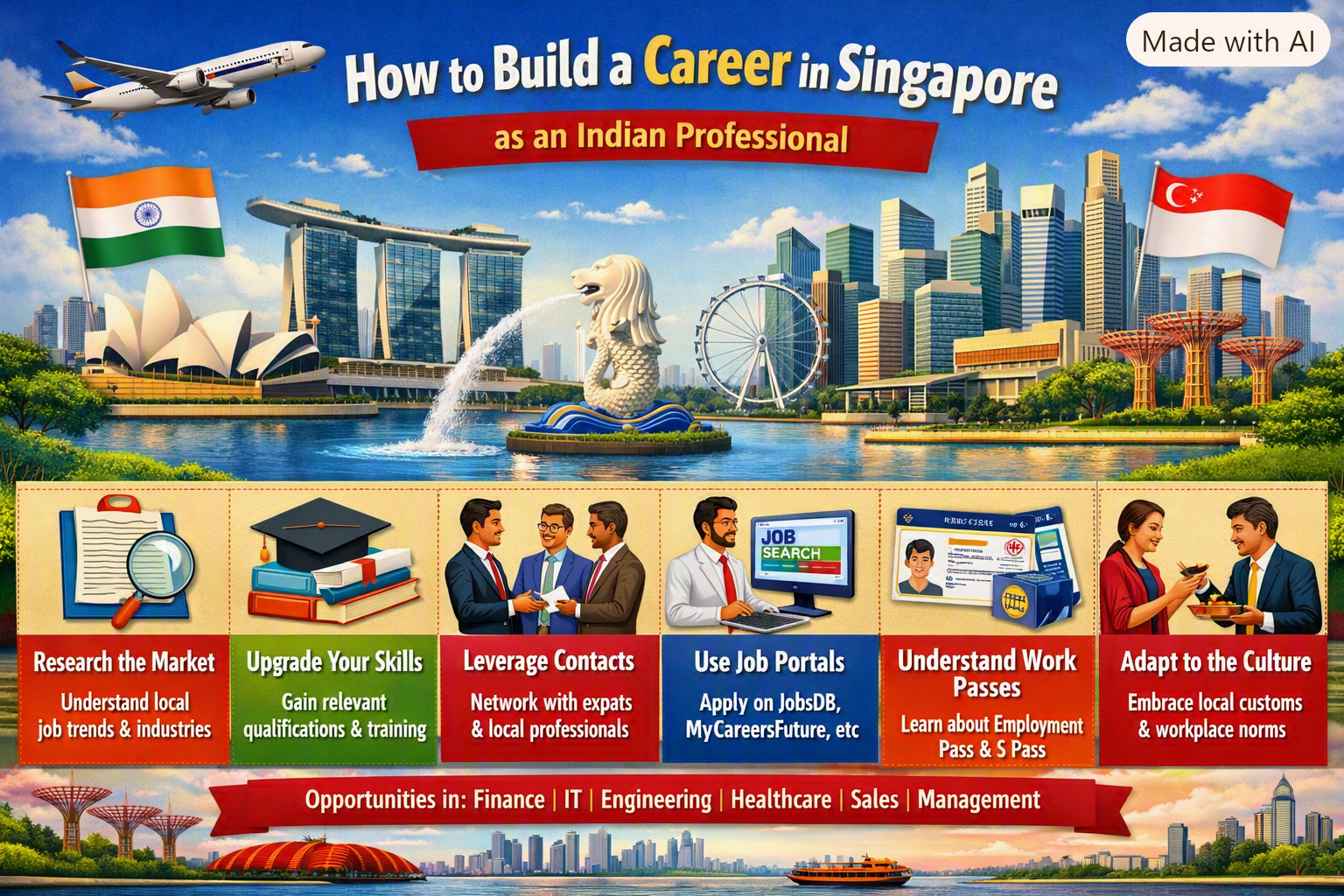
How to Build a Career in Singapore as an Indian Professional?
1. Understand the Singapore Job Market
The first step to finding a job in Singapore as an Indian is to identify the industries that are in high demand there. Singapore has a well-developed financial sector, and the local economy relies on technology and healthcare. Other in-demand sectors are engineering, logistics, consulting, biotechnology, digital services, and many others. To gain experience in such spheres as software development, data analysis, cybersecurity, finance, supply-chain management, and artificial intelligence, you can find a great offer in Singapore.
Research the Companies and Specializations. Once you have an idea of which companies are looking for specialists in Singapore, you need to narrow down the search to specific positions that match your experience. Make sure that you highlight the skills and qualities that are required for the job, as those are the criteria you’ll have to fulfill to get the position.
2. Build Skills That Employers Want
The competition for jobs in Singapore can be intense. Indian professionals need to think of ways to stand out from the crowd. In addition to technical skills, it is important to have good soft skills such as communication, problem solving, leadership, and adaptability. Employers are looking for individuals who not only have the necessary technical skills but are also able to collaborate with others, take charge when needed, and adapt to changing circumstances.
Consider getting certifications that are relevant to your field of work. For instance, if you are a technology professional, you could look into certifications in cloud computing, cyber security, data science, or project management.
If you are a finance professional, it might be a good idea to get certifications in financial regulations. Upskilling is particularly important given Singapore’s status as a global innovation and digitalization hub.
3. Prepare a Singapore-Focused Resume
A good resume is often the difference between landing a job interview and being passed over for one. To help your resume stand out from the competition, it should be brief, to the point, and use accomplishment-oriented language. Instead of stating, “managed a team of employees,” for instance, you could write, “managed a team of 12 employees and cut project delivery time by 20%,” or something similar.
You should also ensure that your LinkedIn profile is up-to-date and reflects your professional goals, as recruiters in Singapore and elsewhere are increasingly using professional social media to find qualified candidates for hire.
4. Understand Employment Pass Requirements
For foreign professionals, it is vital to understand the nuances of Singapore’s work-pass system and determine which type of employment pass or work authorization they need based on their qualifications, salary, experience, and occupation.
Since requirements and salary criteria may change, it is essential to consult the most recent information from Singapore’s Ministry of Manpower before applying for a job. At the same time, an attractive job offer does not necessarily guarantee that a work pass will be approved. In addition, it is worth noting that employers often take into account the uniqueness of the skills possessed by the applicant, so it is essential to demonstrate one’s competencies and specialization.
5. Build a Professional Network
Networking is an essential aspect of building a career in Singapore as an Indian professional. One can find numerous opportunities through networking events, professional interactions, alumni events, conferences, and other similar platforms.
Connect with other professionals working in your industry in Singapore and stay updated with developments and happenings in your field. Engaging with other professionals on social media platforms like LinkedIn also helps one get better opportunities. If one studies in a particular Indian University and some of their alumni work in Singapore, one can connect with them and get handpicked suggestions about the job market there.
While connecting with other professionals and building a network, one should not solely focus on asking for job leads. Instead, one should concentrate on learning from other professionals’ journeys and experiences.
6. Adapt to Singapore’s Workplace Culture Essay
Since Singapore is a multi-ethnic country, Indians working there have to adjust to the presence of people of different nationalities in their workplace. They often have to collaborate with individuals who have a different mindset or whose approach to meetings, hierarchy, and punctuality may be substantially different from what workers in India are used to.
Thus, professionalism, reliability, polite attitude to other employees, and communication skills are vital competencies to navigate the Singapore workplace culture. Indians should be open to new experiences and not expect to find the same working principles as in their home country. Lastly, learning the local culture and not forgetting one’s own may benefit Indians’ working experience in Singapore.
Conclusion: Career in Singapore
Career in Singapore for Indian professionals requires proper planning and a set of skills to help navigate the local business landscape. From researching the local job market and its requirements to ensuring the best resume and professional network, every step plays a critical role in determining career prospects.
Indian professionals seeking to establish themselves in Singapore should strive to build the necessary knowledge base, skills, and attitudes to meet the expectations of local employers. Notably, individuals must invest more effort in improving their communication skills and understanding Singapore’s diverse workplace culture. Overall, Indian professionals have a great opportunity to boost their career growth while gaining valuable insight into the local labor market.
“Singapore offers opportunities for skilled professionals across many industries. Research the right roles, understand work visa requirements, tailor your resume to Singapore’s job market, and build a strong professional network. Take the next step toward your international career with Best Job Tool.”





Leave a Reply