Businesses today operate in an environment where customer demand can change quickly due to economic conditions, seasonal trends, competition, technology, and changing consumer preferences. As a result, companies need professionals who can analyze data, anticipate demand, and help organizations make better decisions about inventory, production, purchasing, and sales.
This has increased the importance of careers in demand planning and sales forecasting across industries such as retail, manufacturing, e-commerce, logistics, consumer goods, pharmaceuticals, and technology. These roles combine analytical thinking with business knowledge, making them attractive options for professionals who enjoy working with data but also want to influence real business decisions.
Demand planning focuses primarily on predicting future product or service requirements, while sales forecasting estimates future sales performance based on historical data, market conditions, customer behavior, and business strategies. Although the responsibilities can overlap, each career path offers different opportunities for specialization and advancement.
For professionals considering these fields, understanding the available roles, required skills, remote-work opportunities, productivity methods, travel considerations, and financial planning can make the career transition more structured and sustainable.
1. Understand the Career Scope in Demand Planning and Sales Forecasting
Demand planning and sales forecasting are not limited to one job title. Organizations use several roles to manage forecasting, supply planning, commercial analytics, and business performance.
Common career options include:
- Demand Planner
- Demand Planning Analyst
- Sales Forecasting Analyst
- Supply Chain Analyst
- Sales Operations Analyst
- Business Forecasting Analyst
- Supply Planning Analyst
- Inventory Planning Analyst
- Commercial Analyst
- Revenue Planning Analyst
- Sales and Operations Planning (S&OP) Analyst
- Forecasting Manager
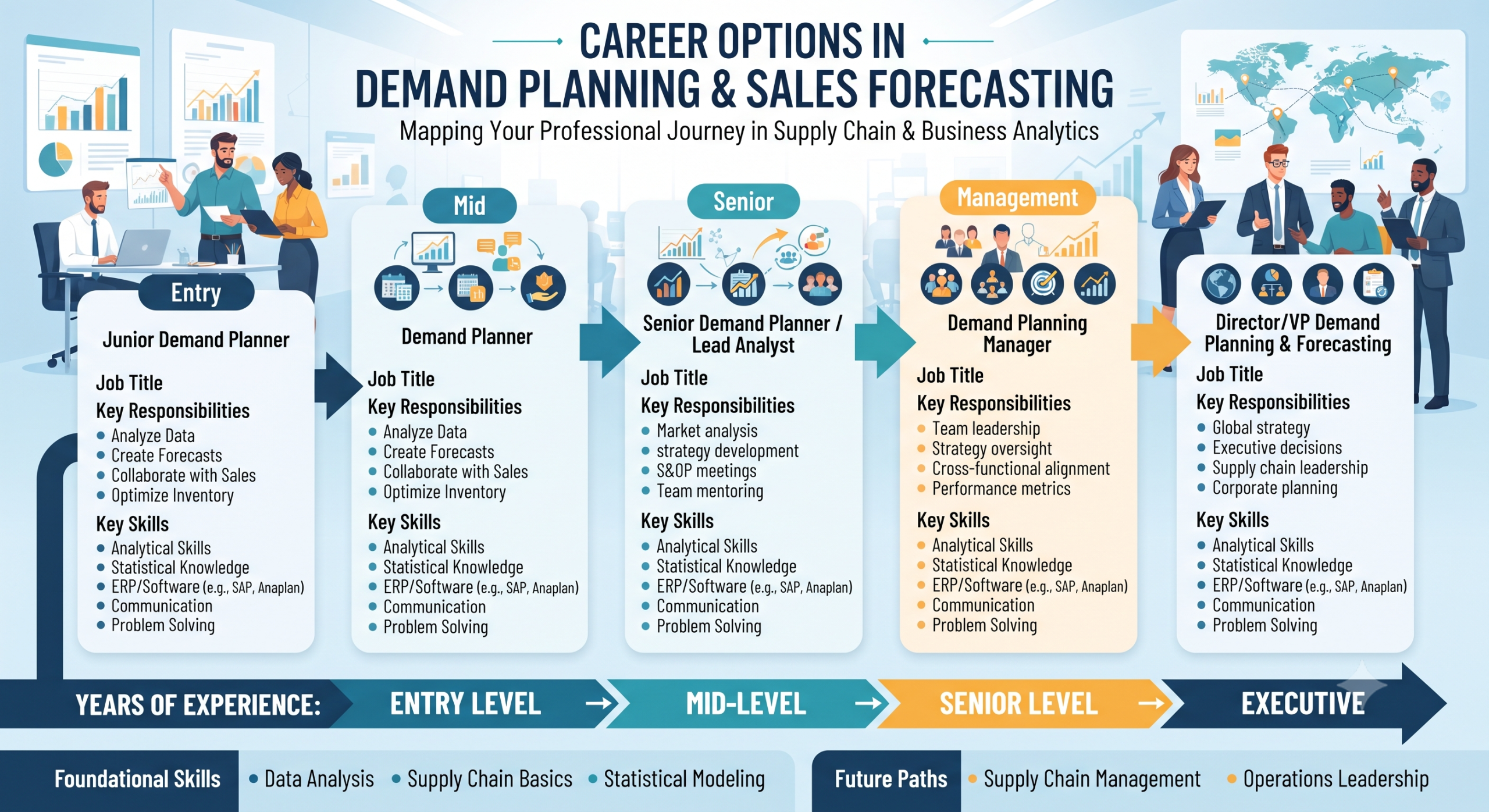
A Demand Planner typically studies historical demand, market trends, promotional activities, and inventory information to create demand forecasts. A Sales Forecasting Analyst focuses more directly on expected sales performance, using customer, product, regional, and historical sales data.
With experience, professionals can move into roles such as Demand Planning Manager, Supply Chain Manager, S&OP Manager, or Forecasting Lead.
The career path can also become industry-specific. For example, a professional working in retail may specialize in seasonal demand, while someone in manufacturing may focus on production planning and raw-material requirements.
2. Build the Technical Skills Employers Look For
Strong analytical ability is one of the most important requirements for demand planning and sales forecasting careers. However, employers generally look for a combination of technical, commercial, and communication skills.
Excel remains an essential starting point. Professionals should be comfortable with formulas, pivot tables, data cleaning, charts, lookup functions, and scenario analysis. Advanced Excel skills can significantly improve productivity when working with large forecasting datasets.
Other valuable technical skills include:
- SQL for querying business databases
- Power BI or similar tools for dashboards
- ERP and supply-chain planning systems
- Statistical forecasting techniques
- Data visualization
- Demand and inventory analysis
- Basic financial analysis
- Forecast accuracy measurement
Professionals should also understand concepts such as moving averages, seasonality, trends, forecast bias, safety stock, lead time, and demand variability.
Technical knowledge alone, however, is not enough. Forecasting decisions often affect sales, finance, procurement, operations, and logistics. Therefore, the ability to explain analytical findings clearly is equally important.
A practical way to develop these skills is to work with realistic datasets. Create a sample sales forecast, identify seasonal patterns, compare actual sales with predicted sales, and explain what management should do based on the results.
3. Explore Remote and Flexible Career Opportunities
Demand planning and sales forecasting can be suitable for remote and hybrid work because many responsibilities involve digital systems, spreadsheets, dashboards, virtual meetings, and cloud-based collaboration.
Remote professionals may work with teams located across different countries and time zones. This creates opportunities to apply for international positions without necessarily relocating immediately.
However, remote forecasting requires strong work discipline. Forecasting cycles often have fixed deadlines, particularly when reports must be submitted before weekly, monthly, or quarterly planning meetings.
Professionals working remotely can improve performance by:
- Creating a fixed forecasting schedule
- Maintaining organized digital documentation
- Using dashboard alerts for important changes
- Blocking uninterrupted time for data analysis
- Scheduling regular communication with stakeholders
- Recording assumptions behind major forecast changes
A global job platform such as best job tool can also be useful when searching for international or remote opportunities. Instead of limiting the search to local vacancies, professionals can evaluate positions based on skills, time-zone requirements, employment type, and career progression.
Remote work also makes location flexibility possible, but candidates should confirm whether an employer permits cross-border employment. Remote does not always mean that an employee can legally work from any country.
4. Use Travel Testing to Evaluate International Career Opportunities
International careers in demand planning and sales forecasting can provide exposure to global supply chains, multinational customers, and different business markets. However, relocating solely because a position looks attractive can involve significant financial and professional risk.
A practical alternative is travel testing.
Travel testing means spending a limited period in a potential location before making a long-term relocation decision. For remote professionals, this can provide insight into the actual working environment.
Before traveling, evaluate:
- Internet reliability
- Cost of accommodation
- Local transportation
- Time-zone compatibility with employers
- Workspace availability
- Mobile connectivity
- Visa and work authorization requirements
- Healthcare and insurance considerations
- Local cost of living
For example, a professional considering a remote forecasting role with a European company could spend several weeks in the target region while maintaining normal working hours, provided their employment and immigration arrangements legally permit it.
Travel testing should not be treated as an extended vacation. The objective is to evaluate whether the location supports professional productivity and financial sustainability.
It is also important to understand that working internationally may create tax, payroll, employment-law, and visa obligations. These should be confirmed with the employer and appropriate professional advisers before making arrangements.
5. Improve Productivity Through Structured Forecasting Workflows
Forecasting involves repetitive data analysis, but the work becomes inefficient when professionals constantly switch between spreadsheets, emails, dashboards, and meetings.
A structured workflow can improve both speed and accuracy.
Start by separating forecasting activities into clear stages:
- Collect and validate historical data.
- Identify unusual changes or data errors.
- Analyze trends and seasonal patterns.
- Develop the initial forecast.
- Incorporate business intelligence from sales and marketing teams.
- Compare the revised forecast with previous versions.
- Document assumptions.
- Communicate major risks and opportunities.
- Monitor actual performance against the forecast.
- Adjust future assumptions based on results.
Automation can reduce manual work. For example, recurring reports can be connected to dashboards, while standardized templates can reduce repetitive spreadsheet preparation.
Professionals should also track forecast accuracy rather than simply producing forecasts. Metrics such as forecast error, forecast bias, and accuracy percentages can reveal whether the planning process is improving.
Productivity should not mean producing forecasts faster without evaluating quality. The objective is to create a repeatable process that helps decision-makers respond earlier to changes in demand.
6. Plan Your Finances Before Changing Careers or Relocating
Career development in demand planning and sales forecasting should be supported by realistic financial planning. Professionals may need to invest in training, certifications, software skills, relocation, travel testing, or a period of job searching.
Before making a transition, calculate your expected costs.
Consider creating separate budgets for:
- Professional courses and certifications
- Laptop and productivity equipment
- Internet and remote-work expenses
- Travel testing
- Accommodation
- Visa or documentation expenses
- Emergency savings
- Job-search expenses
- Relocation costs
An emergency fund is particularly important for professionals moving from a stable local role into international or contract-based employment.
Do not evaluate an opportunity solely by its salary. Compare the total financial value of the position, including taxes, benefits, insurance, retirement contributions, relocation support, paid leave, and currency fluctuations.
For remote international roles, also consider payment methods and exchange-rate costs. A higher salary in another currency does not automatically result in higher disposable income.
Financial planning allows professionals to make career decisions based on long-term value rather than short-term compensation.
7. Build a Long-Term Career Path in Forecasting
Demand planning and sales forecasting can provide a strong foundation for broader careers in supply chain, analytics, finance, sales operations, and business strategy.
Early-career professionals should focus on developing practical experience rather than collecting qualifications without applying them. A portfolio of forecasting projects can demonstrate analytical ability to prospective employers.
A useful career development plan can include:
- Learning advanced Excel and data visualization
- Developing SQL skills
- Building forecasting projects
- Understanding supply-chain fundamentals
- Learning an ERP or planning platform
- Improving business communication
- Tracking measurable results from previous projects
- Applying for analyst and planner positions
- Building professional relationships with supply-chain and sales professionals
After gaining experience, professionals can pursue management or specialist positions. They may eventually move into S&OP leadership, supply-chain strategy, commercial planning, revenue management, or business analytics.
Professionals searching for opportunities can use platforms such as BestJobTool to identify suitable roles while comparing remote, hybrid, and international positions.
The strongest candidates will be those who can connect data with business outcomes. It is not enough to say that a forecast was accurate. A stronger professional can explain how forecasting improved inventory availability, reduced excess stock, supported revenue planning, or helped the company respond to changing customer demand.
Conclusion
Demand planning and sales forecasting offer practical career opportunities for professionals who enjoy analytics, business decision-making, and structured problem-solving. The field extends across industries and provides multiple progression routes, from entry-level analyst positions to senior planning and supply-chain leadership.
Building a successful career requires more than learning forecasting formulas. Professionals should develop Excel, SQL, visualization, statistical, and communication skills while gaining practical experience with real business scenarios.
Remote work can expand access to international opportunities, while travel testing can help professionals evaluate potential locations before committing to relocation. At the same time, productivity systems can make forecasting workflows more efficient, and careful financial planning can reduce the risks associated with career transitions.
The most sustainable approach is to build skills gradually, test opportunities carefully, measure professional results, and make career decisions based on both professional growth and financial stability. With the right combination of analytical expertise, business understanding, remote-work discipline, and strategic planning, demand planning and sales forecasting can become a strong long-term career path.


Leave a Reply