Introduction
Seeing a job reposted after you’ve interviewed—or even after hearing that someone has been selected—can be confusing and discouraging. Many candidates immediately assume the chosen applicant rejected the offer, the company is dishonest, or the hiring process was flawed. In reality, there are several legitimate business reasons why hiring managers repost positions even after identifying a preferred candidate.
Hiring decisions involve multiple approvals, budget reviews, onboarding timelines, and changing business needs. Until a new employee officially joins the organization, companies often keep their options open to reduce hiring risk.
Understanding why jobs are reposted can help you avoid making incorrect assumptions, maintain confidence during your job search, and respond strategically if you see a familiar role appear again. This guide explains the most common reasons hiring managers repost jobs and what candidates should do when it happens.
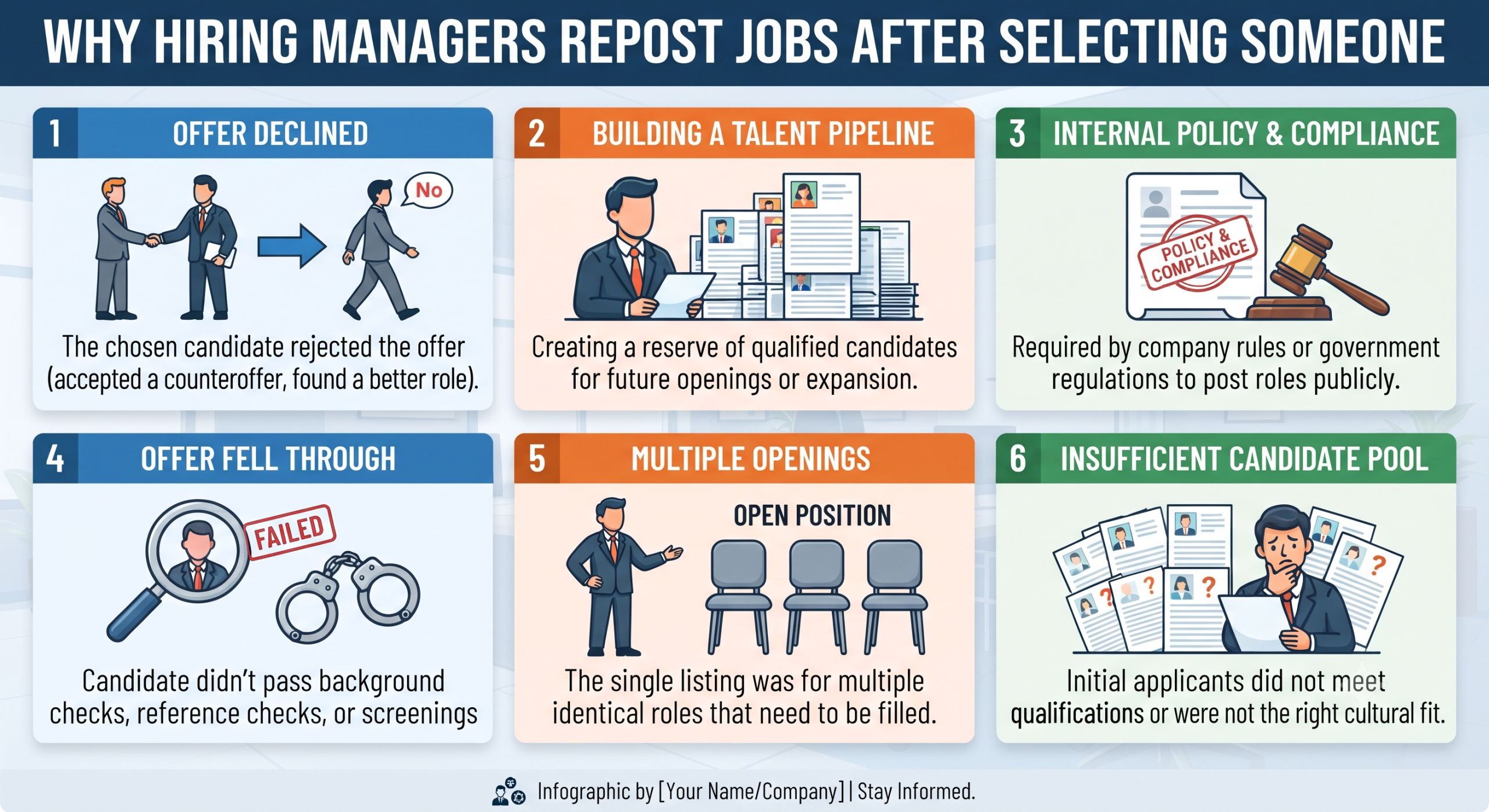
The Selected Candidate Hasn’t Officially Accepted the Offer
Choosing a finalist does not always mean the hiring process is complete.
Several things can happen before employment officially begins:
- The candidate negotiates salary.
- Background checks are still pending.
- References have not been verified.
- Internal approvals are incomplete.
- The candidate is considering multiple offers.
Until a signed employment agreement is in place, companies may continue advertising the position to ensure they have qualified alternatives if the preferred candidate declines.
This is a common risk-management practice rather than a sign that the hiring process has failed.
The Company Wants a Backup Candidate
Hiring managers understand that accepted offers do not always lead to successful hires.
Candidates sometimes:
- Accept another opportunity.
- Withdraw before their start date.
- Fail background verification.
- Change personal circumstances.
- Decide not to relocate.
- Decline after salary negotiations.
Reposting the role helps maintain a strong talent pipeline instead of restarting the recruitment process from scratch.
Having backup candidates reduces delays and protects business operations.
The Organization Is Hiring Multiple People
Sometimes a job is reposted simply because more than one position is available.
Examples include:
- Business expansion
- New client contracts
- Seasonal hiring
- Department growth
- High-volume recruitment
- Multiple office locations
Even after selecting one candidate, additional vacancies may remain open.
Candidates should avoid assuming the reposted role means the original hire was unsuccessful.
Internal Approval Processes Can Delay Hiring
Large organizations often require several approvals before officially closing a position.
These approvals may involve:
- Human Resources
- Finance
- Department leadership
- Executive management
- Compensation teams
While approvals are pending, recruiters may leave the job posting active to avoid interrupting candidate flow.
This administrative process is especially common in larger organizations.
Hiring Needs Can Change Quickly
Business priorities often shift unexpectedly.
Examples include:
- Budget changes
- Team restructuring
- New projects
- Client demand
- Organizational growth
A role initially intended for one employee may evolve into multiple positions, or the required skills may change.
Rather than creating an entirely new job advertisement, employers sometimes repost or update the existing listing.
Recruiters Want to Build a Talent Pipeline
Recruitment is not always limited to filling one immediate vacancy.
Companies often collect applications to support future hiring.
Benefits include:
- Faster hiring later
- Larger candidate pools
- Reduced recruitment costs
- Better workforce planning
- Stronger succession planning
Even if one candidate has already been selected, additional qualified applicants may be considered for upcoming openings.
Strong candidates are often contacted months after submitting an application.
Remote Hiring Increases Candidate Uncertainty
Remote recruitment has expanded hiring opportunities, but it also introduces additional uncertainty.
Candidates may:
- Receive multiple remote offers simultaneously.
- Change relocation plans.
- Reconsider work arrangements.
- Accept counteroffers from current employers.
As a result, organizations hiring remote professionals sometimes keep positions advertised until onboarding is complete.
If you’re searching for flexible career opportunities, best job tool, a global job platform, can help you discover remote and global positions while keeping track of newly posted opportunities across multiple industries.
Reposting Doesn’t Always Mean You Were Rejected
Many candidates assume a reposted job automatically means they were unsuccessful.
In reality, several possibilities exist:
- Interviews are still ongoing.
- Final decisions haven’t been approved.
- Additional positions have opened.
- The employer wants backup candidates.
- Recruitment software automatically renewed the posting.
Unless you receive an official rejection, avoid making assumptions.
Continue applying for other roles while remaining professionally engaged with the employer if appropriate.
What Candidates Should Do When They See a Job Reposted
If you notice a position has been reposted:
- Avoid interpreting it personally.
- Continue your job search.
- Follow up professionally if you recently interviewed.
- Review your application for potential improvements.
- Continue networking.
- Prepare for future interview opportunities.
Do not repeatedly contact recruiters asking why the role reappeared.
Professional patience leaves a stronger impression than repeated follow-up messages.
As you continue exploring opportunities, best job tool can help you discover remote, hybrid, and international roles while expanding your professional options beyond a single application.
Conclusion
A reposted job does not necessarily indicate a failed hiring process or a rejection. In many cases, hiring managers repost positions to manage recruitment risk, maintain a strong talent pipeline, accommodate organizational growth, or ensure they have qualified backup candidates. Until a new employee officially joins the company, employers often continue attracting applicants to protect against unexpected changes.
Instead of becoming discouraged when you see a familiar job listing, focus on what you can control—submitting strong applications, preparing thoroughly for interviews, expanding your professional network, and continuing your search. Understanding the realities of modern hiring allows you to approach the process with greater confidence and realistic expectations. As you pursue new opportunities, best job tool, a global job platform, can help you connect with employers across remote, hybrid, and international markets.
Why Hiring Managers Repost Jobs After Selecting Someone
Introduction
Seeing a job reposted after you’ve interviewed—or even after hearing that someone has been selected—can be confusing and discouraging. Many candidates immediately assume the chosen applicant rejected the offer, the company is dishonest, or the hiring process was flawed. In reality, there are several legitimate business reasons why hiring managers repost positions even after identifying a preferred candidate.
Hiring decisions involve multiple approvals, budget reviews, onboarding timelines, and changing business needs. Until a new employee officially joins the organization, companies often keep their options open to reduce hiring risk.
Understanding why jobs are reposted can help you avoid making incorrect assumptions, maintain confidence during your job search, and respond strategically if you see a familiar role appear again. This guide explains the most common reasons hiring managers repost jobs and what candidates should do when it happens.
The Selected Candidate Hasn’t Officially Accepted the Offer
Choosing a finalist does not always mean the hiring process is complete.
Several things can happen before employment officially begins:
- The candidate negotiates salary.
- Background checks are still pending.
- References have not been verified.
- Internal approvals are incomplete.
- The candidate is considering multiple offers.
Until a signed employment agreement is in place, companies may continue advertising the position to ensure they have qualified alternatives if the preferred candidate declines.
This is a common risk-management practice rather than a sign that the hiring process has failed.
The Company Wants a Backup Candidate
Hiring managers understand that accepted offers do not always lead to successful hires.
Candidates sometimes:
- Accept another opportunity.
- Withdraw before their start date.
- Fail background verification.
- Change personal circumstances.
- Decide not to relocate.
- Decline after salary negotiations.
Reposting the role helps maintain a strong talent pipeline instead of restarting the recruitment process from scratch.
Having backup candidates reduces delays and protects business operations.
The Organization Is Hiring Multiple People
Sometimes a job is reposted simply because more than one position is available.
Examples include:
- Business expansion
- New client contracts
- Seasonal hiring
- Department growth
- High-volume recruitment
- Multiple office locations
Even after selecting one candidate, additional vacancies may remain open.
Candidates should avoid assuming the reposted role means the original hire was unsuccessful.
Internal Approval Processes Can Delay Hiring
Large organizations often require several approvals before officially closing a position.
These approvals may involve:
- Human Resources
- Finance
- Department leadership
- Executive management
- Compensation teams
While approvals are pending, recruiters may leave the job posting active to avoid interrupting candidate flow.
This administrative process is especially common in larger organizations.
Hiring Needs Can Change Quickly
Business priorities often shift unexpectedly.
Examples include:
- Budget changes
- Team restructuring
- New projects
- Client demand
- Organizational growth
A role initially intended for one employee may evolve into multiple positions, or the required skills may change.
Rather than creating an entirely new job advertisement, employers sometimes repost or update the existing listing.
Recruiters Want to Build a Talent Pipeline
Recruitment is not always limited to filling one immediate vacancy.
Companies often collect applications to support future hiring.
Benefits include:
- Faster hiring later
- Larger candidate pools
- Reduced recruitment costs
- Better workforce planning
- Stronger succession planning
Even if one candidate has already been selected, additional qualified applicants may be considered for upcoming openings.
Strong candidates are often contacted months after submitting an application.
Remote Hiring Increases Candidate Uncertainty
Remote recruitment has expanded hiring opportunities, but it also introduces additional uncertainty.
Candidates may:
- Receive multiple remote offers simultaneously.
- Change relocation plans.
- Reconsider work arrangements.
- Accept counteroffers from current employers.
As a result, organizations hiring remote professionals sometimes keep positions advertised until onboarding is complete.
If you’re searching for flexible career opportunities, best job tool, a global job platform, can help you discover remote and global positions while keeping track of newly posted opportunities across multiple industries.
Reposting Doesn’t Always Mean You Were Rejected
Many candidates assume a reposted job automatically means they were unsuccessful.
In reality, several possibilities exist:
- Interviews are still ongoing.
- Final decisions haven’t been approved.
- Additional positions have opened.
- The employer wants backup candidates.
- Recruitment software automatically renewed the posting.
Unless you receive an official rejection, avoid making assumptions.
Continue applying for other roles while remaining professionally engaged with the employer if appropriate.
What Candidates Should Do When They See a Job Reposted
If you notice a position has been reposted:
- Avoid interpreting it personally.
- Continue your job search.
- Follow up professionally if you recently interviewed.
- Review your application for potential improvements.
- Continue networking.
- Prepare for future interview opportunities.
Do not repeatedly contact recruiters asking why the role reappeared.
Professional patience leaves a stronger impression than repeated follow-up messages.
As you continue exploring opportunities, best job tool can help you discover remote, hybrid, and international roles while expanding your professional options beyond a single application.
Conclusion
A reposted job does not necessarily indicate a failed hiring process or a rejection. In many cases, hiring managers repost positions to manage recruitment risk, maintain a strong talent pipeline, accommodate organizational growth, or ensure they have qualified backup candidates. Until a new employee officially joins the company, employers often continue attracting applicants to protect against unexpected changes.
Instead of becoming discouraged when you see a familiar job listing, focus on what you can control—submitting strong applications, preparing thoroughly for interviews, expanding your professional network, and continuing your search. Understanding the realities of modern hiring allows you to approach the process with greater confidence and realistic expectations. As you pursue new opportunities, best job tool, a global job platform, can help you connect with employers across remote, hybrid, and international markets.


Leave a Reply