Introduction
Service roles are built on interaction, communication, and problem resolution. While technical knowledge and process adherence are important, one factor consistently influences performance evaluations more than empathy affects employees expect: empathy. The ability to understand customer emotions, respond appropriately, and manage conversations with sensitivity directly impacts service outcomes. This is exactly why empathy affects performance ratings in service roles across customer support, BPO, client service, and helpdesk environments.
Organizations do not evaluate service employees only on speed or resolution volume. They also assess how customers feel after the interaction. Empathy plays a central role in shaping that experience and, ultimately, performance scores.
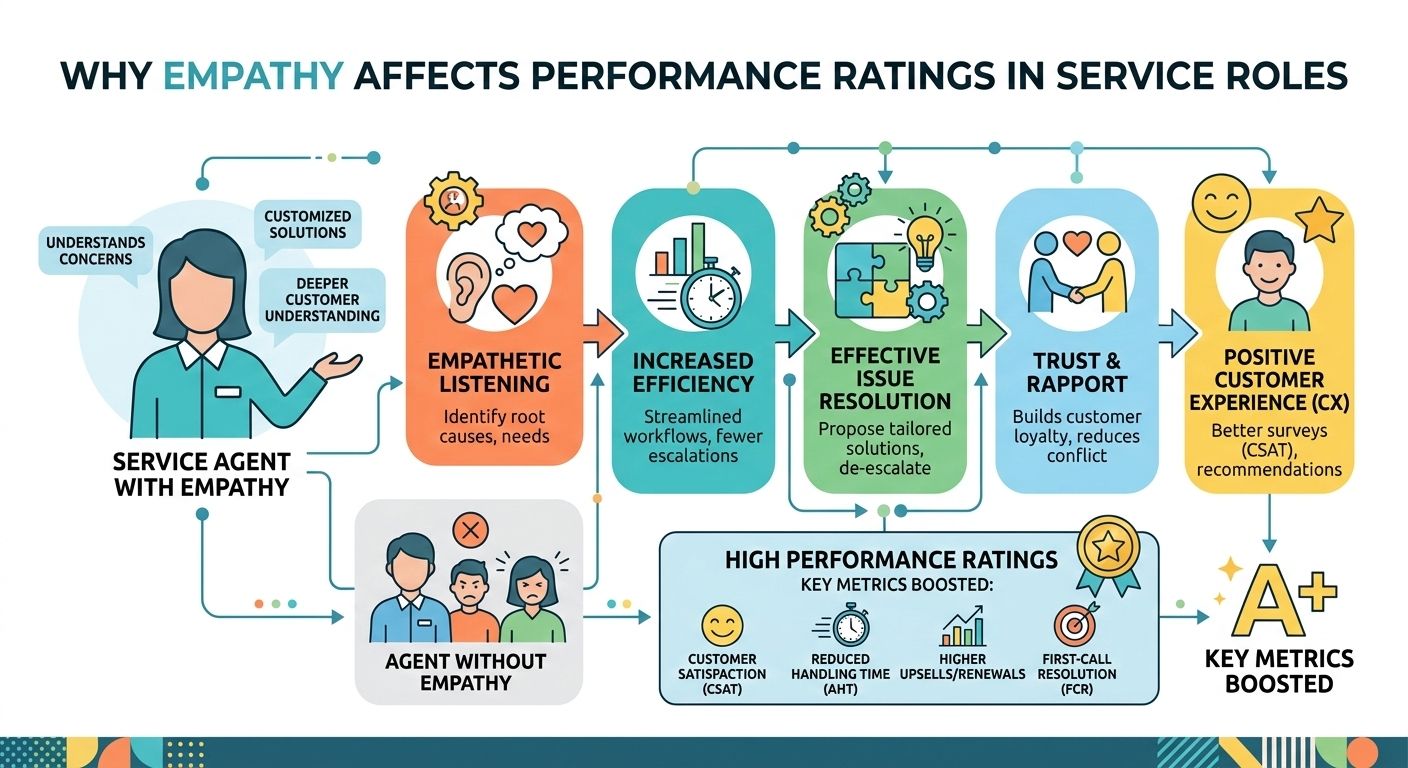
Empathy improves customer satisfaction scores
Customer satisfaction metrics are a major component of performance ratings in service environments. When employees respond with empathy, customers feel heard and valued, even during difficult situations.
A calm and understanding response can reduce frustration and build trust quickly. As a result, customer feedback scores, CSAT ratings, and experience metrics tend to improve significantly when empathy is consistently demonstrated.
Higher satisfaction directly strengthens performance evaluations.
Emotional intelligence enhances service quality
Empathy is a core part of emotional intelligence, which is essential in service roles. Employees who understand customer emotions can adjust their tone, language, and approach accordingly.
This leads to more personalized and effective communication. Instead of giving scripted responses, empathetic professionals provide thoughtful solutions that align with customer concerns.
Quality teams often rate such interactions higher because they reflect strong service standards.
Empathy reduces escalations and complaints
Many escalations occur not only due to unresolved issues but also due to poor communication. When customers feel ignored or misunderstood, frustration increases.
Empathetic communication helps de-escalate tense situations before they escalate further. Employees who acknowledge customer concerns and show genuine understanding can prevent complaints and negative feedback.
Fewer escalations positively influence overall performance ratings.
Performance metrics include communication behavior
In most service organizations, quality audits evaluate parameters such as tone, listening skills, clarity, and professionalism. Empathy directly impacts all these behavioral metrics.
Even if the solution is correct, a lack of empathy may result in lower quality scores. Conversely, empathetic communication can improve audit ratings even in complex scenarios.
Behavioral performance indicators heavily rely on empathy affects emotional engagement.
Empathy strengthens resolution effectiveness
Customers are more cooperative when they feel understood. Empathy builds rapport, making it easier to gather accurate information and provide effective solutions.
This leads to faster and more accurate issue resolution. Resolution effectiveness is a key KPI in service roles, and empathy indirectly improves this metric.
Better cooperation results in higher performance consistency.
Empathy builds long-term customer trust
Service roles are not limited to solving one-time issues. They also contribute to long-term customer relationships and brand perception.
Employees who consistently show empathy create positive customer experiences that increase loyalty and retention. Organizations recognize this impact and reflect it in performance empathy affects reviews and growth opportunities.
Trust-driven interactions elevate professional value.
Quality assurance frameworks prioritize empathy
Most quality monitoring frameworks include empathy as a core evaluation parameter. Calls, chats, and emails are audited based on how well employees acknowledge and address customer emotions.
Statements that show understanding, reassurance, and patience often receive higher audit scores. This directly affects monthly and quarterly performance ratings.
Empathy becomes a measurable performance factor.
Empathy improves workplace collaboration
Empathy is not limited to customer interactions. It also improves internal communication and teamwork. Service environments often require coordination with multiple teams during complex cases.
Employees with empathetic communication styles collaborate more effectively and maintain positive professional relationships. This contributes to a better overall performance image within the organization.
Positive collaboration supports long-term career progression.
Empathy supports stress management and composure
Service roles involve handling frustrated or emotional customers regularly. Empathy helps employees manage such situations calmly instead of reacting defensively.
Maintaining composure under pressure improves call quality, interaction tone, and resolution outcomes. Managers often rate such employees higher because they demonstrate professionalism in challenging scenarios.
Calm behavior enhances performance perception.
Impact on promotions and career growth
Employees with strong empathy skills are often trusted with escalations, VIP customers, and complex service cases. These responsibilities increase visibility and leadership potential.
Managers prefer promoting individuals who can represent the organization professionally in sensitive situations. Empathy signals maturity, emotional stability, and leadership readiness.
This makes empathy a key driver of long-term career advancement in service roles.
Balance between empathy and efficiency
While empathy is crucial, it must be balanced with efficiency and accuracy. Excessively long interactions without resolution can affect productivity metrics.
High-performing service professionals combine empathy with structured problem-solving. This balance leads to strong quality scores, faster resolutions, and better overall performance ratings.
Balanced service delivery defines top performers.
Conclusion
Performance in service roles is shaped not only by technical skills and resolution speed but also by emotional intelligence and communication quality. That is precisely why empathy affects performance ratings in service roles across customer support and service-driven industries.
Empathy improves customer satisfaction, reduces escalations, enhances quality scores, and strengthens long-term trust. Employees who consistently demonstrate empathy build stronger reputations, achieve higher evaluations, and unlock better career growth opportunities. To find service roles that value emotional intelligence, customer experience, and long-term growth, use the best job tool to explore opportunities aligned with your professional strengths.
Find Your Dream Job Today – Explore Endless Career Opportunities and Secure Your Next Role with Best Job Tool.





Leave a Reply