Introduction
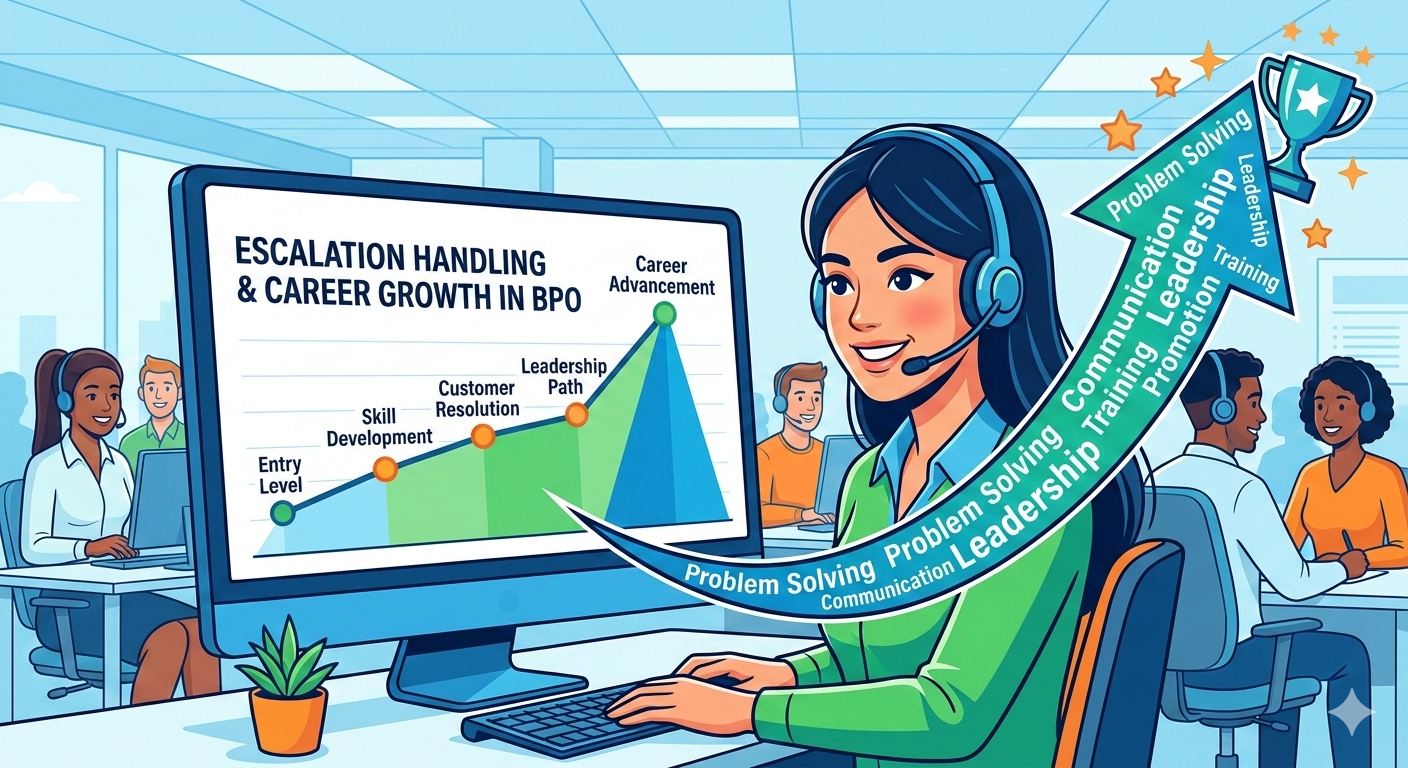
In the BPO industry, performance is not measured only by call volume or ticket closures. Instead, organizations also evaluate how employees handle difficult situations, especially escalations. Escalations involve complex cases where standard solutions no longer work and higher responsibility becomes necessary. Therefore, escalation handling plays a crucial role in shaping career growth in BPO environments where problem-solving, accountability, and communication matter the most.
Moreover, employees who manage escalations effectively appear dependable, composed, and leadership-ready. As a result, this perception directly influences appraisals, promotions, and internal growth opportunities over time.
Escalation Handling Reflects Problem Ownership
Escalations rarely involve routine issues. Instead, they often include dissatisfied customers, service failures, or complicated technical concerns that demand deeper attention. When an employee takes ownership of such cases rather than transferring them immediately, it clearly shows accountability and professionalism.
Additionally, managers closely observe who steps up during challenging situations. Consistent ownership of escalations signals maturity and responsibility. Consequently, this behavior strongly supports long-term career advancement in BPO roles.
High-Pressure Situations Reveal Leadership Potential
Typically, escalations arise in high-pressure scenarios where customers feel frustrated or disappointed. In such moments, employees must remain calm, patient, and solution-focused. Therefore, handling escalations requires strong emotional intelligence and decision-making ability.
Furthermore, employees who maintain composure during escalations naturally stand out. Managers often view them as future team leaders or supervisors. Their ability to manage stress and communicate clearly becomes a strong indicator of leadership potential.
Resolution Quality Improves Performance Evaluations
In BPO environments, performance metrics include quality scores, customer satisfaction, and resolution effectiveness. Notably, escalation cases carry more weight in performance reviews because they directly affect customer retention and brand reputation.
Hence, employees who resolve escalations efficiently contribute significantly to service quality metrics. This, in turn, strengthens their evaluation ratings and improves their chances of promotion.
Escalation Experience Builds Advanced Communication Skills
Handling escalations requires more than scripted responses. Instead, it demands active listening, empathy, negotiation, and clear explanation of solutions. Over time, employees develop communication skills that go far beyond basic customer support.
As a result, these advanced skills become highly valuable for higher roles such as quality analyst, team lead, or operations coordinator. Communication maturity gained through escalation handling significantly accelerates career growth.
Visibility to Management Increases Through Escalations
Routine tasks often go unnoticed. However, escalations usually attract the attention of supervisors, quality teams, and operations managers. Because of this, employees who handle escalations effectively gain higher visibility within the organization.
In addition, increased visibility builds trust with management. This trust eventually opens doors to internal promotions and strategic opportunities. Recognition, therefore, often begins with handling critical situations successfully.
Escalation Handling Strengthens Decision-Making Ability
Unlike regular interactions, escalations demand quick thinking and independent judgment. Employees must assess the situation, choose the right solution, and manage customer expectations at the same time.
Consequently, this real-time decision-making experience prepares employees for supervisory and operational roles. Since leadership positions require confident decision-making under pressure, escalation exposure becomes a major career advantage.
Customer Retention Impact Enhances Professional Value
Escalations directly influence customer satisfaction and retention. A well-handled escalation can transform a negative experience into a positive one. Therefore, organizations highly value employees who can recover dissatisfied customers and protect brand reputation.
Moreover, this business impact increases the employee’s strategic value within the company. Higher contribution to customer retention often leads to faster career progression.
Cross-Team Collaboration Improves Operational Understanding
Many escalations require coordination with technical teams, quality analysts, or operations managers. Through this process, employees gain exposure to broader organizational workflows and systems.
As a result, they develop a deeper understanding of processes, tools, and internal structures. This operational knowledge supports career transitions into roles such as SME, process trainer, or team lead.
Escalation Handling Builds a Reputation for Reliability
In the BPO industry, reliability plays a major role in promotions and role assignments. Managers prefer employees who can handle sensitive and complex cases without constant supervision.
Therefore, consistently managing escalations builds a strong reputation for dependability. Over time, this reputation positively influences appraisals, leadership selection, and long-term career stability.
Pathway to Leadership Roles in BPO
Employees who excel in escalation handling often move into advanced roles such as senior associate, subject matter expert, quality analyst, or team leader. These positions require strong issue resolution and people management skills.
Thus, escalation experience naturally prepares employees for mentoring, decision-making, and process improvement responsibilities. It acts as a stepping stone toward leadership and operations roles in the BPO sector.
Skill Development Through Complex Case Exposure
Escalations expose employees to diverse and challenging scenarios. Each case improves analytical thinking, conflict resolution, and strategic service skills. Therefore, continuous exposure to complex situations enhances professional competence.
Compared to employees who handle only routine queries, escalation handlers develop stronger problem-solving abilities and adaptability. This skill depth increases long-term career competitiveness.
Conclusion
Career growth in the BPO industry depends on responsibility, consistency, and advanced problem-solving skills. In this context, escalation handling shapes career growth in BPO by demonstrating ownership, leadership potential, and measurable customer impact.
Ultimately, employees who manage escalations with confidence, empathy, and strategic thinking gain higher visibility, stronger performance evaluations, and faster promotion opportunities. Escalation management is not just an operational task; rather, it is a powerful career accelerator that builds trust, reputation, and long-term professional success.
To explore high-growth BPO roles that value ownership, performance, and leadership potential, use the best job tool to find opportunities aligned with your career progression goals.
Find Your Dream Job Today – Explore Endless Career Opportunities and Secure Your Next Role with Best Job Tool.






Leave a Reply