Introduction
It’s 2026, and getting your resume noticed in today’s highly competitive job market is more challenging than ever. With thousands of applicants applying for the same roles, having a strong and well-crafted resume is not just an option — it’s a necessity. It is the first impression you make on a hiring manager, and if it’s impactful, clear, and error-free, your chances of getting shortlisted increase significantly.
Why does a Resume Still Matter?
In today’s time, the importance of a resume is still the same as before. Even if you have a LinkedIn profile or online portfolio. It is a document that provides a short and clear summary of the skills and achievements of your career. The recruiter sees the resumes at the very first for shortlisting any candidate. A good resume shows professionalism, communication skills, and attention to detail. It allows you to present yourself in the best way possible. Whether you are applying from ATS or directly, a resumes are your first impression – and as we all know ‘first impression is the last impression’.
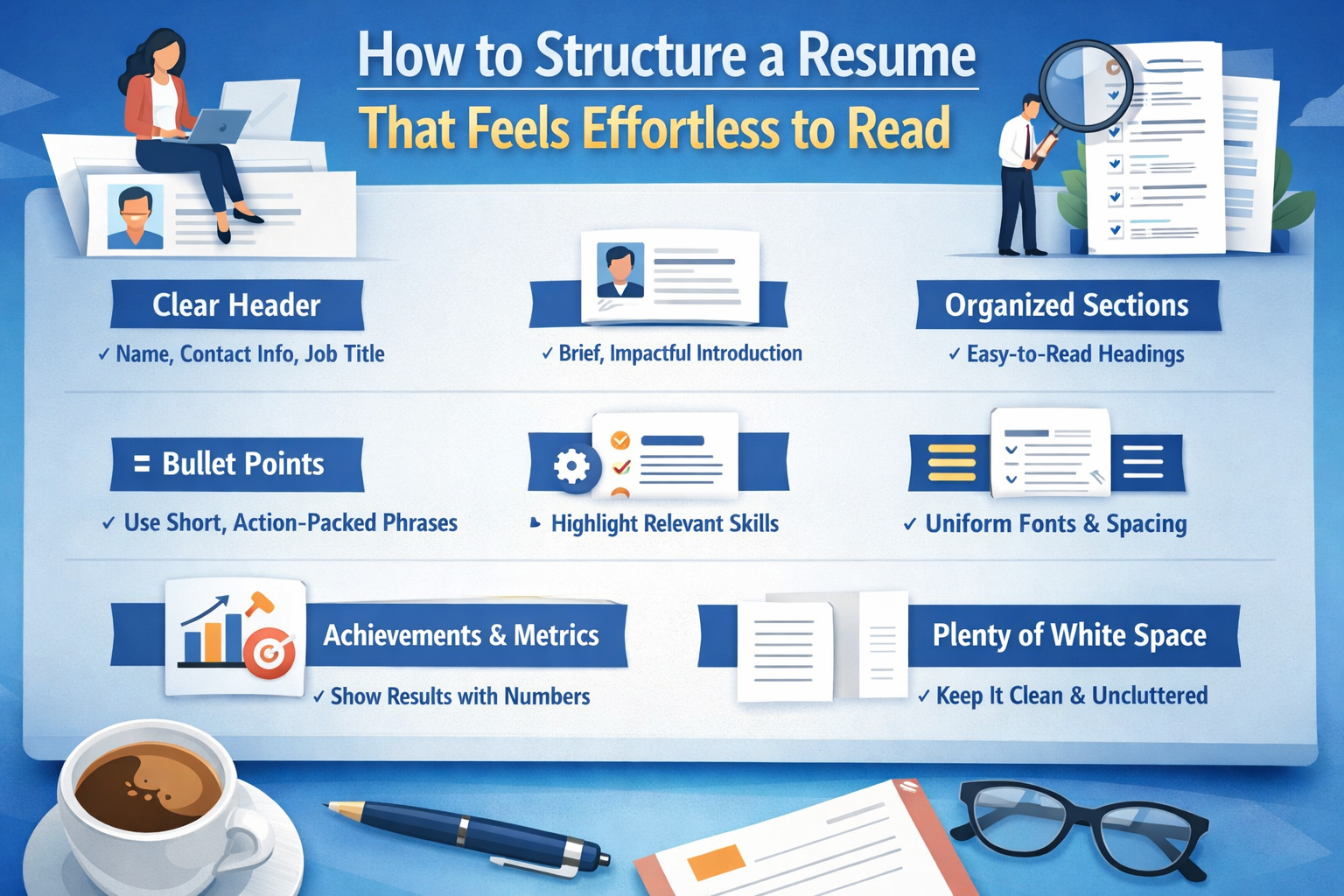
How to Structure a Resume That Feels Effortless to Read?
At present – it is not just a formal document, it’s a part of your personal branding. Now recruiters prefer a simple, clear, and job-specific resumes over a cluttered or overdesigned resume.
1. One-page resume
Hiring managers have to review thousands of resumes, so they don’t have much time, and they don’t want to waste more time on understanding a single resume. It should be one page so that any hiring manager can read it in less time, and your resume should be to the point. So make a one-page resume which will be clear to the point, and impactful.
2. Role-specific customization
Sending the same resume for every job is not a good idea. You have to customize according to the job description, so that you do not get rejected in ATS (Applicant Tracking System) and the hiring manager also likes your resume. Make a Resume that matches your skills, experience, and achievements with the job description. This way, it also shows your professionalism and seriousness.
3. Keyword optimization
Most companies now use Applicant Tracking Systems (ATS) to filter resumes before a human ever sees them. These systems scan resumes for relevant keywords. If your resume doesn’t include the right terms from the job description, it may get rejected automatically. So, it’s important to include industry-specific and job-specific keywords to pass the ATS screening.
4. Quantified achievements
Giving an overview of your work will not work now; you have to be specific about what you have done before. For example, if you have increased sales, then you have to be specific that you increased 30% of sales in 6 months.
Adding numbers, adds value to a it and it also increases the impression on the hiring manager.
5. Modern layout
A cluttered or outdated resume design can turn recruiters away. In 2025, a clean, professional layout is essential. Use simple fonts (like Calibri, Arial, or Roboto), clear spacing, and avoid heavy colors or graphics — especially if you’re applying through an ATS. Make sure your resume looks good on both desktop and mobile.
By following these trends, you can create a resume that not only grabs the recruiter’s attention but also passes AI filters and stands out in a competitive job market.
The Impact of AI (Artificial Intelligence) and ATS (Applicant Tracking Systems)
In today’s time, AI (Artificial Intelligence) and ATS (Applicant Tracking System) play an important role in the hiring process. ATS is a software that scans thousands of resumes and shortlists only those that best match the job description. If it does not have relevant keywords or the correct format, then you might get rejected, even if you are qualified. Those AI tools help recruiters search for better candidates, score resumes, and even schedule an interview. That’s why it’s now important to create a resume that not only impresses humans, but also impresses software systems as well.
What is an ATS?
ATS plays an important role in the hiring process. It is a software that companies use to manage, filter, and shortlist job applications. It scans thousands of resumes and shortlists only those that match the job description. If your resume does not have relevant keywords or the correct format, it will be rejected, even if you are qualified for that role.
How does it work in 2025?
Whenever you apply for a job, the ATS software scans your resume before a human recruiter. This system checks some important things like-
- Keyword match – Does it have all the relevant keywords that are present in the job description, like the skills, tools, and job title?
- Format check- Resume layout should be readable. Complex design, image, and tables confused ATS.
- Relevance- Are your education and skills relevant to the job role
- Ranking- ATS gives a score to each resume and shortlists the top candidate. If you do not optimize your resume properly, then it will be rejected by ATS. It should be attractive plus ATS-friendly.
How to Make Your Resume ATS-friendly?
If you want your resume to easily pass the ATS filter, then you have to keep some important points in mind. An ATS-friendly resume means a it should be so clear that software can easily read, scan, and understand.
1. Use Job-Specific Keywords
You have to first read the job description carefully and notice all the keywords (like: “project management”, “Excel”, “content writing”) in the job description. And try to include all the keywords naturally, so that it can be easily shortlisted by ATS.
2. Keep the Format Simple
Avoid using complex layouts, tables, images, or fancy fonts. Stick to a clean, basic design with standard fonts like Arial, Calibri, or Roboto. Save your resume as a .docx or PDF file (if accepted).
3. Use Standard Headings
Use conventional headings such as:
Work Experience, Education, Skills, Certifications.
Avoid creative or unusual section titles that ATS might not recognize.
4. Avoid Graphics and Icons
ATS cannot read visual elements like logos, icons, charts, or images. Keep your resume 100% text-based to ensure all content is scannable.
5. Include Both Hard and Soft Skills
Mention relevant hard skills (e.g., Excel, Python, SEO) as well as soft skills (e.g., leadership, teamwork, communication) that are aligned with the job.
6. Customize for Every Job
Never send the same resume everywhere. Tailor it for each job application by updating the summary, keywords, and skills to match the role.
7. Use Online Tools
You should use tools to create your resume easily. These tools will help you make an effective, impressive, and ATS-friendly resumes. Make use of tools like: Jobscan, Teal, Rezi, Hiration.
These help you compare your resume to job descriptions and improve your ATS score.
By following these steps, it will be more likely to pass through ATS filters and reach the hands of hiring managers — increasing your chances of getting shortlisted.
Conclusion
A resume that feels effortless to read is not about adding more information—it is about presenting the right information in the right way. Recruiters spend only a few seconds scanning a resume, and a clean structure helps them quickly understand your value. Clear headings, logical section order, concise bullet points, consistent formatting, and proper white space make your resume easy to scan and hard to ignore.
When your resume flows naturally, it reduces mental effort for the reader and increases your chances of getting shortlisted. A well-structured resume does not just look professional—it communicates clarity, confidence, and attention to detail. By focusing on readability and structure, you allow your skills and achievements to speak for themselves.
Read more such blogs here.


Leave a Reply