Introduction
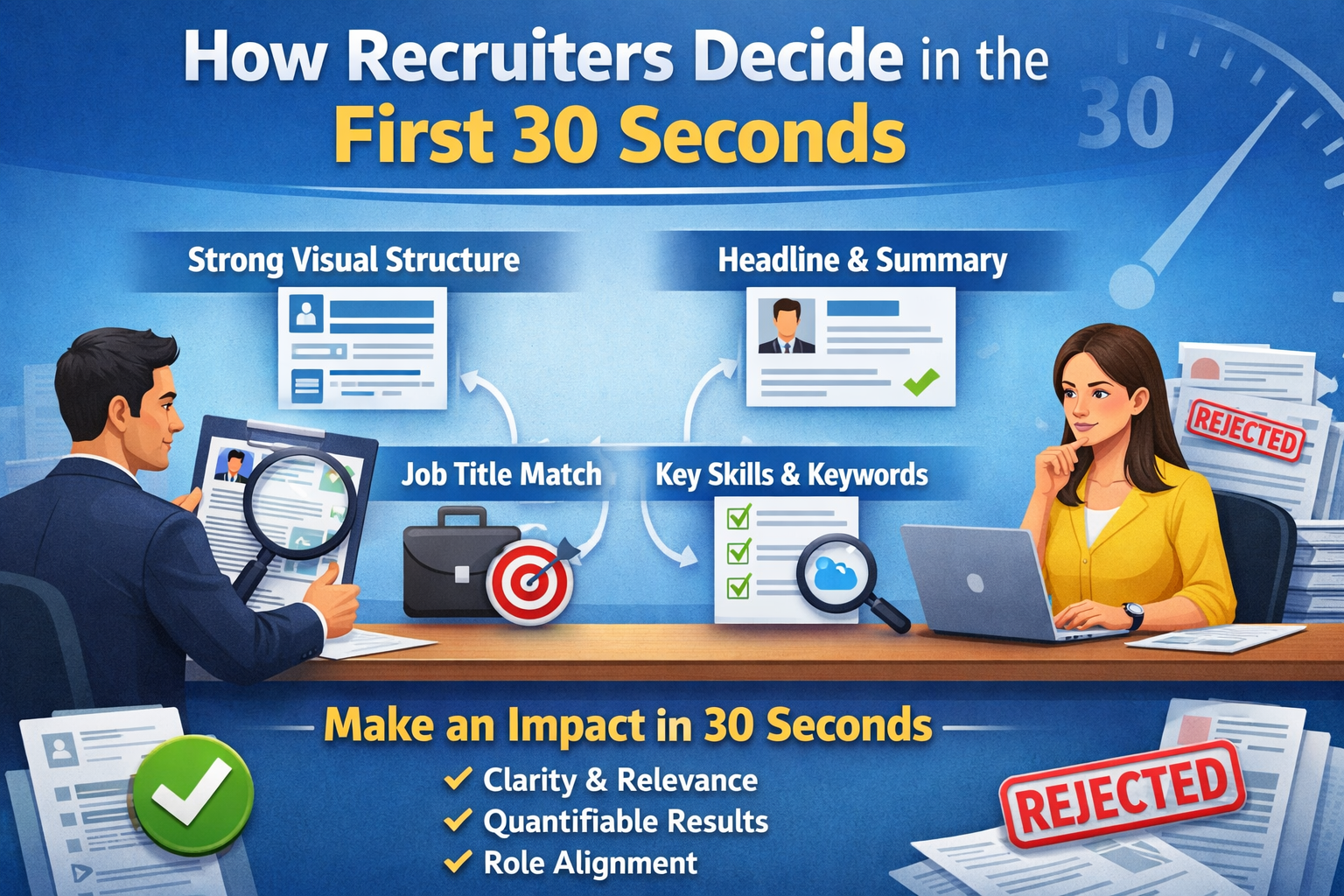
Truth is that mostly recruiters do not read resume in detail. Recruiter only have 22-30 seconds for each candidate to decide whether the candidate should proceed further or rejected. In short time, date, judge, your clarity, relevance, and presentation. In this article, we are going to understand what recruiters see in the first 30 seconds, which signals grab their attention, and the reason behind it.
The Reality of the 30-Second Resume Scan
Mostly candidates think that the recruiter read their resume in detail, but reality is completely different. Recruiters daily have hundreds of resumes, and that’s why they only have 20 to 30 seconds for each resume. The purpose of this short scan is to decide whether resume reading in detail would be worth or not. In this 30-second, resumes are not read line by line.
They only see key sections such as job title, summary, recent experience, skills, and overall layout. If they feel confusing, cluttered, or irrelevant in starting of resume, then recruiter move to next resume. That’s why it is important to understand resume doesn’t mean writing. It is to present information smartly. Your resume should show clarity, relevance, and professionalism in 30 seconds. Otherwise, you will lose the chance.
How Recruiters Decide in the First 30 Seconds?
1. First Impression Starts With Visual Structure
When resume open your resume, they first see overall layout and visual clarity. If resume is cluttered, the size of text is small or alignment is messy, then it immediately creates negative impressions. Clean headings, proper spacing, bullet points and readable fonts give signal to recruiter that the candidate is organized and professional. Simple and neat design give you an edge because recruiters have limited time and they want to scan resume quickly.
2. 30 Seconds Scan with Headline & Summary
Headline and summary section of resume is the first stop for recruiter. It should be clear and should use role-specific keywords such as digital marketing specialist or software developer instead of vague titles. You should highlight short and crisp sentences in summary which highlights experience, skills, and achievements. This section gives recruiter an immediate context that your profile is relevant to the role or not. If summary is not impactful and tailored then your resume can easily pass over.
3. Job Title Matching With the Role
Recruiters first check whether your past job titles matches with their open position or not. If they feel titles are similar or responsibilities are aligned, then they instantly think it as relevant profile. If you have used creative or confusing titles, then recruiter take time to understand and risk increases. That’s why focusing on job title clarity and role alignment in resume is very important.
4. Top Half of the Resume Matters Most
The first focus of recruiters is on the top half of a resume, means the part which is present on the content page. In this section, you need to include name, contact details, headline, summary, and top skills. Mentioning here your recent experience or most relevant achievements are best. If top half is clear and impressive, then recruiter has interest to read whole resume. If section is cluttered or irrelevant, then there is chance that resume get rejected immediately.
5. Keywords That Trigger Attention
Recruiters quickly find specific keywords which matches with job description. These keywords can be skills, tools, certifications, and industry terms. When recruiter see those keywords, they get signal that the candidate is relevant to role. If keywords are missing or vague then risk of ignoring resume can increase, that’s why customizing every resume with role specific is very important.
6. Experience Relevance Over Experience Length
For recruiters, the relevance of experience is more important than quantity. Only mentioning experience of 10 years is not enough if it is not relevant to role. You need to highlight your achievements and responsibilities in bullet points, which directly aligns with job description. Relevant experience gives recruiters confidence that you can handle role easily. Unnecessary or irrelevant details only create distraction and clutter.
7. Numbers, Results & Impact Statements
Recruiters notice immediately when you present your achievements with numbers and measurable results. Only writing responsibilities are not enough. If you write with numbers such as “increased website traffic by 40% in six months” or “reduced team costs by 15% through process optimization”, then recruiters get a clear signal that you have created a real impact and they will be more interested in shortlisting you. Numbers instantly show credibility and professionalism, and your resume looks different from generic profiles.
8. 30 Seconds Scan of Skills Section
Recruiters instantly scan a skills section. It is their quick filter to decide whether you will be suitable for a role or not. Keep skills as role-specific and relevant and focus on hard skills, which are mentioned in job description. Soft skills are optional, but you can mention short and impactful. If required skills are clearly mentioned in resume, then recruiter instantly gives signal of no. Simple and clean skills list give a positive edge.
For more information, read “How Recruiters Scan Resumes in Under 8 Seconds”.
Conclusion
In the end, the first 30 seconds are not about telling your entire career story—they are about proving relevance, clarity, and value at a glance. Recruiters make quick decisions based on structure, keywords, job title alignment, and visible impact, because their time is limited and their expectations are specific.
A well-structured, customized resume that highlights results, relevant skills, and role-specific experience can instantly shift a recruiter’s decision in your favor. When you design your resume with the recruiter’s scanning mindset in mind, you don’t just get noticed—you get shortlisted.
Explore more such blog with the Best Job Tool.



Leave a Reply