Introduction
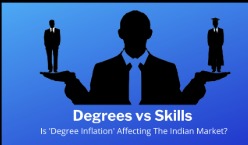
The job market has changed more in the last few years than in the last few decades. Today, companies are not just looking at degrees—they are looking at what you can actually do. Many employers now believe that practical skills, real experience, and problem-solving abilities matter more than formal qualifications. This shift is happening because businesses need people who can start contributing quickly, adapt to new tools, and handle real-world challenges.
In this new hiring environment, skills have become the strongest currency. Whether you are a student, a fresher, or someone changing careers, focusing on skill-building can open more doors than a degree alone. This article explains why skills are becoming more important and how they can help you stand out in modern hiring.
Why Skills Beat Degrees in Modern Hiring?
1. Skills improves workplace relationships
Skills help in building good relationships between colleagues. If an employee has skills like teamwork, feedback-taking, and understanding instructions properly, the work becomes smoother and employees can coordinate well with one another.
Because of skills, one employee can build trust with another. When someone has strong skill, they complete their tasks with full responsibility, which automatically builds trust among team members. Employees understand each other’s feedback better, take it positively, and use it to improve themselves. They listen to instructions carefully, understand them clearly, and follow them correctly. This ensures that every step of the task is completed properly, and the work is finished on time and efficiently.
These skills also help reduce conflicts in the workplace and significantly improve overall productivity.
2. Degrees show knowledge & skills show execution
If someone has a degree, it only tells us that the person has knowledge of a particular field. But it does not tell us whether they can actually perform the work well or not. Having a degree does not guarantee good performance. Sometimes, a person without any degree may have stronger skills, which allow them to do the job even better than someone who is certified.
This is why skills are essential for building real capability. Without skill, you cannot execute any task properly, no matter how much theoretical knowledge you have.
degrees represent theory, while skills represent the practical side of that knowledge.
3. Skills improve employability in every industry
If an employee has strong skills, it means they can perform well in the company. When an employee uses skill in their work, they are able to follow every step properly because they have practical knowledge of each task. This leads to better results for the company.
For example, imagine a person who has a content writing certification. But when they start working for a company, they struggle with basic tasks. They cannot write clear emails, they lack basic data interpretation skills, they cannot manage their time, they don’t listen actively, and they are unable to communicate with clients. In this situation, the certified employee becomes a loss for the company.
On the other hand, someone without any certification but with strong skills becomes an asset. They know how to write clear emails, understand basic data, manage time effectively, listen actively, and communicate well with clients. These skills directly improve the company’s performance and contribute to its growth and profit.
That’s why skills are more important than big degrees.
4. It make you highly adaptable in changing job markets
When an employee has strong skill, they can easily adapt to changes in the job market. Today, technology is evolving very quickly—every month new tools and new systems are introduced. This creates challenges for many employees, and it also leads to conflicts within teams.
However, when employees have skills, they adjust to these changes smoothly and work according to the new requirements. This increases their productivity, keeps teamwork conflict-free, and contributes to the company’s overall growth and profit.
On the other hand, having big degrees does not guarantee adaptability. A certified person may have knowledge of older tools and technologies that they learned earlier. But when new technology is introduced, they may struggle to learn and adjust.
Someone with strong skills can adapt to any change easily without facing major difficulty.
If you want to know how to prepare for further job market change, then visit here.
5. The hidden advantage
If a person has strong skills, they don’t need additional training to start working in any company. skills are extremely helpful—not just for performing well in a company, but also for improving daily life activities. Small habits make our lifestyle easier and better, and when our lifestyle improves, our way of working also becomes smoother and more effective.
If we have skills—such as communicating clearly, managing time efficiently, and handling problems easily—we can complete every task properly and deliver better output to the company. Recruiters also prefer candidates who have strong skills rather than only big degrees. This is because recruiters know that if they hire someone who already has skills, the company will not need to train them much. They can handle their work easily and work without constant supervision.
This becomes beneficial for both the recruiter and the candidate. Since the candidate already knows how to manage their tasks from day one, they get better support in the company and can adjust quickly.
That’s why having skill is truly essential.
6. Help you to stand out without expensive degrees
A candidate with great communication and research skills can easily outperform someone who only has expensive degrees. Just because a person has costly degree doesn’t guarantee that recruiters or seniors will notice them. But if you have strong skills and you use them to work effectively, recruiters and seniors will definitely notice your performance.
If you have skills, you can handle many tasks that a certified person may still struggle with. Skills make you stand out among many people, make you a strong employee, and even shape you into a better individual. These skills help you grow faster in your career.
With strong skill, you can go much further in your professional journey, and your chances of getting promotions also increase.
If you want to grow bigger and achieve success in life, you must develop skills.
You can also read our article on “micro-skills vs big certifications”.
Conclusion
In today’s hiring world, skills matter more than any degree. Companies want people who can think, solve problems, and deliver results—not just someone who has a certificate. Degrees can give you knowledge, but skills show what you can actually do. This is why practical learning, real projects, and hands-on experience are becoming more important every year.
If you keep improving your skills, building your portfolio, and staying updated with industry trends, you will always have opportunities. The future belongs to people who learn, adapt, and take action—not just those who hold a qualification.
You can read more informational blogs here.


Leave a Reply