Introduction
At the workplace, there is a lot of work assigned to every employee. But this does not mean that every employee will always be able to complete their work on time. Some employees may experience delays sometimes.
It is not necessary that an employee who usually completes work on time will never face delays. At some point, due to different reasons, delays can happen.
However, you don’t need to take stress because of this. You just need to communicate delays professionally. This will help reduce your stress and also give you some extra time to complete your work properly and calmly.
In this article, we will learn how you can communicate delays professionally.
How to Communicate Delays Professionally?
1. Inform Early
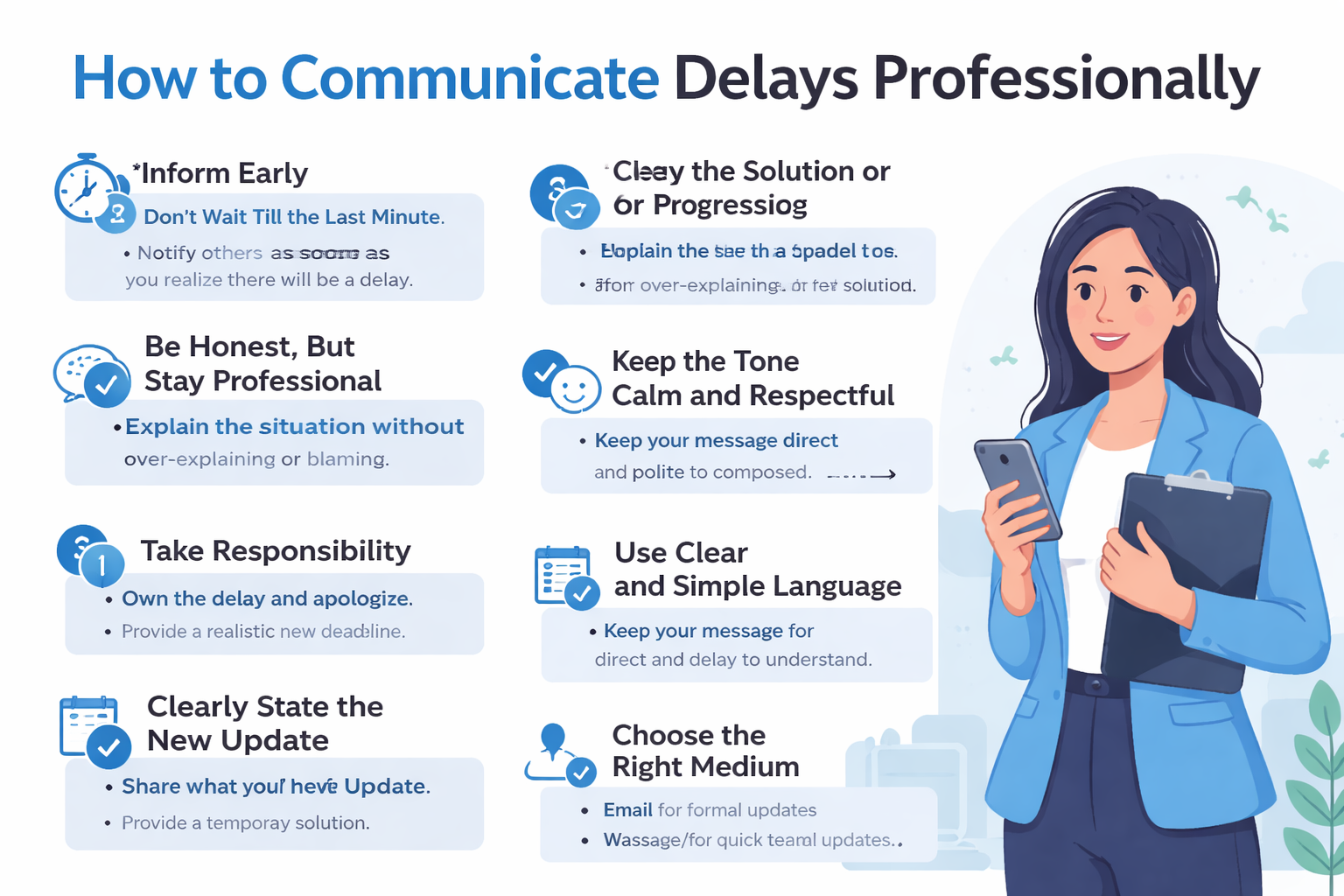
The first way to communicate delays professionally is to inform early. Many employees do not take informing about delays seriously, but it is very important to share this information early so that the other person gets enough time to adjust.
If you realize that there might be a delay in your work but still think you can complete all tasks on time by taking a lot of pressure, then that is not correct. Informing about the delay early shows responsibility and awareness, and it helps prevent last-minute stress.
2. Be Honest to Communicate Delays
Another important thing you need to know when informing about a delay is to be honest but stay professional. Whenever you realize that you might miss a deadline, be honest and share the situation with your senior.
However, do not share too many personal details. Just give relevant information and avoid blaming others.
3. Take Responsibility
A good employee in the workplace is someone who takes responsibility for their work and its results. Team members trust such employees, and they are given important tasks.
But it is not enough to only take responsibility for your work. You should also take responsibility for informing your seniors if your work is getting delayed.
This shows maturity and helps build trust. Also, remember not to blame anyone. Just inform about the delay so you can get extra time and your senior can prepare accordingly.
4. Clearly State the New Timeline
Another effective point is to clearly state the new timeline. This means that if you only say that your work will be delayed, the other person does not get complete information. They may expect a different timeline, while you have something else in mind, which can create confusion.
That is why it is very important that when you communicate a delay to your senior, you also share a clear timeline of when they can expect the work. Make sure the new timeline is realistic so that no confusion is created.
This helps you focus on your work, and the other person also sees your update as genuine and professional.
5. Offer a Solution or Progress Update
Every task has a set timeline, and employees work according to it because everyone’s work is connected in the workplace. When you are given a task, your senior depends on you to complete it so they can move forward with the next process. Your senior also has their own deadline, which is why they ask you to finish your task on time.
So, if your work is delayed for any reason, it is very important to inform your senior in a professional way. If possible, also share what you have completed so far or suggest a temporary solution. This shows your effort and commitment.
For example, you can say: “I have completed 70% of the work and can share the current draft if that helps in the meantime.”
6. Keep the Tone Calm and Respectful to Communicate Delays
The last tip to communicate delays in a professional way is to keep your tone calm and respectful. The workplace is a professional environment where everyone communicates professionally with each other.
So, whenever you inform your senior about a delay, you should keep your tone calm and respectful. Your message should sound polite and composed, not stressed or defensive.
Conclusion
In conclusion, communicating delays professionally is less about the delay itself and more about how you handle it. When you inform early, stay honest, take responsibility, and provide a clear new timeline, you show reliability and respect for others’ time. Instead of damaging your image, proper communication can actually strengthen trust and credibility.
Delays are sometimes unavoidable, but professionalism is always a choice—and how you communicate in such moments defines your work ethic and your reputation.





Leave a Reply