Introduction
Many people think career planning is something we do once a year. Some even do it once in five years. We sit with a notebook in January, write big goals, feel motivated for a few days, and then life happens. Work pressure increases. New responsibilities come. Priorities change. And slowly, those goals disappear. The truth is simple: the world changes fast. Industries change fast. Even we change fast. That is why career planning should not be yearly. It should be quarterly.
Planning your career every three months keeps you aware, flexible, and confident. It helps you grow step by step instead of waiting for one big opportunity.
In this article, we will understand why quarterly career planning works better and how you can start doing it in a simple way.
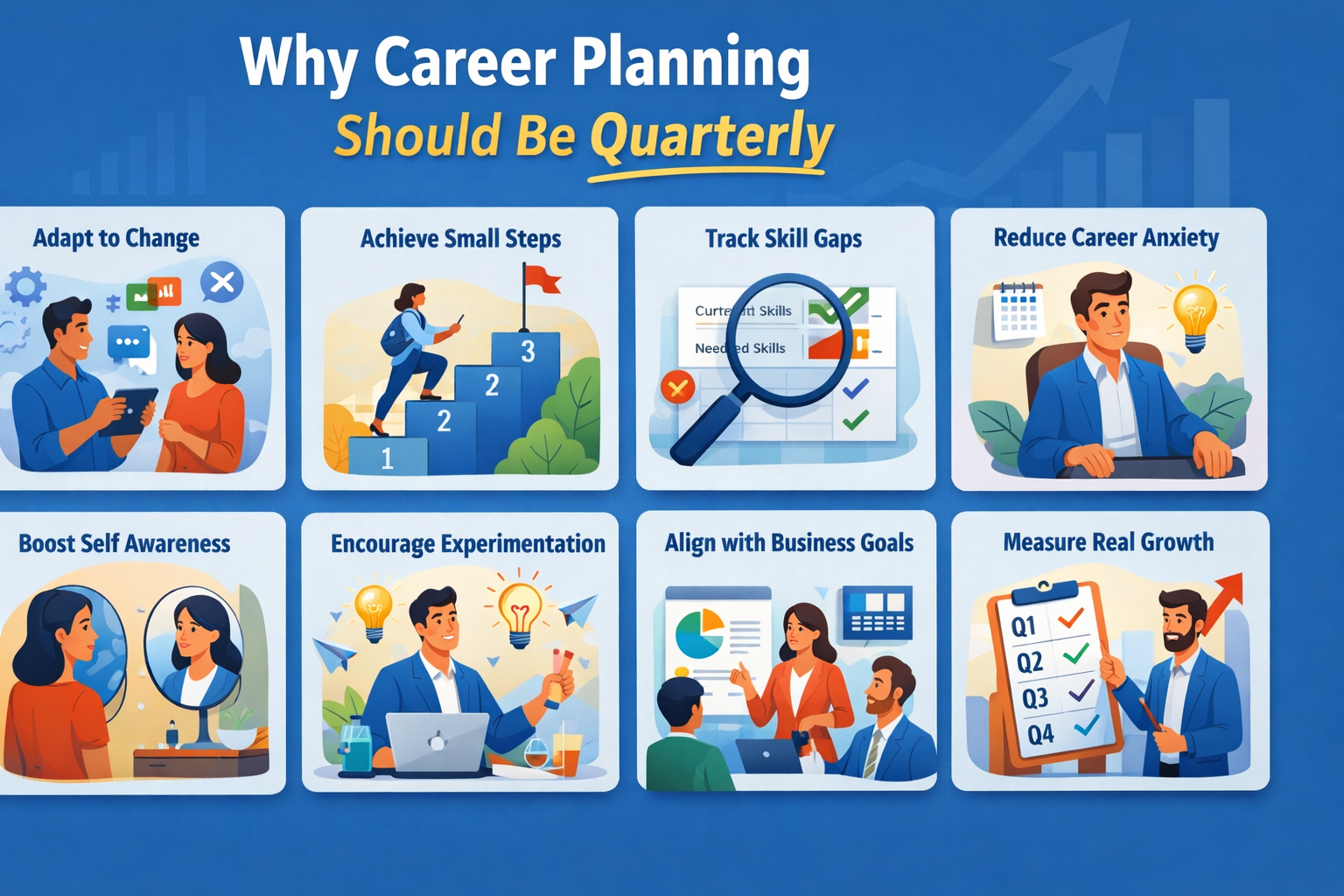
Why Career Planning Should Be Quarterly?
1. The World Changes Faster Than We Think
Today’s job market is not stable like it used to be. New tools, new skills, and new technologies appear every few months. Just look at how quickly platforms like LinkedIn evolve, or how fast tools like ChatGPT change the way people work and learn.
If you plan your career once a year, you may miss important shifts.
For example:
- A new skill becomes in demand.
- A new role becomes popular.
- Your industry faces sudden change.
- A company restructures its teams.
When you review your career every three months, you can quickly adjust. You don’t feel stuck. You don’t feel left behind.
Quarterly planning makes you responsive, not reactive.
2. Big Goals Feel Less Overwhelming
When you think about your five-year plan, it can feel heavy.
You may think:
- “I want to become a manager.”
- “I want to switch careers.”
- “I want to start freelancing.”
- “I want financial freedom.”
These are big goals. And big goals can create fear.
But when you divide the year into four quarters, everything feels smaller and clearer.
Instead of saying:
“I want to become a content strategist in two years.”
You say:
“In the next three months, I will complete one certification and improve my writing portfolio.”
See the difference?
Quarterly planning turns big dreams into small actions.
Small actions reduce stress, build confidence, and create real progress.
3. Quarterly Planning Keeps You Focused, Not Busy
Many professionals are busy but not growing.
They attend meetings, complete tasks, reply to emails, and meet deadlines.
But are they moving forward?
Quarterly career planning forces you to ask important questions:
- What skill did I improve this quarter?
- What result did I achieve?
- What new responsibility did I take?
- What value did I create?
These questions shift your focus from activity to growth.
Being busy does not mean you are progressing. But reviewing every three months helps you measure real improvement.
4. Quarterly Planning Helps You Track Skill Gaps
Skills become outdated quickly.
For example:
- A marketing professional must learn new digital tools.
- A writer must understand SEO and analytics.
- A software developer must learn updated frameworks.
If you wait one year to evaluate your skills, you may discover a big gap. And big gaps create panic.
But when you review every quarter, you can ask:
- What skill is trending?
- What skill do I need next?
- What skill is becoming less important?
You can then take small learning steps.
Three months is enough time to:
- Finish one online course.
- Read 2–3 important books.
- Practice a new tool.
- Build one small project.
Quarterly planning keeps your learning consistent and realistic.
5. Quarterly Planning Builds Career Awareness
Sometimes we work on autopilot.
We wake up, go to work., finish tasks., return home, and repeat.
After one year, we realize nothing changed.
Quarterly career planning increases self-awareness.
Every three months, you reflect:
- Am I enjoying this role?
- Do I feel challenged?
- Do I feel respected?
- Am I learning?
- Do I see growth here?
These reflections prevent long-term dissatisfaction.
It is better to adjust direction early than regret after five years.
6. Quarterly Planning Reduces Career Anxiety
Career anxiety often comes from uncertainty.
When you don’t know:
- Where you are going.
- What you are improving.
- What your next step is.
Your mind creates fear.
But when you have a simple three-month plan, your mind feels calm.
You know:
- What you are working on.
- Why you are working on it.
- When you will review it.
Even if the plan is small, clarity reduces stress.
Quarterly planning gives you control over your direction.

7. Quarterly Planning Encourages Experimentation
One of the biggest mistakes people make is waiting for “perfect timing.”
They say:
- “Next year I will try freelancing.”
- “Next year I will start writing online.”
- “Next year I will apply for new roles.”
But waiting often becomes habit.
Quarterly planning encourages small experiments.
For example:
Quarter 1: Post 5 articles online.
2: Apply to 10 freelance projects.
3: Take one leadership task.
4: Attend networking events.
If something does not work, you only lose three months—not one year.
Three months is short enough to experiment.
Three months is long enough to see results.
8. Quarterly Planning Improves Performance Reviews
Most companies conduct performance reviews once or twice a year. But if you review yourself every quarter, you are always prepared.
You will have:
- Clear achievements.
- Documented progress.
- Improved skills.
- Real examples.
When your manager asks, “What did you achieve this year?” you won’t struggle to remember.
You will know.
Quarterly self-review makes annual evaluation easier and stronger.
9. Quarterly Planning Matches Business Cycles
Many companies operate in quarterly cycles.
Sales targets are quarterly.
Revenue reports are quarterly.
Strategy reviews are quarterly.
When you align your career planning with business cycles, you stay relevant.
You can ask:
- How can I support this quarter’s business goal?
- What skill will help my team this quarter?
- What project can I lead this quarter?
This makes you visible.
And visibility creates opportunities.
10. It Strengthens Long-Term Vision
Some people think quarterly planning means short-term thinking. But it is actually the opposite.
When you review every three months, you stay connected to your long-term vision.
Imagine you want to become:
- A senior manager.
- A successful freelancer.
- A recognized expert.
Every quarter you ask:
“Is my current direction taking me closer to that vision?”
If yes, continue.
If not, adjust.
Quarterly planning protects your long-term goal from daily distractions.
11. It Builds Discipline
Growth is not about motivation. It is about consistency.
Motivation changes.
Energy changes.
Mood changes.
But if every three months you sit down and review your path, you build a habit.
This habit creates discipline.
You start thinking in cycles:
- Plan.
- Act.
- Review.
- Improve.
This pattern becomes part of your personality.
And disciplined professionals grow faster than talented but unplanned professionals.
12. It Makes Networking Intentional
Networking is not about randomly connecting with people. It should match your career direction.
If your quarterly goal is:
- Moving into leadership → connect with managers.
- Entering freelancing → connect with clients.
- Learning new tech → connect with experts.
Platforms like LinkedIn allow you to build meaningful connections when your goals are clear.
Without quarterly planning, networking becomes unfocused.
With quarterly planning, networking becomes strategic.
13. It Prevents Burnout
Sometimes burnout happens because we try to do everything at once.
We want:
- Promotion.
- Side hustle.
- New skill.
- Networking.
- Fitness.
- Personal development.
All together.
Quarterly planning forces you to prioritize.
Maybe this quarter:
Focus only on skill development.
Next quarter:
Focus on visibility and networking.
Next quarter:
Focus on income growth.
You do not carry everything at the same time.
This balance protects your energy.
Conclusion
Career growth is not about speed. It is about direction.
If you run fast in the wrong direction, you only move away from your real goal.
Quarterly career planning gives you direction, clarity, and flexibility. It allows you to adjust without panic, reduces anxiety, builds discipline, and It supports experimentation. And it makes growth visible.
You do not need a perfect five-year plan today.
You only need a clear three-month focus.
When you improve every quarter, one year becomes powerful.
When you improve every year, five years become transformational.
Your career is not built in one big decision.
It is built in small, consistent quarterly choices.
And those choices shape your future.
You can read more such blogs with the Best Job Tool.





Leave a Reply