Introduction
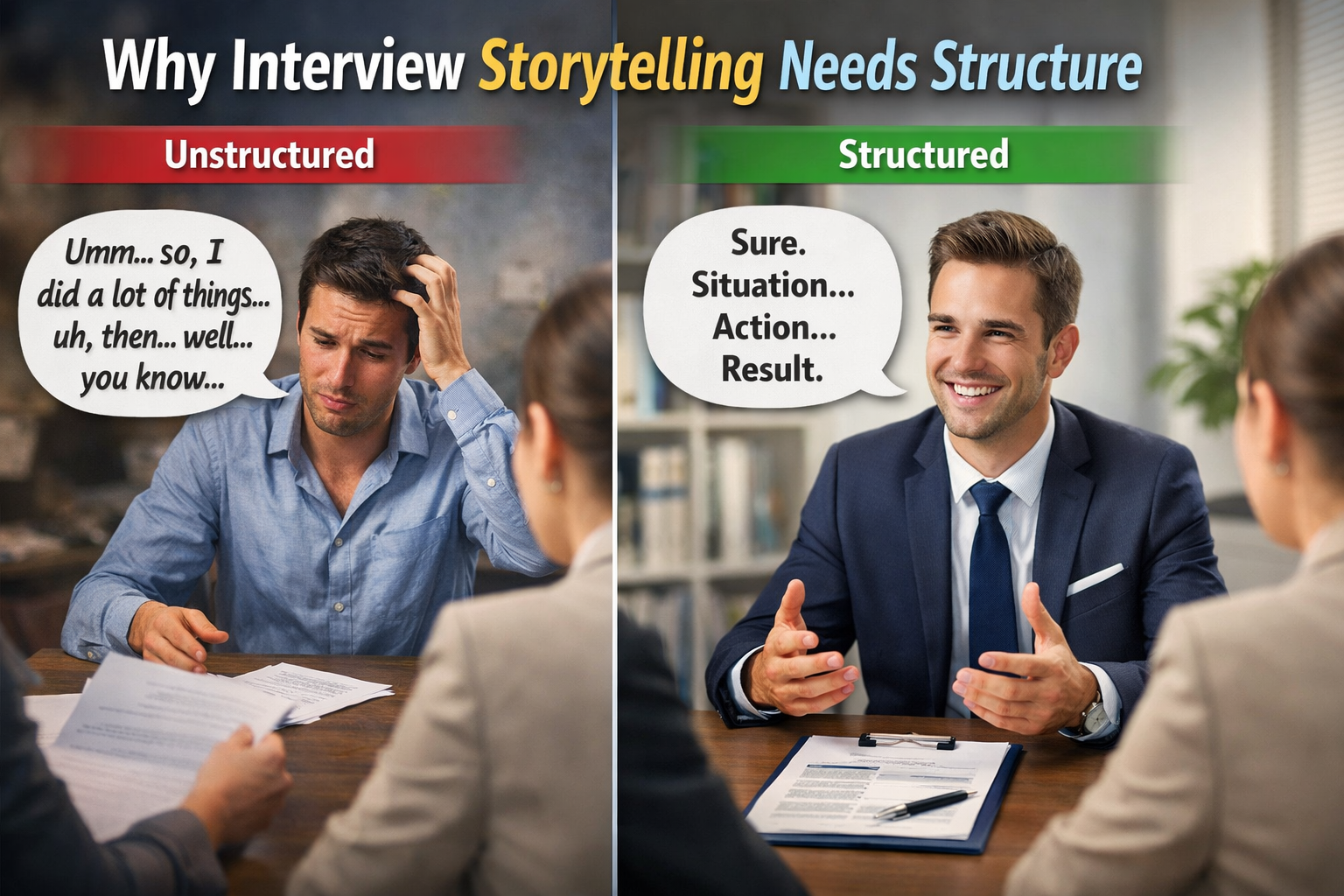
In an interview, everyone wants to perform well, even if candidates have to do a lot of hard work and practice for it. But it is not necessary that everything becomes successful only through hard work. Along with hard work, smart work is also very important. In an interview, giving the right answer is important, but presenting the answer in the right way is even more important. And the best way to present your answer is through storytelling.
But storytelling does not mean you have to present your answers in a long and boring way. You need to structure your storytelling answers to increase your chances of getting hired. In this article, we are going to talk about why storytelling needs a structure.
What Is Interview Storytelling?
Interview storytelling means presenting your real experiences in the form of a clear and meaningful story during an interview, instead of giving short, random, or one-line answers.
It is the art of presenting your experience in a clear and structured way that helps you stand out from the crowd and impress the hiring manager.
Why Interview Storytelling Needs Structure?
1. Structured Interview Storytelling Makes You Clear
If your answer is structured, the recruiter will not face any confusion while understanding them. A structured answer helps the recruiter easily understand each point clearly, and there is no misunderstanding. Whatever you want to communicate is understood exactly as you mean it.
On the other hand, if your storytelling is scattered and unstructured, the recruiter may not understand them quickly. They may skip the details, fail to understand your message properly, and even reject your profile. However, with structured answer, your chances of getting hired increase.
2. Structured Interview Storytelling Improves Interview Performance
Instead of giving random answers, when you give structured interview storytelling, the recruiter can clearly understand every point you make—whether the answer is short or long. When the recruiter understands you well, they are able to recognize your value and learn more about you as a candidate. This helps the recruiter start building trust in you, and when trust is built, it means you are creating a positive impression.
When you successfully create a positive impression on the recruiter, it is a sign that your interview performance is strong, and this further increases your chances of getting hired.
3. Structured Interview Storytelling is Easier to Remember
Imagine there are two candidates and both have submitted their responses. One candidate’s storytelling are structured, while the other candidate’s answers are scattered. Which one do you think will be easier to remember?
The answer is the candidate whose story are structured. When your answers follow a clear structure, the recruiter does not face difficulty in understanding them. Because of this clarity, the human brain can remember such answers easily. That is why using structured answer makes your response more impactful and memorable.

4. It Reduces the Chance of Mistakes
If your storytelling is structured, the chances of making mistakes become very low because you present every point clearly and with proper attention. This makes errors almost unlikely. When there are no mistakes in your answers, it creates a positive impression on the recruiter, as they feel that the candidate handles every task professionally and carefully. That is why structured interview storytelling are important.
5. Structure Saves Time
When a candidate explains their experience in the form of a story to the recruiter, it gives two main benefits. First, the recruiter can easily understand things step by step. They listen with more interest and do not feel bored. Because of this, they give more value to your words and understand your experience better.
The second benefit of storytelling is that it saves a lot of time. In interviews, time is very limited and there are many candidates. So, the recruiter spends only a short time on each person. If your response is clear, logical, and interesting, it keeps both you and the recruiter focused. This helps the interview finish smoothly and in a better way.
Read “Why Structured Answers Perform Better”. for more knowledge.
Conclusion
Structured storytelling helps you stay focused, confident, and professional. It allows the interviewer to understand your thinking process, your actions, and your results without confusion. Instead of giving long and unclear answers, you present your story in a simple and powerful way.
Remember, your experiences are valuable. Your achievements matter. But structure is what makes your story impactful and memorable.
Want to explore more such blogs? Visit here.





Leave a Reply