
Introduction
In today’s competitive job market, analytical roles are in high demand. Companies look for professionals who can analyze data, solve problems, think logically, and make informed decisions. Roles such as data analyst, business analyst, financial analyst, research analyst, operations analyst, and even strategy roles require strong analytical skills.
However, getting selected for an analytical role is not only about having technical knowledge. It is also about how well you perform in the interview. Interviews for analytical roles are designed to test your thinking process, problem-solving ability, communication skills, and decision-making approach.
This article explains important interview techniques for analytical roles in a simple and practical way. It will help you prepare confidently and perform better in your next interview.
Understand What Analytical Roles Require
Before attending the interview, it is very important to understand what an analytical role actually involves.
Analytical roles mainly focus on:
- Collecting data
- Understanding patterns and trends
- Solving problems using logic
- Making data-driven decisions
- Presenting insights clearly
Interviewers want to see how you think, not just what you know. They are more interested in your approach to solving problems than the final answer.
When you understand this clearly, you can prepare your answers in a better way.
Interview Techniques for Analytical Roles
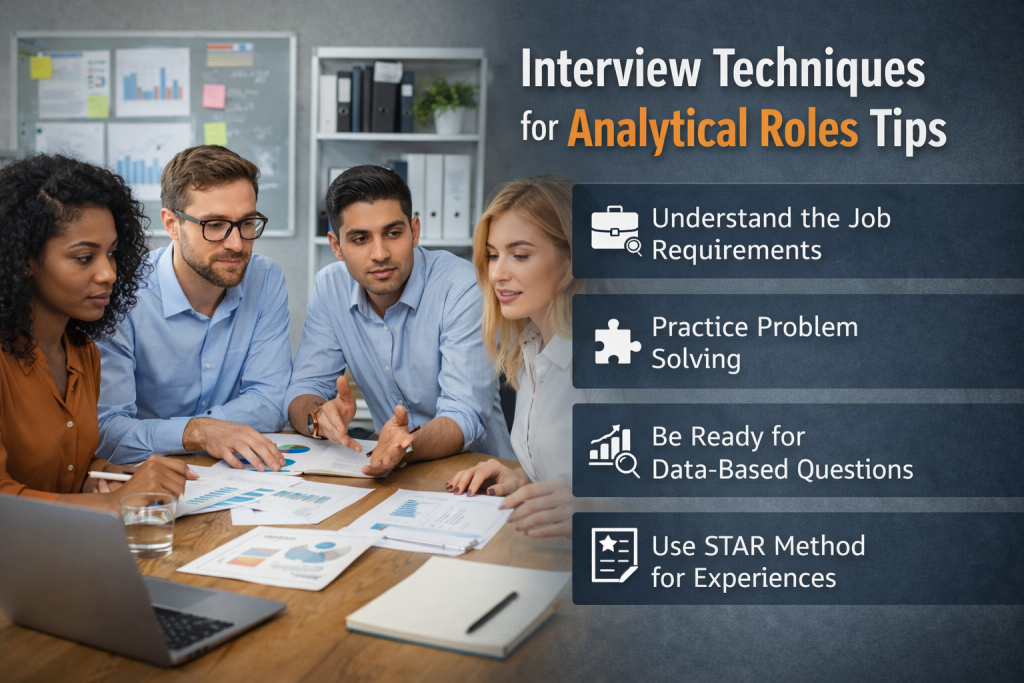
1. Study the Job Description Carefully for Analytical Roles
The job description is your biggest guide for interview preparation.
Read the job description carefully and identify:
- Required skills
- Tools mentioned (Excel, SQL, Python, Power BI, Tableau, etc.)
- Type of analysis involved (financial, business, data, operations)
- Responsibilities and expectations
Try to match your experience and skills with the job requirements. During the interview, your answers should reflect that you understand the role and are suitable for it.
2. Strengthen Your Basics
For analytical roles, basics matter a lot.
You should be clear about:
- Logical reasoning
- Basic mathematics
- Statistics concepts (mean, median, variance, correlation)
- Data interpretation
- Charts and graphs
- Business understanding (for business analyst roles)
Interviewers often ask simple questions to check your foundation. If your basics are strong, you will feel confident while answering even complex questions.
3. Practice Problem-Solving Questions
Problem-solving questions are a core part of analytical interviews.
These questions may include:
- Case studies
- Logical puzzles
- Real-life business problems
- Data-based scenarios
When answering such questions:
- Do not rush
- Understand the problem clearly
- Ask clarifying questions if needed
- Explain your thinking step by step
Even if your final answer is not perfect, a clear and logical approach can leave a positive impression.
4. Explain Your Thought Process Clearly
One of the most important interview techniques for analytical roles is thinking out loud.
Interviewers want to understand:
- How you approach a problem
- Why you choose a particular method
- How you handle uncertainty
Always explain:
- What assumptions you are making
- Why you are choosing a specific solution
- What alternatives you considered
Clear communication of your thought process is more valuable than giving a fast answer.
5. Prepare for Case Study Interviews for Analytical Roles
Case studies are very common in analytical roles, especially in consulting, analytics, and business analyst positions.
In a case study interview:
- You are given a real or hypothetical problem
- You are expected to analyze it and suggest solutions
Tips to handle case studies:
- Break the problem into smaller parts
- Structure your answer logically
- Use data where possible
- Focus on both analysis and business impact
Interviewers want to see structured thinking, not memorized answers.
6. Be Comfortable with Data-Based Questions
Many analytical interviews include data-related questions.
You may be asked to:
- Analyze a table or chart
- Identify trends
- Find inconsistencies
- Suggest insights from data
To prepare:
- Practice reading graphs and dashboards
- Work on sample datasets
- Improve your Excel or spreadsheet skills
Even simple questions like “What do you observe in this data?” can test your analytical mindset.
7. Prepare Examples from Your Past Experience
Behavioral questions are also important in analytical roles.
Common questions include:
- Tell me about a problem you solved using data
- Describe a time when you made a decision based on analysis
- Share an experience where your analysis helped improve results
Use the STAR method:
- Situation
- Task
- Action
- Result
Choose examples that show:
- Logical thinking
- Data usage
- Impact of your work
Real examples make your answers more convincing.
8. Show Curiosity and Analytical Mindset
Interviewers like candidates who are naturally curious.
You can show this by:
- Asking relevant questions
- Exploring “why” behind problems
- Showing interest in how things work
An analytical role is not just about tools. It is about mindset. Show that you enjoy analyzing problems and finding better solutions.
9. Be Honest When You Don’t Know Something
It is completely okay to not know everything.
If you face a question you are unsure about:
- Do not guess blindly
- Admit honestly that you are not sure
- Explain how you would approach finding the solution
This shows maturity, honesty, and problem-solving ability, which are important traits for analytical roles.
10. Prepare for Technical Tools and Skills for Analytical Roles
Depending on the role, you may be tested on tools such as:
- Excel
- SQL
- Python
- R
- Tableau
- Power BI
You should:
- Understand basic concepts
- Be ready to explain how you used tools in projects
- Practice simple queries or functions
Interviewers usually check practical understanding, not just theoretical knowledge.
11. Improve Your Communication Skills
Analytical professionals often need to explain complex ideas to non-technical people.
During the interview:
- Use simple language
- Avoid unnecessary jargon
- Explain insights clearly
Good communication is as important as good analysis. Interviewers prefer candidates who can convert data into meaningful stories.
12. Manage Time Effectively During the Interview
Some interviews are time-bound and include multiple questions.
Tips:
- Do not spend too much time on one question
- Stay calm and focused
- Prioritize clarity over speed
Time management shows that you can work efficiently under pressure.
13. Ask Smart Questions at the End
When interviewers ask, “Do you have any questions for us?”, never say no.
You can ask:
- How does this role contribute to business decisions?
- What kind of problems will I work on?
- How does the team use data for decision-making?
These questions show genuine interest and analytical thinking.
14. Practice Mock Interviews for Analytical Roles
Mock interviews help you identify weaknesses and improve confidence.
You can:
- Practice with friends
- Record yourself answering questions
- Use online interview platforms
The more you practice, the more natural your answers will sound.
15. Stay Calm and Confident
Analytical interviews can feel stressful, but confidence is key.
Remember:
- Interviewers are not trying to trick you
- They want to understand your thinking ability
- It is okay to take a moment to think
Stay calm, listen carefully, and answer thoughtfully.
16. Learn from Past Interviews
If you have attended interviews before, reflect on them.
Ask yourself:
- Which questions were difficult?
- Where did I hesitate?
- What can I improve next time?
Continuous improvement is a strong analytical trait.
You should also read blog on “Interview Preparation Without Over-Rehearsing”.
Conclusion
Interviewing for analytical roles requires a mix of logical thinking, problem-solving ability, technical skills, and clear communication. It is not about giving perfect answers but about showing a structured and analytical approach.
By understanding the role, strengthening your basics, practicing problem-solving, and communicating your thought process clearly, you can significantly improve your interview performance.
Preparation, honesty, curiosity, and confidence are the keys to success. With the right interview techniques, you can stand out and increase your chances of securing an analytical role.
You can read more such blogs here.




Leave a Reply