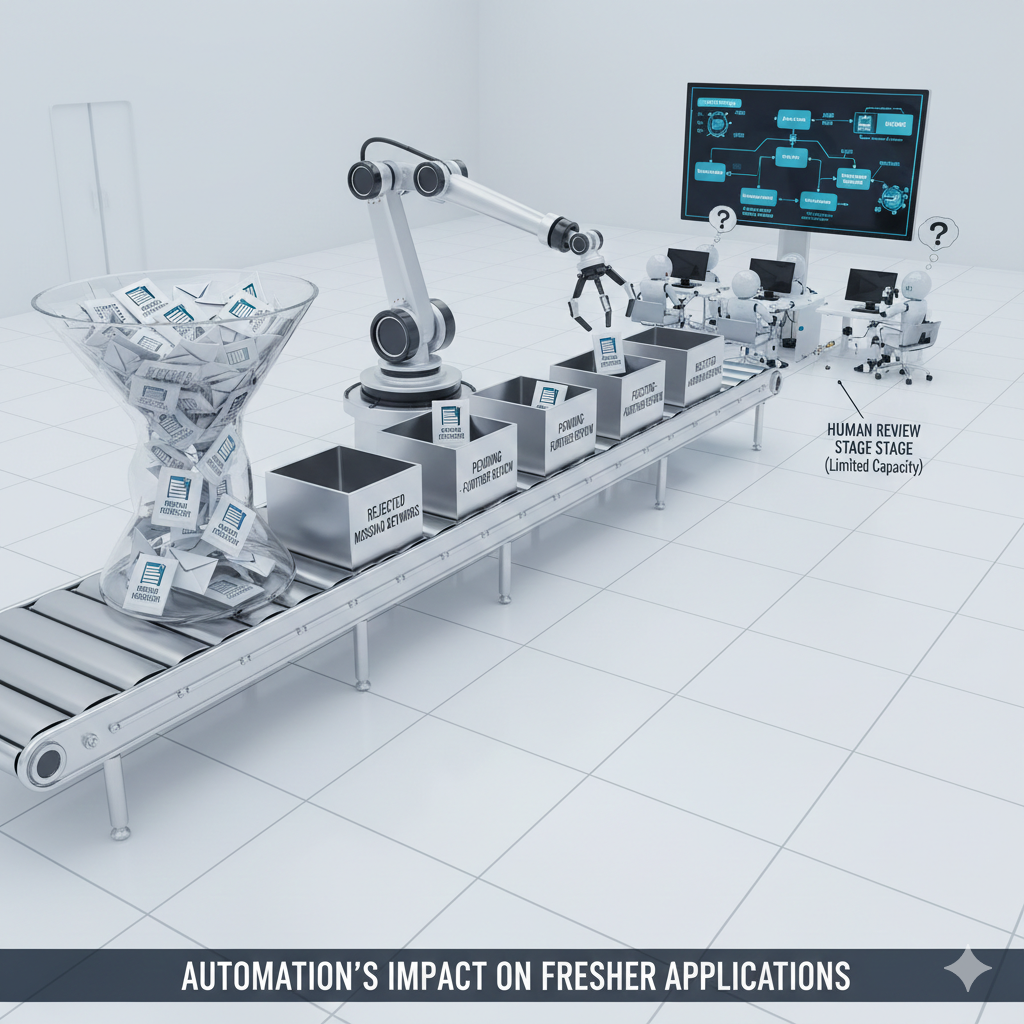
Automation has reshaped how companies hire. For freshers, this shift can feel confusing and frustrating. Many candidates apply to dozens of roles and still receive no response. In most cases, the issue is not capability. The issue is scale. Hiring teams receive massive volumes of applications, so they depend on automation to manage the flow.
This is why understanding how automation affects fresher applications is important. It helps you apply smarter, improve visibility, and increase the chance of getting shortlisted.
Automation increases competition instantly
Job platforms make applying fast and convenient. As a result, more candidates apply to the same role within hours. Freshers are not only competing with classmates. They are competing with applicants across cities and sometimes across countries.
Because the volume is high, companies cannot manually review every profile. So, automation becomes the first stage of selection. This means your application must be structured well from the start. Otherwise, it may never reach a recruiter.
Resume screening happens before human review
Most companies use resume parsing systems or applicant tracking tools. These systems scan your resume for role keywords, skills, education, and section structure. If your resume is poorly formatted or missing relevant terms, the system may rank it lower.
Freshers often get rejected without any feedback. That can feel personal. However, it is usually a filtering outcome, not a judgment of your potential.
To improve your chances, your resume should be easy to read and aligned with the job requirements. Simple formatting, clear headings, and relevant skill placement make a major difference.
Automation rewards relevance, not effort
Many freshers believe that applying to more jobs automatically improves results. In reality, automation rewards relevance. If you apply with the same resume everywhere, your profile may not match the system filters.
Recruiters also search inside the system using specific keywords. If your resume does not include those terms naturally, you may not appear in their search results. This is why tailoring matters.
A fresher resume can still look strong if it highlights projects, internships, certifications, and practical skills clearly. You do not need long experience. You need a focused and relevant presentation.
Screening questions can reject applications instantly
Many job applications include screening questions. These questions are often used to filter candidates quickly. Some answers can automatically disqualify an applicant, even if they have potential.
Freshers should treat these questions seriously. For example, questions about joining date, shift preference, location flexibility, or required skills are often used as strict filters. If you answer without reading carefully, you can lose opportunities unnecessarily.
A good approach is to apply only to roles where the basic conditions match your situation. This saves time and improves response rates.
Keyword matching impacts fresher profiles strongly
Freshers usually have fewer work experiences. So, the resume becomes skills-focused. Automation looks for tools and skills related to the role, such as Excel, SQL, PowerPoint, Canva, Java, Python, or communication skills.
However, adding random keywords without proof can backfire. It may help you pass the system, but interviews will expose the gap. Instead, connect keywords to real work. Mention how you used the skill in a project, internship, or certification assignment.
This approach keeps your resume credible and improves your selection chances.
Formatting mistakes reduce visibility
Many freshers use visually attractive resume templates. Unfortunately, some templates confuse automated systems. Elements like tables, columns, icons, and heavy graphics can disrupt resume parsing.
A clean structure performs better. Use clear headings, standard fonts, and simple alignment. Keep your content easy to scan. When both automation and recruiters can read your resume quickly, your chances improve.
Also, avoid adding unnecessary sections. Keep the resume focused on skills, projects, achievements, and education.
Automation makes feedback rare, so tracking becomes essential
One of the biggest problems with automated hiring is the lack of feedback. Freshers apply and hear nothing back. This creates uncertainty and stress.
To stay in control, track your applications. Note the job role, resume version, date applied, and response status. After a week or two, review what is working and what is not.
If you are not getting calls, improve your resume keywords and project descriptions. If you are getting calls but failing interviews, focus on communication and role preparation.
Small improvements every week create better outcomes over time.
Smart networking reduces dependence on automation
Automation is not the only hiring channel. Referrals, recruiter messages, and direct outreach can bypass heavy filtering. This is especially useful for freshers.
You do not need aggressive networking. You need professional communication. Connect with alumni, follow companies, and message recruiters politely with a clear introduction. A short message and a relevant resume can create opportunities that job portals may not.
Even one referral can improve your chances significantly. It increases the chance that a human reviews your profile earlier.
Conclusion
Automation is now a permanent part of hiring. It helps companies manage volume, but it also makes the fresher job search more competitive and less personal. Understanding how automation affects fresher applications helps you avoid common mistakes and apply with a stronger strategy.
When you use clean resume formatting, relevant skills, and targeted applications, you increase your shortlisting chances. When you combine that with networking and follow-ups, your results improve even faster.
To explore fresher-friendly roles and apply with confidence, use the best job tool.
Find Your Dream Job Today – Explore Endless Career Opportunities and Secure Your Next Role with Best Job Tool.




Leave a Reply