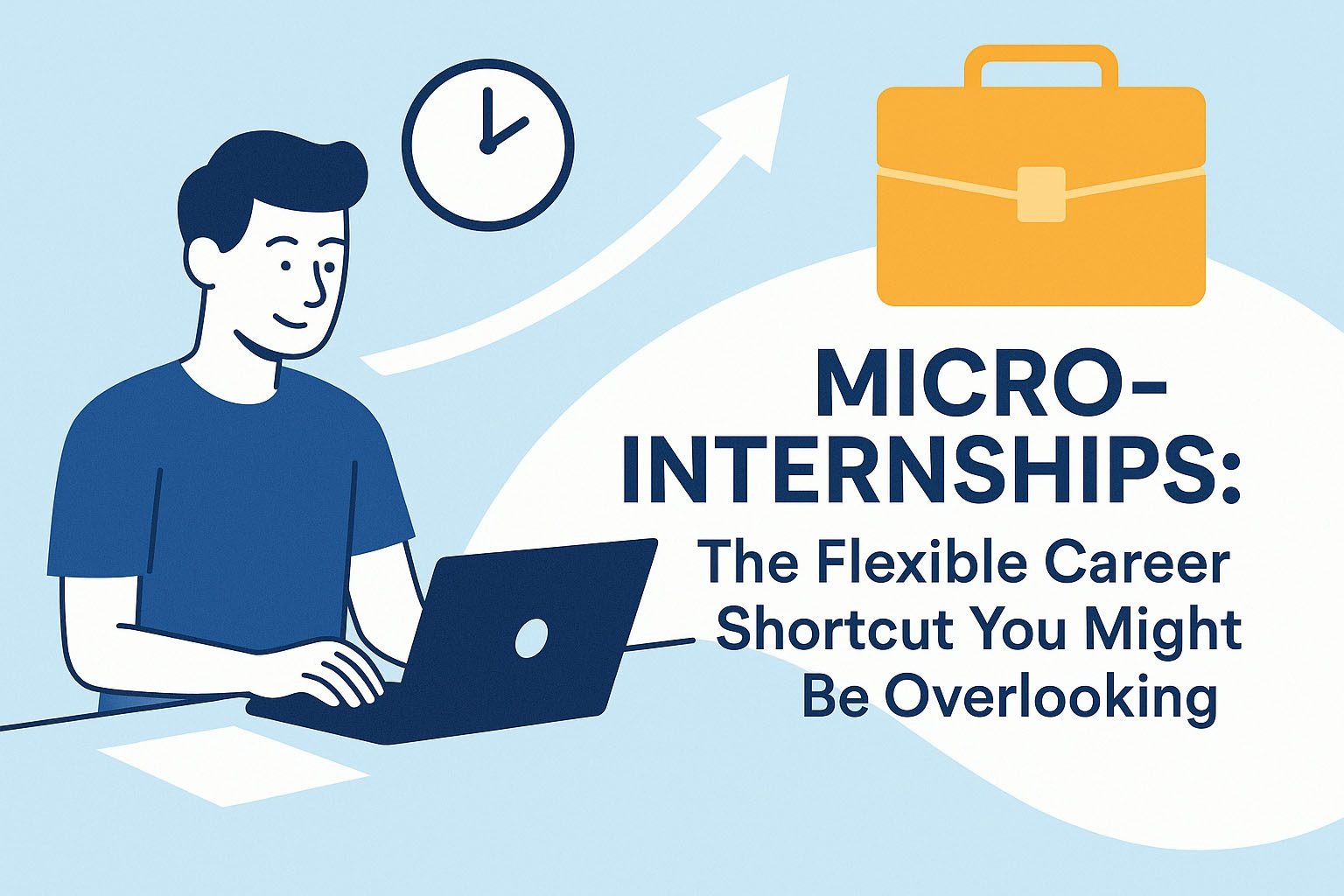
What Are Micro-Internships?
Micro-internships are project-based work opportunities where candidates work on real company tasks. These internships usually last 1 to 8 weeks and focus more on learning practical skills and delivering output.
Micro-internships include:
- A shorter training period
- No fixed full-time commitment
- Solving real business problems
In these internships, candidates are given a specific project such as content writing, data analysis, social media management, market research, or basic automation tasks. Companies evaluate candidates based on their performance and results, not just theory.
Micro-internships can be paid or unpaid, and in most cases, the biggest benefit is that companies hire candidates by seeing their actual work rather than relying only on resumes or degrees.
A micro-internship acts as a bridge between skills and jobs, where both the company and the candidate understand each other through real work.
Why Traditional Hiring Is Failing Today?
Traditional hiring processes are not able to match today’s fast-changing job market. This process is slow, outdated, and ineffective for both companies and candidates.
The biggest problem is that this process mainly depends on resumes and degrees. Companies still focus more on college names, years of experience, and fancy resumes, which is why many capable candidates do not get shortlisted.
Another major issue is long and slow hiring cycles. Multiple interview rounds, endless screening, and frequent delays often lead to the loss of good candidates. In today’s competitive market, talent does not wait for long. Resume exaggeration and skill mismatches are also serious problems, as skills written on a resume do not guarantee actual work performance.
Hiring costs are also increasing. Companies spend heavily on job portals, recruiters, onboarding, and training. If a company hires the wrong candidate, the loss becomes even higher.
Finally, traditional hiring is not future-ready. In an era of remote work, gig roles, and project-based jobs, relying only on resumes and interviews has become outdated. Today, companies want real proof of work, which traditional hiring fails to provide.
Why Micro-Internships will Dominate the Future of Hiring?
1. Hiring Is Moving From Degrees to Skills
In today’s job market, the importance of degrees is reducing, while the importance of skills is increasing. Deciding whether a candidate can do real work or not just by looking at a college name or qualification has become difficult.
Micro-internships give companies the opportunity to test candidates based on their actual skills through real projects. Skills written on a resume become meaningful only when a candidate can deliver them practically.
In this model:
- Output matters more than interviews
- Hands-on ability is checked instead of theoretical knowledge
- There is less risk of fake or exaggerated resumes
That is why the future of hiring depends more on proof of work rather than degrees, and micro-internships act as a strong bridge between skills and jobs.
2. Companies Want Low-Risk Hiring
Full-time hiring is expensive and risky for companies. If a candidate does not fit the role, there is a loss of time, money, and productivity. In traditional hiring, this risk is high because evaluation happens mostly through interviews.
Micro-internships work like a trial-based hiring model. Companies first evaluate a candidate’s performance, communication, and work ethics through a short-term project. If the candidate performs well, they are offered a full-time or long-term role.
Through this approach:
- There is less risk of a wrong hire
- Training and onboarding costs are reduced
- Hiring decisions become more confident and data-based
That is why many companies are adopting micro-internships as a safer hiring option.
3. Faster and More Efficient Recruitment through Micro-Internships
The traditional hiring process is slow and complicated. It includes resume screening, multiple interview rounds, HR approvals, and frequent delays. During this long process, many candidates accept offers from other companies.
Micro-internships make recruitment fast and efficient. Companies directly assign a project and take hiring decisions based on performance, removing the need for long interview chains.
The benefits of this model are:
- Hiring time is reduced from weeks to days
- Interview bias is reduced
- Decisions are made based on output, not opinions
For fast-growing startups and dynamic companies, this approach is a perfect fit, where both speed and quality matter.
4. Micro-Internships are Perfect Fit for the Remote and Gig Economy
Remote work and the gig economy have completely changed the way people work. Today, companies prefer outcome-based work rather than fixed hours or physical presence.
Micro-internships align naturally with this system because:
- They are mostly remote
- They are project-based
- They have clear deliverables and deadlines
Through micro-internships, companies can access global talent without location restrictions, and candidates can work according to their own schedules. This flexibility makes micro-internships an ideal model for the modern workplace.
5. Better Opportunities for Freshers and Career Switchers
The biggest problem for freshers and career switchers is the requirement of prior experience in traditional hiring. The condition of “want experienced candidates” often prevents them from entering the job market, even if their skills are strong.
Micro-internships provide a practical entry point:
- A chance to work on real-world projects
- An opportunity to build a portfolio
- A platform to prove skills
Career switchers can explore a new field without leaving their current job, and freshers can qualify for full-time roles by demonstrating their capabilities. In this way, micro-internships make hiring more inclusive and fair.
6. Stronger Employer–Candidate Matching
In traditional hiring, the focus is mostly on resumes and interviews, which creates a high risk of mismatch between candidates and employers.
Micro-internships provide stronger matching because companies can evaluate candidates while they work on real projects.
They assess:
- Work ethic and professionalism
- Problem-solving and creativity
- Teamwork and communication skills
- Compatibility with company culture
When candidates are hired for full-time roles after a micro-internship, they are more likely to be successful and productive. This approach reduces hiring mistakes and improves employee retention.
7. Cost-Effective Talent Discovery
The traditional hiring process is expensive because it includes fees for job portals and recruiters, multiple interviews, HR involvement, onboarding, and training costs.
Micro-internships provide a low-cost option for talent evaluation. Companies can identify the best performers through short-term projects without making a heavy financial investment.
Read “How to Use Micro-Internships to Fast-Track Your Career in India”.
Conclusion
Micro-internships are shaping the future of hiring because they overcome the limitations of traditional recruitment methods. They are not just short-term projects but a skill-first, low-risk, and efficient hiring model. For companies, micro-internships allow them to evaluate real skills in action, reduce hiring costs and risks, and ensure better cultural fit and employee retention.
For candidates, they provide hands-on experience, opportunities to build and showcase a portfolio, and an accessible entry point for freshers and career switchers. In today’s fast-paced, remote-friendly job market, degrees and long interviews are becoming less relevant, while micro-internships are emerging as the preferred way to identify and nurture talent. They make hiring faster, fairer, and outcome-focused, positioning micro-internships as the future of talent acquisition.
If you want to do micro-internships then find only on trusted platform such as Best Job Tool.


Leave a Reply