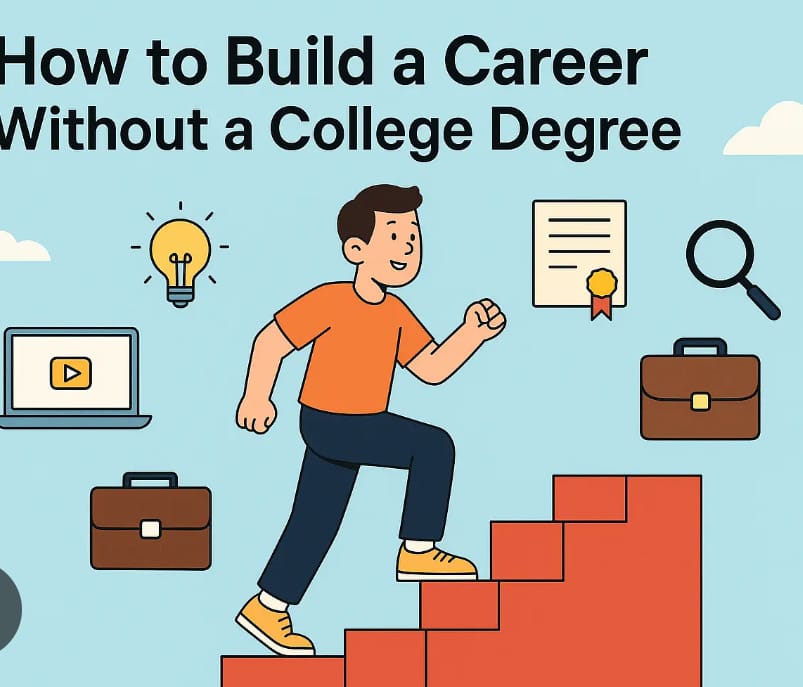
Introduction : Career Without a Degree
Do you also not have a college degree but still want to build your career in the U.S.?
If you think, or if someone has told you, that it is impossible, then that is completely wrong — because it is absolutely possible to build a strong career in the USA without a degree.
And this article will discuss exactly that: how you can build a successful career in the USA without a college degree.
High-Demand Careers That Don’t Require a Degree
Nowadays, the job market is changing rapidly. Earlier, a College degree was mandatory for a good job, but now companies give more importance to a practical skills, certifications, and real-world experience. That means if you do not have a degree but have a strong skill then you can also build a high-paying career in the U.S.
Below are the detailed explanation of every field which does not require a degree to build a successful career.
1. Tech Roles
Tech industry is one of the fastest-growing sectors in the U.S. Here portfolio and certifications matter more than a degree. You can easily skill up with the help of YouTube, Coursera, Google certification, and bootcamp.
a. It supports specialists
The role of IT support specialist is to solve the issues of computer, networks, and software and provide technical support to employees. You don’t need a degree to be a good IT support specialist, you just need some skills such as basic computer knowledge, trouble shooting, and communication skills. You can be a network engineer or an IT admin for fast growth and the salary range is $40,000 to $60,000 per year.
b. Web developer
The main work of a web developer is creating a website maintaining it and coding in HTML, CSS, and JavaScript. The skills you need to become a good web developer are coding and a portfolio of websites. You can get the average salary in the U.S. for a web developer is $15,000 to $90,000 per year. For better growth, you can be a full-stack developer, a front-end, or back-end engineer.
c. Cybersecurity (junior role)
The roles of cybersecurity include protecting systems, networks, and data from hackers. The skills which are required for cybersecurity include basic Linux, security fundamentals. The salary is between $55,000 to $80,000 and for better growth you can be a cyber analyst, penetration tester, and security engineer.
2. Creative Fields
If you are creative then you don’t need a degree at all, you just need portfolio, ideas, and consistency.
a. Content writing
The role of a content writer is to write blogs, articles, social media posts, and website content. The skills you need to be a good content writer are English writing, research, and SEO basics. You can build your career in content writing through a medium-profile, WordPress blog, or freelancing.
b. Graphic designer
The work of a graphic designer is to create logos, posters, brand designs, and social media creatives. The tools that are used to create all these logos are Canva, Adobe Photoshop, and Illustrator. A good graphic designer does not need a degree they just need a good portfolio to be hired. The average salary of a graphic designer is $45,000 to $75,000.
c. Digital marketing
The role of a digital marketer is managing social media, SEO, ads, and email. The skill required for Digital marketing is analytics, content planning, and marketing strategy. You can start your career as a digital marketer through the Google Digital Marketing Certificate and the average salary is $40,000 to $80,000.
3. Healthcare Support Roles
The healthcare industry is recession-proof in the U.S. Here you can get a lot of roles easily without a degree.
a. Medical assistant
The role of a medical assistant is to assist doctors, do basic checkups of patients, and maintain records. The training period of a medical assistant is 6 to 12 months and the average salary of a medical assistant is $35,000 to $50,000. You can be a nursing assistant or an office manager.
b. Pharmacy technician
The role of a pharmacy technician is to prepare medicines and assist pharmacists. The training of a pharmacy technician includes a short course and certification. The average salary of a pharmacy technician is $35,000 to $50,000. You can work in hospitals, pharmacies, or clinics everywhere as a pharmacy technician.
4. Sales Jobs
Sales is a field in which communication, confidence, and persuasion skills are the most important.
a. Real estate agent
The role of a real estate agent is to help clients buy or sell a home. The requirement to be a real estate agent is to have a real estate license. The income of a real estate agent is based on commission.
b. Saas Sales
The work is to sell software products to business clients. This field does not require a degree it only requires some skills such as communication and basic tech knowledge. It includes base salary as well as heavy commission.
c. Retail Management
The role of a retail manager is to manage stores, handle inventory, and leading the team. You can start as an associate then promote to supervisor and become a manager, so it has high growth potential. The average salary of a retail manager is $40,000 to $70,000.
5. Logistics
The logistics sector in the U.S. is a booming career because Amazon, Walmart, FedEx, UPS are high-hiring.
a. Truck driver
The requirement to be a truck driver is just a CDL (commercial driver’s license). The average salary of a truck driver is $60,000 to $1,00,000. This field is highly demanding because it requires long-distance driving.
b. Warehouse associate/ supervisor
The role of a warehouse associate is managing, packing, scanning, and shipping inventory. This field requires no degree and no experience for entry-level job. The average salary is $35,000 to $55,000. You can start from a supervisor and reach the manager role easily in the field.
Skill-Based Hiring Without Degree: What Employers Actually Want
1. Practical Knowledge and Hands-On Ability
Now U.S. companies give more priority to skills rather than a degree. A college degree can be a plus point but it is not a guarantee to get a job. Now employers focus on practical skills, performance, and real-world experience.
Employers see more practical work than theoretical work. You should know how to work. For example, if you work in IT support then you should have theoretical as well as practical knowledge of computer troubleshooting.
Companies expect that you can start your work from day-1 because U.S. companies work in a fast environment, they need candidates who can contribute immediately to their company.
2. Soft Skills
a. Communication
Whether you are in the office or doing remote work effective communication works everywhere. Clarity should be in every format of communication whether it’s verbal, written, or digital communication. Also, active listening is important because right communication does not happen just by speaking it also by understanding. Focusing on clarity and tones in digital messages or virtual meetings has also become an essential skill.
b. Creativity and innovation
Creative doesn’t mean art only, it also means thinking out of the box in every field. Innovative people find new ideas and unique perspectives which impact directly in the growth of the company. In the time of AI and automation, human creativity is one and only skill that is irreplaceable.
c. Growth Mindset
A growth mindset means having a mind that says to learn from every situation. These people take feedback as a chance for improvement and to upgrade themselves continuously. In the future workplace, growth will be impossible without adaptability and continuous learning.
Mistakes to Avoid in Building a Career Without Degree
1. Poor Understanding of U.S. Workplace Culture
The culture of every country is different. The U.S. work environment is friendly but extremely professional and direct.
Common misunderstandings are,
- Only formal tone for an example in Indian style we use “Dear Sir, please kindly help me.”
- Overly polite behaviour
- Indirect communication
- Fear of asking questions
- Taking feedback personally
U.S. companies prefer,
- Clear communication
- Straightforward answers
- Confidence
- Transparency
- Quick decisions
For example, if you speak in an interview, “Sir actually I want to thank you very much for giving me this precious opportunity” then us recruiter feels it unnatural so it is better to say, Thank you for interviewing me. I am excited about this role.”
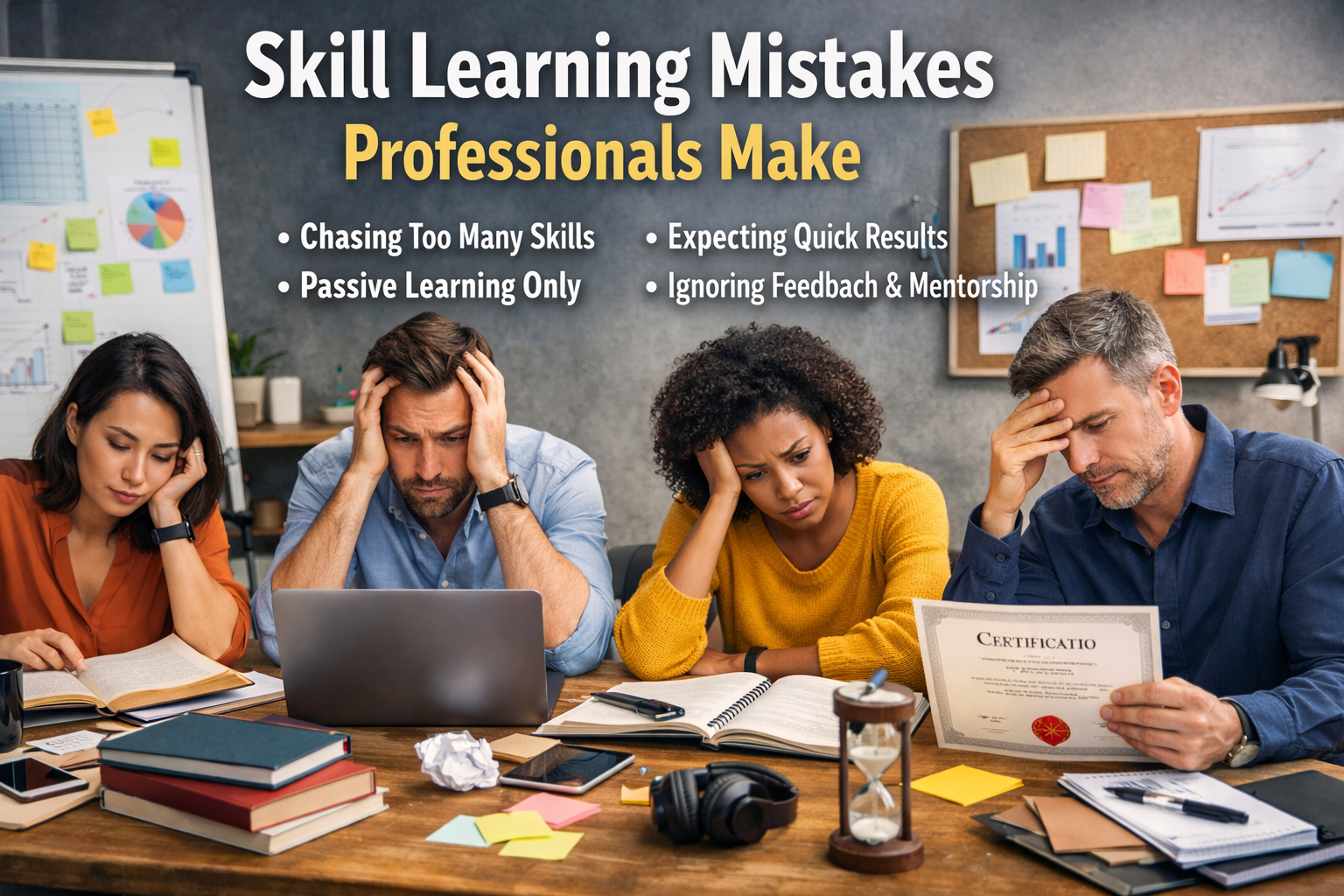
2. Relying Only on Free Courses Without Practical Projects
Many people watch YouTube or free courses but do not practice them and that is the biggest mistake. You can understand the skill by watching a free course but you will not develop the skill until you do not make a project.
For example to watching just the IT course is not enough, practice in computer troubleshooting as well.
3. Weak or No Networking
In today’s professional world, networking is a hidden power but many job seekers ignore it. They think that if they just do their work efficiently they will get opportunities on their own, but the reality is that connections are also an important part of career growth.
Networking doesn’t mean meeting people only, it means building genuine professional relationships. When you connect with the right people in the early stage of your career like mentors, seniors, recruiters, or industry experts then you get knowledge guidance and hidden opportunities that are not available in books or internet.
In today’s digital age, LinkedIn is the best platform for networking. There you can connect with people of your interest engage with their posts and share your work to increase visibility. Also attending career events webinars and workshops is a great way to create real connections
The common mistake that people make is that they connect only at the time of need like a job referral or recommendation. This approach creates a bad impression. Networking is a long-term investment in which you need to build relationships first, then only you can get support naturally.
That’s why do not create a network for ‘use’ only, instead create to add value. Do genuine comments on the post, celebrate their achievements, and try to become helpful. When you connect sincerely then your network becomes a strong career support system for you.
4. Not Preparing for U.S.-Style Interviews
Mistakes are,
- Not understanding behavioral interview questions (STAR method)
- Weak answers about strengths/weaknesses
- Not asking the right questions at the end
- Speaking too formally or too casually
Tips for a successful interview-
Everyone wants to have a successful interview, but to make it successful you need to follow these basic tips.
Research the company
Before the interview, search for the company’s LinkedIn page, website, or any recent news. You must know about the services that the company offers, the mission of the company, and the work culture of the company.
When you tell all these things to the interviewer, you will be successful in impressing them.
Prepare common interview
questions
Before going for an interview, you should prepare for some common interview questions. When you go prepared, then you show the best version of yourself – and that confidence impresses the interviewer. So, go prepared before going for an interview.
Practice with mock interviews
Practice speaking with a friend or in front of a mirror to improve your confidence and fluency.
Dress professionally and be on time
Wear formal, neat, and clean clothes. Don’t overdress or underdress.
Understand your resume well
Be ready to explain everything you’ve written in your resume with real examples and clarity.
Pay attention to your body language
Pay attention to your body language. Make eye contact, smile slightly, and avoid unnecessary hand gestures. Sit straight, and be confident.
Ask questions at the end of the interview
When you ask questions of an interviewer, it shows your genuineness and your interest in the role. And you get a better idea about the role and work culture. It’s a professional impression. That’s why we have to ask 1-2 questions at the end of the interview.
Be positive and polite
Even if a question is difficult, stay calm and polite. Avoid negative comments about past experiences.
Send a thank-you email after the interview
It’s a professional gesture that leaves a strong and positive impression.
5. Ignoring Soft Skills
International candidates write their foreign experience, but didn’t explain how it will be useful for a U.S. company.
The meaning of transferable skills is, skills which are important in every role and in every country such as communication, team work, time management, leadership, customer service, and English fluency.
For example, if you work in customer service in India, then a USA interviewer can ask you about, “how your experience is relevant in a US workplace?”
Then you need to explain problem-solving, handling diverse customers, managing pressure, and communication skills.
Conclusion
Building a successful career in the U.S. without a college degree is absolutely possible today. The job market has shifted from degree-based hiring to skill-based hiring, giving more opportunities to people who are willing to learn, grow, and prove their talent. When you focus on developing practical skills, earning relevant certifications, and creating a solid portfolio, you can compete with anyone — even degree holders.
This article covered several important areas to help you start your career journey confidently. You learned about the high-demand careers that don’t require a degree, from tech and healthcare to skilled trades and creative fields. You also discovered what employers truly value in candidates today, such as hands-on experience, strong soft skills, and industry-recognized certifications. In addition, the article highlighted the common mistakes to avoid, including relying only on theory, not networking, ignoring communication skills, and sending the same resume to every job.
By understanding and applying these insights, you can create a clear path toward a stable, well-paying, and growth-oriented career in the U.S. Whether you are just starting out, switching careers, or looking for better opportunities, the guidance shared here will help you make smarter decisions, avoid common setbacks, and move closer to your goals with confidence.
If you want, I can now help you compile the full article, format it for Medium, or rewrite it in a more engaging tone.
You can read more blogs here.




Leave a Reply